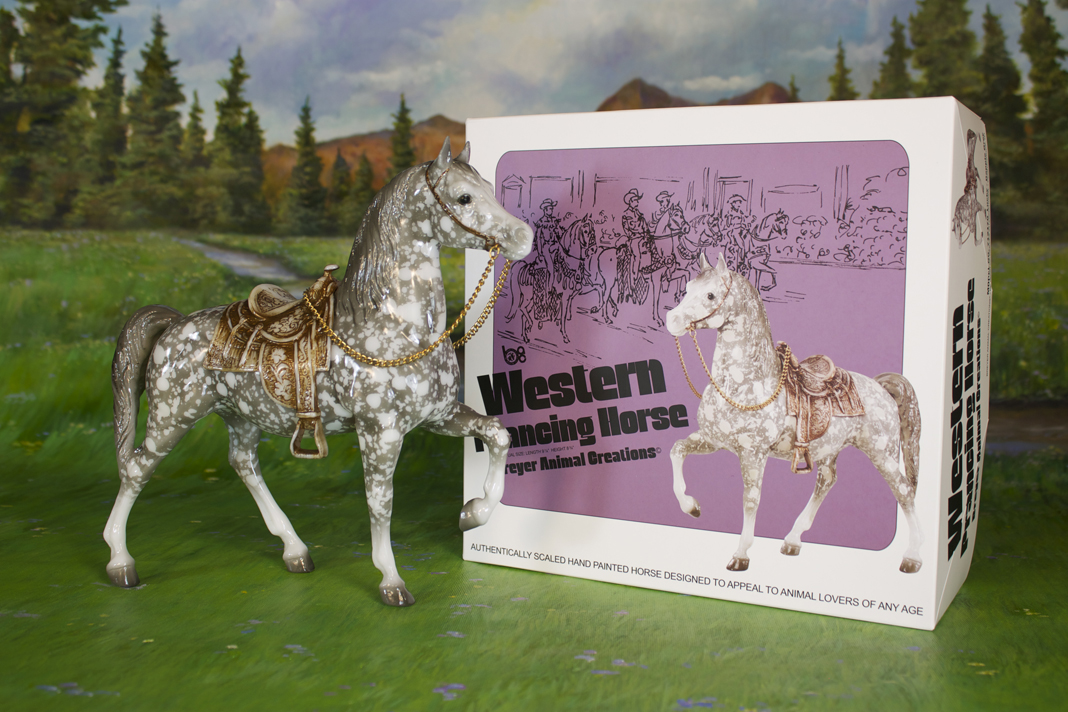
Showing posts with label Western Prancing Horse. Show all posts

Friday, June 16, 2023

Everything Else

Another one of those all over the place days.

First, RIP John Romita, Sr.: Steve Ditko may have created his iconic look, but Romita was the definitive Spider-Man artist.

Second: what’s up with the price of knock-offs lately? I’ve been trying to pick up a couple of them just for novelty’s sake, but in some cases they’ve actually been selling for more than the Breyer mold they’re copying!

Or is just another case of everyone getting on the same page again and collectively deciding this would be a cool thing to do? I kind of get it: who does not love a Wee Western Prancing Horse?

But darn it all, I really wanted to get a few more of those Hong Kong Mini Me’s! Just another thing to look for at BreyerFest, I guess.

Third: I wish there was a better way of defining what names go with what molds. Reeves has been attempting to give molds generic, descriptive names, but the problem with that is that “Loping Quarter Horse” and “Working Cow Horse” don’t really convey the personality of molds like Latigo and Bobby Jo. 

And what happens when they come out with another, but slightly different Loping Quarter Horse? Do they start getting numbered at that point, or are they described by their size compared to the other(s)? That kind of naming scheme just replaces one problem with another.

Picking an actual name-name, or giving them a very specific descriptor or kooky nickname is just easier. Except there’s never been a real formula for this sort of thing, either: sometimes it’s the first release, sometimes it’s the most popular one, and other times it’s something hobbyists make up out of thin air (hello, Foalzilla!)

And getting everybody on the same page is hard, regardless. (Remember the Othello vs. Winter Song Wars?)

With older molds with already established names, I’d just do a gentle redirect with newer collectors: if someone at BreyerFest looking for Zenyatta, tell them your Lonesome Glory models are on the top shelf and to the right. Unless you genuinely don’t have any Lonesome Glory molds, or have absolutely no idea what they are asking about.

The only time I visibly got angry with someone over misidentifying a mold is when I had to deal with someone who repeatedly referred to the Desatado as the Marsh Tacky, several years and several releases after the 2013 BreyerFest Special Run. 

(In their defense, I’m not sure the kid was picking up anyone’s social cues.)

And finally, for the curious: the blog averages about 500 page hits a day – that’s for the whole blog, not any specific post – though the stats have been a little messed up recently because all US-based web sites are getting slammed due to overseas interference. 

More would be better, but I can’t complain. About that, anyway. 

Sunday, April 30, 2023

Griffin Lamps

After planting trees in the morning, I had an uneventful birthday, working on craft projects and restoring my latest acquisition:

I don’t have much documentation about the manufacturer of this lamp, the Griffin Lamp Manufacturing Company, other than this ad I found in the November 1970 issue of Western Horseman:

The company made more than just the Western Prancing Horse lamp; you can occasionally find similar lamps with other toys attached, like stuffed animals and die-cast trucks. In fact, I might have had one on my night stand when I was little; I think it was a vinyl bear? It was basically a big squeaky toy, and not (thank goodness) one of those creepy stuffies with a human face.

(It’s long since gone.)

The Western Prancer ones turn up every once and a great while; the last one I saw previous to the Buckskin was a Smoke with its original lampshade, and it went for more money than I was comfortable paying. (While Smoke is not listed in the ad, its absence is obviously a typo.)

The Buckskin one had been sitting on eBay for at least a month prior; I didn’t notice it at the time because I was trying to behave myself for Lent and not actively buying anything. So when he happened to pop up on top of my searches early last week, I decided to make it my birthday present this year!

He was in much better shape than I expected him to be, other than the missing shade and saddle. I have been trying to upgrade my Buckskin Western Prancing Horse for quite a while too, and other than the yellowing, I think he’s aesthetically better than my current Buckskin. 

But since I consider the lamp its own separate thing, I’ll still be on the lookout.

The numbering of these lamps in the ad is interesting, since it obviously follows the numbering of the original Western Prancer releases, with a one added to the front: Buckskin is #1111, Palomino is #1112, Bay is #1114, and Appaloosa #1115. This is not dissimilar to the numbering system they used for the Showcase Collection, which used trailing zeroes. Or even the Presentation Collection, which had the number 50 prefixed to their original release numbers: for example, the Presentation Collection Man o’ War was numbered #5047. 

All of these oddball releases happened around the same time (the late 1960s and early 1970s) so it makes me wonder if Breyer had originally intended to market these as a part of their own product line, but pulled out at the last minute. (In case it is not obvious, the base is also plastic.) 

I have a feeling that the replacement saddle for the lamp will end up costing me more than what I paid for the lamp itself. Alas, I’m already consigned to paying a princely sum for the lampshade, so I may just bite the bullet and go for it anyway. 

Wednesday, July 6, 2022

The Sorrel Family

Here’s the evidence that I am not totally crazy:

Behold! An entire family of Dark Sorrel Family Arabians!

And here’s the Five-Gaiter that came with the Foal, many moons ago. That was such a deal!

The Western Prancing Horse and Fighting Stallion that I have in this variation are on the lighter side, incidentally. 

The fact that there’s a lot of variation in all of these variations is an excellent argument for the idea that these were not a one-off Special Run items, but things with extended production runs. 

That’s obviously the case with the #114 Bay Western Prancer, who appears to have been made in this variation for most of his production run. 

It’s a little less clear with the Fighting Stallion. Based on the fact that early ephemera pictures depict the Sorrel variation, I think he was made in that variation at the beginning of his production run, but switched over to Breyer’s early version of “Bay” (reddish-brown body with black mane and tail and black hooves) pretty quickly. 

This obviously throws the chronology for Gloss Bay Fighters into question, but I do not want to get into that contentious issue today.

So where does that leave the Family Arabians? Good question! I tend to fall into the “it’s a production variation” camp, rather than “previously unknown/undocumented Special Run”, because two of the other Sorrel variations turned out to be just that: variations, not independent Special Runs. 

The questions then become: when, and for how long? Those, I am not so sure about.

Back to the paperwork!

Sunday, June 19, 2022

Chalky Western Prancing Horse

In addition to all the other things I have going on right now, I was also “gently” reminded that I needed to finish dusting, so I had to spent a good portion of my weekend doing just that. That set my self-imposed deadline for the latest writing project back a day, but at least I won’t have to hear complaints about the dust for another six months or so…

I’d also like to know how I ended up with three Test Color Shetland Ponies. I don’t dislike her, but she’s also not someone anywhere near my “Top Ten”, so me ending up with that many Tests on her is kinda weird. 

In my defense, I didn’t spend all that much on all three of them combined, and I do not pass by cheap Test Colors, no matter the mold or color. (Dear Universe: A Test Color Trakehner would be a very nice change of pace. I will also accept a Morganglanz.)

It occurred to me that while you know may quite a bit about the fact that a Chalky Man o’ War was my first Breyer model, you don’t know much about the second and third models.

I didn’t get them until the Christmas of that same year: they were a #46 Pacer and a #110 Smoke Western Prancing Horse. The Pacer himself is unremarkable: he’s just the standard release in Liver Chestnut, with a few minor marks because Pacers are notoriously tipsy.  

The Smoke Western Prancing Horse, on the other hand, is also a Chalky:

Since I never had to search for another, it took me a while to realize just how scarce Chalky Smoke Western Prancers were. I’ve tried getting the Palomino, and even scored a few, but the ones I found were not in the best condition, even for Chalkies, and then the market went boom and I’ve pretty much had to give up finding inexpensive, misidentified Chalkies since then. 

The scarcity of the Smoke is probably related to the fact that the Western Prancer was not a high-volume seller at the time, generally. While the Palomino did remain in production through 1985, the Smoke was gone by the end of 1976. 

This also explains why some Chalkies are easier to find than others. Newer molds and colors introduced during the Chalky Era (1973-1975) – like Brighty, El Pastor, and the Appaloosa Performance Horse – were better sellers than models like the Smoke Western Prancing Horse, something that had been around for over a decade and was near the end of its production run.

Friday, July 16, 2021

A Reintroduction

I am not completely happy with it – the curses of an artistic temperament, alas – but this year’s Sampler is up! 

It’s been up since early Thursday morning, but I wanted to do my shopping trip yesterday and I didn’t have time to make my formal announcement. My “trip” was unusual, but I’ll talk about it another day when I’m feeling a little less out of sorts.

(How unusual? At one point I was stuck in traffic behind the 2023 Corvette! That is not a typo, and no time travel was involved.)

As a bonus, I’ll offer up color versions of the pictures accompanying the Early Micro Runs article. I was originally going to include them in color in the Sampler, but I decided to keep it all in black and white instead. 


(By the way, printed copies will be available next week: I’m kind of wiped right now and I just want to chill for most of the weekend.)

It really is kind of remarkable that I have pictures of all these things, especially since I physically own none of them. I was present for raffles of the Rose Gray Proud Arabian Mare and the Red Bay Cantering Welsh Pony, but didn’t win either of them, naturally. Even back then I was not so lucky.

Oh, and for those of you joining us for BreyerFest, howdy! The current content has been a little BreyerFest-focused because it’s that time of the year, but it can – and does – change. 

I try to post about ten times a month (every three days or so) and while most of the content is about Breyer History, it sometimes veers off into other topics I am interested in, including: quilting, comic books, art history, old movies, gardening, and the weird stuff that only seems to happen to me (yes, I’m one of THOSE people!)

I’ve been collecting since 1974, been involved in the hobby since 1978, and I’ve done work for Breyer – off and on – since I published my first article in the original Just About Horses in 1985. I still occasionally do work for them, but as you’ll see, I’m also not afraid about calling them out when they sometimes do dumb things. 

I’ve done everything in the hobby from live showing to customizing to pedigree assignment (we called it “breeding” back in the old days!) but my first love has been researching and obsessing over model horse history, particularly Breyer History. 

I will confess that I don’t know everything, I am occasionally wrong, and I am sometimes a bit of a drama queen (if you didn’t already get that from the blog title). 

I also occasionally – and absolutely unintentionally, I swear – talk about models before they’re released. This is super-awkward because there are some things that I’m not supposed to talk about. 

Like the Corvette, time travel is not involved, and I make no claims of psychic abilities: I just know the market and the product well enough to be able to make better predictions than most. Whether I realize I am doing it or not.

And in case you’re going to ask, my social media presence is a light one. I have a pretty busy offline life, and other than this blog, my Internet activity is not a priority. 

I also do not have a Facebook account, and hope to keep it that way. Long story short: aside from the fact it is not a good fit for the way I socialize in general, I also happen to think that Facebook’s business model is doing more harm to the world than good, so I try to keep my interaction with it to a bare minimum.   

Saturday, April 3, 2021

Swing And A Miss

Sigh. Weren't we just talking about bad information?

This picture – from the latest Collector’s Club online newsletter, celebrating mold birthdays from 1961 – is mostly wrong:

The first and most obvious: the Grazing Mare didn’t come out until 1965. This is not a matter of a lack of documentation. She’s not in the 1961 Dealer’s Catalog inserts, she’s not in the 1963 Dealer’s Manual, and she’s not in the 1964 Dealer’s Catalog inserts. The first time we see her in any official Breyer ephemera is on the official pricelist from 1965, with the Grazing Foal.

The Running Mare and Western Prancing Horse are probably 1962 releases; I don’t have any official Breyer ephemera that says so, but I have multiple copies of Red Bird Sales Company fliers from the early 1960s, and the Running Mare and Foal and Western Prancing Horse don’t appear on the earliest of version of them. The earliest version of these fliers does include the Semi-Rearing Mustang and the Five-Gaiter, who we’re pretty sure are genuine 1961 releases.

The Fighting Stallion is the most questionable one here: although he does appear in the 1961 Dealer’s Catalog insert sheets, I think he might have been released as early as 1960, but I only have circumstantial evidence of that. 

So, at best, Reeves got only two out of five right? 

I could kinda-sorta understand why they didn’t get the Running Mare and Western Prancing Horse right; that ephemera is pretty scarce and not widely circulated, and despite my best efforts to the contrary, bad information has an annoying habit of persisting long after it has been corrected. 

To the point where I wonder if I should even bother sometimes.

But the Grazing Mare? A pretty big swing and a miss here, guys.

Saturday, September 19, 2020

Idiosyncratic Grails

There are actually two different categories of hobby “grails”.

The first is the more obvious, and the one we more often think of as grail models: something that’s some combination of old, rare and scarce. Like a vintage Decorator, a Raffle Model, a Test Color, or a highly-sought-after variation of a popular release (i.e. a Chalky Misty).

Things like that are usually acquired either by sheer luck, or the application of a lot of money. And often both, in the case of numerically scarce models like Raffle pieces and Test Colors.

The second is less obvious, but more common – in many senses of the word. These tend to be more idiosyncratic, and more personal. Like trying to find a matching Stallion, Mare or Foal to complete a family, after the fact. Seeking out obscure variations of less popular molds, like the Grazing Mare or Morganglanz.

Or in this case, finding the ideal or “ultimate” version of an otherwise very common release:

The #112 Palomino Western Prancing Horse is the most common of the original vintage Western Prancing Horses, that included the #110 Smoke, #111 Buckskin, #113 Black Pinto, #114 Bay, and #115 Appaloosa. The Palomino ran from ca. 1962 through 1985, outlasting the #110 Smoke by nearly a decade.

How common is the Palomino? I swear, I find one in almost every big body lot I purchase, and there’s at least one in my body box at any given time.

(Checks sales list: Yup!)  

I’ve gone through many, many Palomino WPHs over the years, but it wasn’t until this past week that I finally found The One, above

That’s the thing with these idiosyncratic grails: they’re often way more difficult to find than something that’s numerically more rare. Or perhaps more frustrating, because you find yourself wading through so many potential candidates and find most of them lacking, one way or another. 

You find yourself more forgiving of small (and sometimes, not so small) flaws in a rarity because you know the likelihood of finding something better is remote. But with something more plentiful, the nagging possibility of something better is always out there.

What’s remarkable about this WPH is that in addition to his “bright” un-honeyed color and near-perfect condition, he also has no USA mold mark.

That means he’s at least 50 years old, because the Western Prancing Horse didn’t get the USA mold mark until sometime in 1970. It’s like he was just taken out of his shipper box and teleported 50 years in the future!

Of course, this now means I have to dig the previously-somewhat-adequate one I have out of storage, in addition to the Spanish Fighting Bull I have to compare to the ones I found last week, and (you knew this was coming, right?) probably fish out a few others from not one, but two box lots that are slowly making their way to me.  

Oh, I also ordered the Breyer Halloween Classic Ratsputin and (only!) one of this year’s Spooky Stablemates. (I still hadn’t spent my $25 BreyerFest live show credit, and just happened to log onto the web site a shortly after they uploaded them, and they qualified as Regular Run items, so...)

And I haven’t even gotten around to completing my purchase for the Vintage Club In Between Mare Zahra yet!

So much for reining in my spending this Fall. LOL.

Friday, August 28, 2020

Garage Sale Finds, Yay!

Earlier in the week I was going through my paperwork for the year thus far, and lamented that the “Nonretail” portion of my purchases – made at flea markets, yard sales, auctions and such – was pretty skimpy, and would probably remain so for the rest of it.

Then I did one of my intermittent searches on Craigslist and found a potentially interesting local garage sale that led to… these lovely finds!

Believe it or not, this is my first light, Nonchalky version of the #110 Smoke Western Prancing Horse. My first Smoke – my second model horse ever – was a Chalky variation I received for Christmas back in 1974. I’ve also gone through several Charcoal variations before settling (I think!) on the one I have now.

But a standard, actually “Smoke” Smoke Western Prancing Horse, or one I considered worth adding to my collection, had eluded me until now. I was kind of hoping to find a minty, New-in-White-Picture-Box one, or even an example with a Blue Ribbon Sticker, but this fellow with awesome pinking and original saddle and reins will more than do.

He needs a little bit of touch up work, but I’ll worry about that another day.

And well, you also know my fondness for vintage Red Roans. It’s kind of interesting that in spite of the Red Roan Running Mare’s relative rarity (produced only from 1971-1973) that’s she’s not considered more desirable.  

I think it’s a combination of two factors.

First, while she certain has her share of fans, the Running Mare is simply a less-collected mold than her 1960s contemporaries, like the Semi-Rearing Mustang and Fighting Stallion.  

Second, she’s come in so many Variations, Special Runs and even scarce Regular Run items over the years that the #119 Red Roan doesn’t even break the top ten in terms of rarity or desirability. Even vintage Test Colors of her are not especially difficult to find. (Still not cheap, though!)

Just about the only time you see the price of a Red Roan Running Mare hit the stratosphere is if it’s found in Showcase Collection packaging, or features an exceptionally beautiful or distinctive paint job.

Speaking of that, vintage Red Roans vary, a lot; I’m justifying keeping this pretty girl because aside from her original shipper box, she has finer freckling than my other Red Roan Running Mare, who also happens to have corn spotting. And a sticker that’s not really her sticker, but that’s another story.

All of the other goodies came along for the ride; they’re not things I normally collect, but I have a hard time resisting cute, little things.

Tuesday, August 7, 2018

Bay, Bay and Bay

If Monday was any indication of what’s to come, it looks like this week is shaping up to be a sequel to last week.

However, I decided to take some of that this-only-seems-to-happen-to-me stress out on one of my hapless customizing projects (that Mesteno’s Mother mold I blathered about a while back) so it’s nothing but pretty ponies for the rest of the post, yay!

Specifically, three Bay Western Prancing Horses:


The older “Sorrel” variation of the #114 Bay Western Prancer, the later “Bay” variation of the same release, and the Tractor Supply release of Annie Oakley’s Prince.

The Sorrel was one of my very first in-hobby purchases, and I was positively giddy when I got him: he was my first model with eyewhites, and one of the first models I purchased that was older than me!

The Bay Bay was a CHIN purchase. I was looking around the hotel hoping to upgrade my Buckskin WPH; I thought I had a potential candidate, but didn’t pass closer inspection. Then I found the Bay Bay variation, so I bought him and called it a day.

The Prince was an NPOD find. He’s not a true Sample or anything interesting like that, just a bubble-wrapped warehouse leftover I found when I was wandering about the NPOD sometime over the weekend. I had been half-heartedly looking for on eBay, but the prices were scaring me off.

Unlike other Sorrel variations of the 1960s Bays (like the Fighting Stallion, and the Family Arabians) it appears that the Sorrel Western Prancing Horse is actually rather plentiful and common.

The Bay Bay – distinguished from the Sorrel by the reddish cast to his body, and a Black mane and tail – was made for at least a year or two before he was discontinued at the end of 1971, as my example doesn’t have the USA mold mark.

As far as I know, the #114 Bay release – either the Sorrel Bay or the Bay Bay – never had any kind of black paint on the hooves or legs. Saddles for the Bay, unlike some of the other vintage Western Prancer releases, could be either Tan or Gray.

I think I’m all Bayed out now. Unless something shows up with a sticker or box. Not likely, but you never know with me.

Thursday, November 3, 2016

October (Model Horse) Surprises

Gah! So many goodies out right now – Gideon, Coeur de Lion, the Premier Club Shagya Arabian (a Shagya at last!) and now this bizarre Test Color Clydesdale Mare THAT I LOVE:


It looks like the kind of Test Color my nine year old self would have designed! If my parents had been rich, and they had had the “Design Your Own Test Color” back then.

Alas, I blew my wad on the trip and I really need new tires, so most of these end-of-year items won’t be coming home with me. The upcoming Silver Filigree will probably be off the table, too, whoever it may be.

I’ll make an exception for the Mare of course, and possibly for the Nonhorse piece, especially if it’s one of the molds I think/hope it will be, like a Zebra, Elk, Deer Family Set or Saint Bernard. Though both the Mare and the Nonhorse are unlikely anyway, since I haven’t been getting drawn for those kinds of things lately.

(I’ll cuss if it’s the Saint Bernard – that’s one collection I had some hopes of keeping complete.)

Most of my purchases for the rest of the year will be of this type, all inexpensive recent Salvation Army finds:


The white kitty with the black tail tip is my favorite. I have no idea who made it – I’m guessing it’s Russian or Eastern European, since it came with the striped Art Deco Cat, made by Hollohaza in Hungary.

And box lots, too. Here’s one of those pieces from that lot I was so excited about last week:


Yes, that’s another “Transitional” saddle, this time a gray to match my tan.

On yet another Western Prancing Horse, that both baffles and amuses me.

It is funny that the two Transitional saddles I now own – and a third that I almost purchased, locally – were all found on the Western Prancing Horse. Funny because this is a saddle that was designed for the Western Horse, and that’s where most of the rest of the hobby finds theirs, when they do.

While it’s possible that some Western Prancers were released with Transitional saddles, because that’s just the weird kind of stuff that happened back in the Chicago days, I’m going to chalk up my personal experience to a sampling error.

In this case, it was in a lot that came with some spare pieces, so I’m going to assume this is a case of parts getting switched around and/or lost.

I can also partly attribute it to the fact that I’m one of those handful of collectors who actively collects Western Prancing Horses. Even though my collection is technically “complete”, I always give them an extra look when I’m cruising the Internet. Sometimes, I am rewarded.

Mostly with oddball Black Leopard Appaloosa variations … and now, apparently, rare saddles.

Monday, June 27, 2016

A Smoke Western Prancer Hoof Variation?

The flea market was better for me yesterday:


Two more bodies, and a pretty decent Zippo Pine Bar. Good enough to consider keeping, but I’ll have the look at the budget in a week or two before I make that decision.

I’m also hedging a bit on the Quarter Horse Gelding, since he’s a “transitional/in-between” body – toned down muscles, but no tummy tuck – and I’ve always wanted to make a Suffolk Punch out of one. (And I just bought a fresh batch of epoxy. Hmm.)

The weekend was productive on a number of fronts. In the process of doing a bit of research on my Sampler, an interesting little something jumped out at me that I hadn’t noticed before. Notice anything unusual in this picture of the Smoke Western Prancing Horse from the 1963 Dealer’s Catalog?


His hooves are black! Typically Smokes have gray hooves. In fact, it’s what distinguishes darker Smokes from Charcoals, which have pink or tan hooves. I can’t recall ever seeing a vintage Smoke Prancer with black hooves.

The color Smoke debuted around this time – 1962/1963 – so it might just be a case of an early Test or Preproduction piece being used for the photo shoot. (Check out the fancy feathering on his mane, too. Sweet!)

It’s also possible that the photographer or graphic designer who put the catalog together might have done a little photo retouching, and assumed that the hooves were supposed to be darker. Or it just did it because they thought it looked better that way anyway.

I had “seen” this photograph before, multiple times, but it was usually a black and white photocopy I was examining. I alway assume that any odd color shifts I see in black and white copies are the result of the copier distorting the image. But as I was examining my color original –  researching another topic entirely – it became obvious that there was no distortion: those hooves really are black.

Yet another example of why it is so important to have access to original source materials, and not just copies.

As I said above, I’ve never seen a Smoke with black hooves – on the WPH or anyone else – so it’s likely just a Test. If one ever did show up, though, I would be all over that….

Sunday, January 3, 2016

Getting Lucky

Regarding sales: I’ll be suspending sales for the next couple of weeks to deal with the usual beginning of the year stuff. All of my spare AQHA Horses will remain here for the time being.

Shopping, alas, got started a little early this year. The first haul, from Saturday:


A Hartland Our Lady of the Fatima, a Red Mill Unicorn, two yards of pink and white calico, and a fabulous pair of shoes. The Hartland will stay, the Red Mill will go, the fabric is a perfect match for a long-stalled quilt project, and the shoes are for what I’m now calling “The Carmen Project”.

A mixed bag, but it’s not like one can go thrift shopping with a specific list in mind; some imagination and improvisation does help. If I went to these places looking only for Breyers, or very specific Breyers, I’d walk away more disappointed than not. I prefer to approach every object I find as a maybe, rather than a nope.

You’d think that it would make list making and the obtaining of grails a rather frustrating effort, but I’ve long since adapted to that by adjusting my sense of scale: my grails and lesser wants tend to stay on my want list for years, not weeks or months.

It helps, too, that I sometimes get lucky – this year, quite literally! Two of the releases in the Vintage Club are molds that I actively and enthusiastically collect: the Traditional Man o’ War, and Western Prancing Horse, a Resist Dapple Gray named … Lucky!


(Is that dappling in his mane? Gosh, I hope so.)

The Western Prancing Horse was the second or third model in my collection, after the Man o’ War: I received both a Pacer and the Western Prancing Horse the following Christmas, but I don’t remember which box I opened first.

(Hey, it was a long time ago. How long? He is a Chalky Smoke.)

Aside from Test Colors – which are not too scarce on this mold, just expensive – the Western Prancing Horse is not a difficult mold to collect. It’s not without its challenges: the Black Pinto is a little rare, there are multiple variations of the Black Leopard Appaloosa that might drive you crazy, and Chalkies of both the Smoke and Palomino are very pricey.

The only one that could qualify as a true “Grail” piece would be the Chestnut, a model so scarce that I didn’t even bother putting it on my want list to begin with. And then he happened:


The best kinds of grails are the ones that never even make it to your want list.

Saturday, May 9, 2015

Minor Discoveries

Here’s that Western Prancing Horse I’ve been promising all week; he’s looking a little less yucky, though he does need a bit more work before he goes on the sales list:


He’s not all that impressive, at first glance - just a standard #110 Smoke Western Prancing Horse from the late 1960s, sans saddle. But even with a model as ordinary as this, there are a couple of points worth discussing.

The first is the "souvenir" decal for Lexington, Kentucky. Those decals aren’t an unusual thing to find on a model horse - I’ve seen Breyers, Hartlands, Hagen-Renakers, and all manner of Japans with them - but they are just unusual enough that they come up as a topic from time to time in the e-mails I receive.

As something that was added to a model after it left the factory - by a gift shop or at the tourist trap - the presence or absence of a tourist decal doesn’t significantly add or subtract to a model’s value.

The only value a decal like this one adds to a model depends in the significance of the location highlighted in the sticker. In the case of this Western Prancer, it does: Lexington is a place of great significance to model horse people, as it is the home of the Kentucky Horse Park, and BreyerFest.

The second feature that struck me about the Prancer was the reins: they’re an unusually bright shade of gold. Most of the reins I see are have the same level and color of tarnish as the wire bit that’s threaded through the bit holes, but not in this case. They’re clearly made of slightly different materials.

At first I thought the reins might have been a later replacement - perhaps from a Hong Kong knockoff - but I didn’t find any evidence to support that theory. Some Hong Kong reins are made of a lighter metal (aluminum?) and don’t have the same brassy heft that Breyer reins do, but the reins here "feel" right. They just don’t look right.

This suggests is that around this time, Breyer either switched their chain rein suppliers, or the suppliers of the chain reins changed the way they made them.

It’s a minor detail, admittedly, but sometimes minor details point the way to more significant discoveries. 

Sunday, May 3, 2015

A Good Start

Something short today; I’ll be juggling quite a few things over the next two weeks, and I want to get it off to a good and proper start.

I think this qualifies as a "good day at the flea market":


I bought a bunch of other stuff too, but I’m sticking to the models because that’s what most of you are here for. They weren’t even all that there was, but they were the best of today’s crop. Not a bad start to the season, I think!

Everything here will be for sale, eventually. They’ll all need some serious cleaning first: the Western Prancing Horse isn’t the dirtiest, least-touchable thing I’ve ever bought, but he’s definitely in the Top Ten.

(Is it because they look like horses that some people are predisposed to storing them in barns?)

I’ll be talking about the Prancer in greater detail later in the week, once he’s made presentable. There are a couple of interesting features to this particular WPH that make him a little more interesting than your average Western Prancing Horse. 

The Rearing Stallion does have a balder-than-average face, but he isn't all that interesting to me otherwise. That mold's been a little bit of a "meh" for me lately, so that might play a part in my disinterest.

In other news, the fourth One-Day Stablemate is the G3 Thoroughbred in Dappled Rose Gray Tobiano Pinto, with fleabites, by the name of Meringue:


He’s not one of my favorites of the newer molds - his long, mulish ears kind of bother me - but oh dear, that paint job is something, isn’t it?

I sure hope they plan on making a lot of these little guys. Otherwise, there may be some issues.

Actually, there have only been a few years since they started issuing One-Day Stablemates that they’ve sold out before the end of the event, primarily when they switched over from a single release to multiple releases. It used to be that leftover One-Day Stablemates were not an uncommon sight in the Sales Tent, sometimes as early as the Sunday afternoon of the year they were released.

Last year there was a bit of progress: they managed to make enough that they are still for sale in the BreyerFest leftovers section of the web site - in boxed four-piece sets, at a slight discount. That’s how I got mine!

Judging from the online reactions, I think the One-Day Stablemates may be the "IT" items this year. While supply may not have been a problem last year, we all know that it takes a while for the lessons Reeves learns to stick.

In other words, I recommend anyone who really wants them to pre-order and/or arrange pickups. Better to be safe than sorry!

Thursday, January 22, 2015

Always Room For Another

FYI: I made some changes to my links; more may be added in the future. For the record, adding the OMH link does not mean I am leaving Blab. As far as drama goes, it’s not a topic-specific problem, but a people-specific one. Same people? Same dramas eventually, whether it’s over politics, preferred brands of mustard or judging standards at NAN.

I am of the opinion that more forums lead to better forums. Heck, I’d start my own, if I had the time. My recent forum activity has been somewhat minimal lately because I’m (a) currently in the busy season at work, and (b) working on some other personal and professional concerns that are a higher priority now. I’m hoping most of what I need to get done will be done by the middle of the year, and I can get back to my more usual level of intensity.

And now back to the show.

From its earliest days, this mold has always been known as the Western Prancing Horse, or Western Prancer:


So to see this in the solicitation e-mail for the Vintage Club Two-Bits made me do a double-take:
Two Bits' glossy leopard appaloosa pattern is borrowed from the Western Prancing Pony, and the color has rarely been seen in the Breyer line since the 1960s.
Western Prancing Pony? The only recollection I have of this mold ever being called a pony is with the Red Dun #889 Ranger - Cow Pony, from 1994-1995. The WPH mold did "replace" the Fury/Prancer mold in the Breyer line ca. 1962, and the Fury/Prancer is ponyish in size compared to Breyer’s other horse molds then.

But the WPH is clearly intended to be horse-sized.

The part about the splash-spot nature of the Vintage Club Two-Bits’ paint job is true: it was a very rarely seen color even back in the old days, and best known as a color specifically associated with the Western Prancer. There was a brief renaissance of the color in the early 1990s, most notably with the release of two Special Runs - on the Pony of the Americas mold, and as a part of the BHR Balking Mule set - though in those two cases they were Matte, not Glossy.


It’s a color that’s also known for its great variability. Some have big spots or little speckles, many spots or only a few. The points vary widely too, from high to low, and from black to charcoal to light gray. You could spend a lot of time collecting many different variations of the Appaloosa Western Prancing Horse, and I have:


Always room for more!

Monday, November 3, 2014

A Horse for Nerds

Another recent arrival, a gift from a friend during a recent transaction:


I don’t have the original release of Champion to compare, but he appears to be pinker, with more "airbrushy" socks, pinker hooves, and less yellow in the mane and tail than most of the originals I’ve seen online, though not outside the range of production variation.

None of that is really necessary to distinguish him from the original, since he does have completely different reins - silver, and without the handgun bits - and I’m presuming a VIN number too, since I haven’t taken him out of his box yet.

(Oh, I will - it’s just not safe do so in these parts yet.)

I haven’t picked up the original release yet because all of the ones I found around here had issues, mostly with the reins, which were usually broken or mangled in some unique and interesting way. The last official release on the WPH - the 2004 Tractor Supply Special Run Bay, as Annie Oakley’s "Prince" - had similar issues with the reins, and was really quite hard to come by in these parts besides.

That struck me as odd, because the Western Prancing Horse always seemed to be more of a "model horse nerd’s" horse. He doesn’t have the vintage cachet that the Western Horse, Western Pony, and Fury Prancer do, and his molded tack and saddle make it difficult to update him to more modern tastes. I just assumed that like the original Champion - who had a healthy five-year run - the Hollywood/Western tie-in did most of the work selling him. That's what makes the John Wayne horse Dollor, on the Smart Chic Olena mold, so pricey in the secondary market.

("Nerd" is defined here as someone who not ashamed to love something not because of, or in spite of, but regardless of its popularity with the general public.)

I haven’t seen too many of the Reissue Champions floating around secondhand yet, either, which means he’s likely selling to hobbyists who want him for him, not for what they can get for/with him. He has his fans, but it's more like a fanbase for a beloved Character Actor (like "Cuddles" Sakall) than an A-List Movie Star (like Cary Grant).

Once I get some of the inventory issues sorted out around here, I’ll be on the hunt for the handful of WPHs I don’t have in the herd, including an upgraded Chalky Palomino, the black Vigilante, Prince, and of course the original release of the Champion. The Gloss Bay Pinto is not even on the radar.

A vintage Test Color would be nice, but they’re rather scarce on that mold. Even back then, I guess, he wasn’t all that cool. Ah, well, fine by me!

Saturday, September 20, 2014

Time to Revise My Grail List

Instead of kvetching about the timing of another new release that I want that I can’t buy right now (the Warehouse Find Chestnut Western Prancing Horse) I will instead sigh wistfully over a model I never knew I wanted, and that I know I will never have:


A Proud Arabian Mare painted almost identically to the Splash Spot Leopard Appaloosa Western Prancing Horse. Oh, you beautiful creature you!

This photo is from another one of Marney Walerius’s photo albums, a recent acquisition for the archives. There’s no identification material on the back of the photo, and it’s unlike most of the others in the album in terms of style, size and focus. So who or what it is, is a mystery.

My initial reaction was that it might not even be Original Finish at all - an early BHR Repaint, perhaps - but the photo was found in an album that consists entirely of Original Finish Breyers. Marney must have believed (or known) it to be OF as well.

While it’s possible that they could have used an Old Mold Mare body to test a paint job for the Western Prancer - the Mare was discontinued ca. 1960, the WPH introduced ca. 1962 - it seems more likely to me that it’d be a Test of the Proud Arabian Mare rather than the Old Mold Mare.

First of all, there are a number of photos of other actual Test Colors of the PAM in another of Marney’s  albums, while Old Mold Mare Tests (and variations) are exceedingly rare. Second, there’s the matter of timing: the PAM was introduced in 1971/2, and the Appaloosa WPH was in production through 1973. 

Where this model is now is also a mystery, but that can be said for many of the models contained in these albums. A number of the Tests in these albums have turned up over the years - and I even managed to identify one I had purchased myself, recently. So I am not completely without hope.

Just without room in the budget. Darn you, car payments and doctor bills!

Saturday, December 21, 2013

Spot Check

Reeves really shouldn’t have sent all those special offer e-mails this week, getting my hopes up and stuff. Though I am tempted to buy the Totilas with the strange and awkward base, just because so many people are making fun of it.

That usually translates into highly desirable oddball item in a few years. There’s always the slight possibility that what we see might not be what we get, too.

I’ve been good so far and I haven’t used the Western Horseman Discount code yet, so I shall consider it.

The week was not completely model-free. I found two inexpensive bodies and a Goebel Wachtmeister cat at the local Salvation Army, and this beauty on eBay:


Not the glossy, black and white speckled thing I was hoping for, but an almost no-spot Appaloosa Western Prancing Horse? That's nothing to sneeze at!

He’s definitely all Original Finish: I see no tampering or spot removal. He just … doesn’t have that many spots. Sometimes you'll see a model with significantly more spots or freckles on one side compared to the other, but his other side is almost as spotless as this one.

The vast majority of Appaloosa Western Prancing Horses are way more spotted than this, with some edging into fleabitten or roan territory. Pieces with bigger and fewer spots are less common, but pieces with almost no spots are rarest of all.

I haven’t seen any yet with no spots that weren’t tampered with in some way, though.

This means I now have FIVE Appaloosa Western Prancing Horses. I’m not sure if this means I have either reached or exceeded my quota yet. My original intent was to upgrade my Buckskin; I have one who is adequate, but better is better. The latest prospect shot out of my price range (darn sticker, again), so this fellah became my consolation prize.

In case you were wondering, he does have those two "spots" in his unspeakable area.

I'll be cutting it short today to work on this year’s Christmas Beading Project. A life-sized Hyacinth:

http://korizza.net/2011/03/blog-post_4127.html

FYI: No, I can’t read Russian. I’m following the pictures, and winging the rest. Not because I’m being hardcore, but because all the best online beaded flower patterns are in Russian. So far, so good; three buds down, 21 more to go…

Thursday, October 3, 2013

Looking at a Gift Horse

If all goes well, I will not be venturing beyond what I call the "pajama perimeter" for the next couple of days. (Pajama Perimeter = The places where I feel comfortable being in my pajamas. Generally extends outside to the mail box and back. And possibly anywhere while in my car, as long as I do not exit the vehicle.)

(Yes, I’ve given this concept lots of thought.)

No need for y’all to know why. Just seemed like a good idea when I came up with the notion at work the other day. ‘Nuff said.

I’ve featured this pretty boy in a couple of different places already, but I figured today would be a good day for his "public" debut:


Yep, he’s one of those Flaxen Chestnut "Mystery" Western Prancing Horses, whom I received a while back as a "gift for services rendered" thingie. (More on that another time.) We don’t know much of anything about these fellows, other than the presence of a "B" mold mark suggests a manufacture date of ca. 1979-1982.

And that they are very, very hard to come by. So much so that I, as dedicated a Western Prancing Horse aficionado as they come, never considered him a "grail" item. I don’t think I even put a watch notice on the one that did turn up on eBay a few years ago, because I knew one incontrovertible fact about him: that he wasn’t coming home with me on my budget. 

The previous owner mentioned something about Marney possibly being involved in his creation and/or distribution, which narrows down his possible origin stories, but not as much as you might think.

I have two equally plausible and competing theories about the origins of the Flaxen Chestnut WPH. I’m not saying either one is necessarily the truth, but they might be somewhere in the general vicinity.

The first is that it was some sort of gift/raffle/prize concept that Marney could have whipped up from cull/leftover Palomino Western Prancing Horse bodies at the factory. The color is close enough to the original Palomino that I could easily see this happening with just a little overpainting.

For whom, for what show, or what purpose, I have no clue. Sometimes she did things just because she had the opportunity to do so, and did so.

The second is that they might have been tests of some sort for the #1120 Brenda Western Gift Set that debuted in 1983. The production sets included a Chestnut Pinto Western Prancing Horse with a pattern nearly identical to the original #113 Black Pinto release, with a white mane and tail.

I could easily imagine them coming up with the Chestnut idea initially and painting up a few samples, only to decide later in the process that the set could use a little more "oomph" with some pinto markings. Somehow Marney could have found them knocking around the factory at some point, and took them home for "redistribution" purposes.

Regardless of the nature of his origin story, I love him and I am grateful for the opportunity to own him now.

Tuesday, July 2, 2013

So, This Happened

So this happened on Sunday, at the flea market. This is as I found - and bought it:


Whoo-hoo, big box of horses! Here’s the box, emptied out:


Yeah, it’s mostly not-Breyer, but I’m not picky: I’m an equal opportunity horse-shaped-object lover here. It’d been a while since I had a "major" score at the flea market, anyway. And the price I got it at? Ain’t no way I was going to pass it up! I swear the whole flea market could hear me cackling on my way back to the car.

(The best part? The old guy who walked up behind me and shook his head. "You got a good deal!" Darn tootin’, I did!)

The only items I’m keeping out of the lot (for now) are the Ohio Arts Western Horse copy, and the Appaloosa Western Prancing Horse. I already have three or four other Appy WPHs, but unlike the others, this one has gigantic polka dot spots. That’s fairly unusual for that particular release - I should know! I’d been on the lookout for that variation for a while, but most of the ones were either too expensive, or didn’t pass muster.


And he’s almost mint! With his original saddle and reins! Remarkable, considering the circumstances he came from.

Some of this stuff will not be making it to BreyerFest, though. I thought I’d toss the Lone Ranger and Tonto on eBay, for instance, considering that the movie premieres this week. Especially since the Scout that came with Tonto is the rare one.

I’m not too wedded to getting a certain price, though. If the contents of this lot cover its initial cost, plus my gas money for BreyerFest, I will be happy. Even if it doesn’t, the thrill of excavating a whole box of vintage horses - everything in the box was at least 35 years old - was worth the price.

I like to make a profit as much as the next person, but I’m also realistic: collectibles, in general, aren’t that great an investment. They can be, if you can keep your emotional distance from them, but this is a difficult thing, since so much of the value is tied up in our emotional attachment to them.