Showing posts with label Western Horse. Show all posts

Sunday, April 16, 2023

More, or Less?

Enjoying a momentary respite here: the taxes are done, the seeds have been started, and (most) of the financial paperwork I wanted to wrap up has been… wrapped up. Nothing I need to get done can get done until tomorrow, other than some stray e-mails that I am procrastinating about.

I was going to write up a more full-bodied explanation of my reasoning surrounding the likelihood of the early Family Arabian Special Runs, but the initial dive into my research materials left my head spinning. So instead, let’s focus on something that is both less – and more – of a mystery:

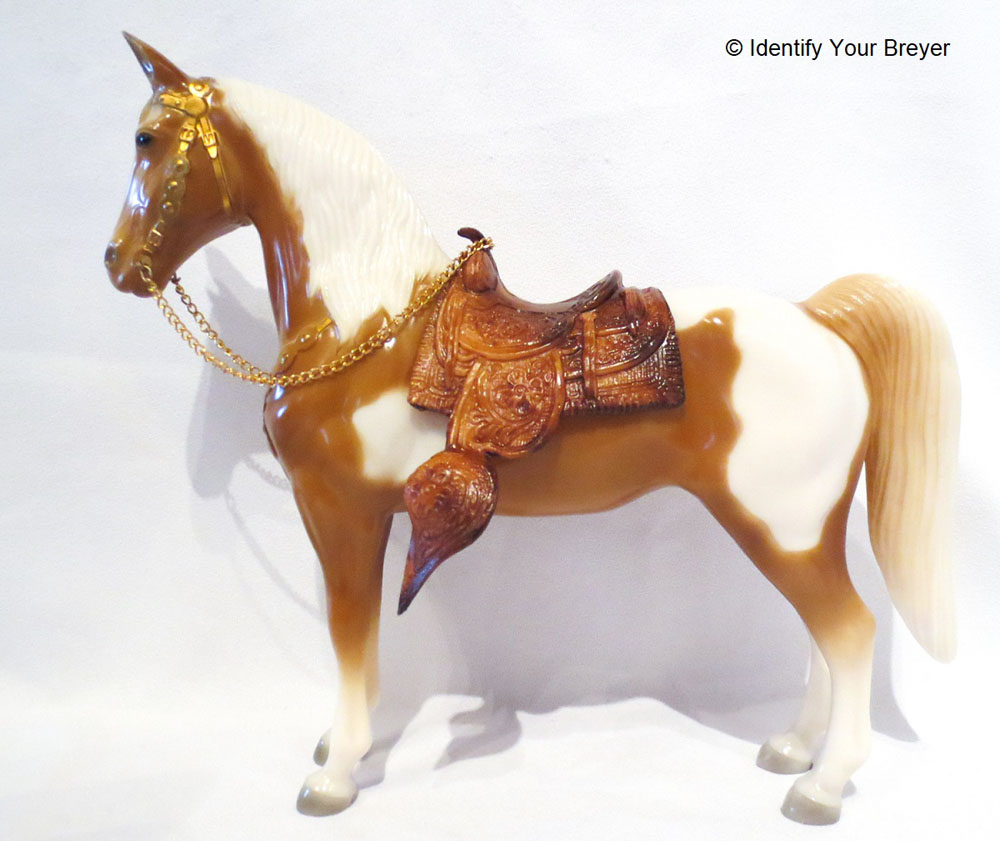
As I mentioned many, many years ago, I picked up this Western Horse at Model Horse Congress back in 1985 or 1986, which was both significantly before the Just About Horses Special Run Palomino Pinto from 1990, and well after the Regular Run release #56, which was discontinued in 1966. 

The fact that he is essentially unfinished (the black paint is very obviously not factory original, in person) and without his original reins tells me he was a Cull, and the fact that that particular shade of Matte Neon Palomino was typical of models from the early 1980s suggests he “escaped” from the factory not long before I had purchased him. 

Even curiouser: the pinto mask/stencil used to create him was also last used in production over ten years earlier!

(I cannot remember if the saddle was a replacement, or came with. Probably a replacement.)

I didn’t think too much about how truly odd he is until recently, though: in fact, he really is one of the weirdest things in my collection. Had he been a very early Test for the JAH release that was shelved? A frivolity that the one of the painters played around with? Were they training, or giving a painting demonstration of how those metal masks worked, with the Western Horse simply being the most convenient test subject? 

Most of the random Test Color Western Horses I see tend to be of the solid variety, and also usually complete. I am presuming he was either an Employee Take-Home, or a model Marney salvaged from the factory as a body. 

Bodies that also happened to be Test Colors, or other such rarities were not that uncommon back then, by the way. The bodies that always freaked me out were the Special Run Culls: I remember seeing a few of the Chestnut Midnight Sun that absolutely messed with my head. 

It’s a body, but it’s also a Rare Special Run! Argh, my brain!

It was not that big a deal for most other hobbyists (who were just happy for the cheap bodies) but now I wonder just how much something like that would go for today, in its original state. Crazy bucks, more than likely; I even remember some of us speculating about that possibility back then. And laughing about it....

Another question I have been asking myself about him lately is: should I restore him? I am not as weirded out as I used to be about naked, or partially naked models sitting on the shelf, and I am not one of those hobbyists who insists that even obviously unrealistic paint jobs require realistically painted eyes.

If I do, I’ll probably strip the black paint off and replace his reins, because I still remain a minimalist when it comes to Original Finish restorations. But not much beyond that: if he was simple discard, a cull of little import, then those scuffs and marks are also an indicator of his history. Fully restoring him would erase all that. 

Just something to think about. 

Wednesday, May 25, 2022

Another Decision

Just passing through again today: I am elbow deep in some heavy literal and metaphorical stuff. (Actually, I’m using the literal stuff to avoid dealing with the metaphorical stuff. But that’s as much as you’ll get out of me on either.)

Since we’ve now covered every other item in that small collection I recently purchased, here’s the final piece, who also offers me another conundrum:

Believe it or not, I don’t have this actually-kinda-common variation of the Palomino Western Horse in my collection yet. I have a Chalky, I have one with a Transitional Saddle, I have one with o-link reins, and I have one on a Clock who also happens to be a two-stocking variation. 

But a basic #57 Western Horse with a basic Brown Snap Saddle? Nope. I’ve had several pass through my hands over the years, but most of them have had condition issues, as Western Horses tend to do.

It’s nothing structural or age-related: Western Horses, like Family Arabians, tend to get well-loved over the years. This example isn’t perfect, but he is one of the nicest ones I’ve run across in a while: like the rest of the lot, I think these models were strictly display only (and maybe even residents of a well-tended china cabinet?) 

But do I really need another Palomino Western Horse? Since my time is at a premium and selling is most definitely not a priority right now, he will probably be mine until at least July, anyway...

Monday, March 7, 2022

The Price of Knowledge

Apparently I was for sale on eBay

(LOL) 

If I were to self-identify as a model horse, it’d be some type of heavy warmblood (Cleveland Bay?), the Shagya Arabian or maybe a Lipizzaner like Pluto. The rationale: I am not petite, and am of Belgian-Polish-Hungarian descent. Probably Dapple Gray too, since going gray early runs in the family…

But for $37, you’re only going to get about an hour and a half of uninterrupted in-person time from the real me. While my time is free at BreyerFest, it’s usually limited in quantity, and I often have no idea when it’s available. 

I probably should organize a meet-and-greet this year, if only to get an hour or so of time to sit for an hour in one place and just shoot the breeze. 

(Hmm.) 

Anyway, in a minor follow up to the previous post about the other eBay auction, I am aware of that many of the various Western Horse Knockoffs that exist have value, and that the Gold Foil Sticker boxes also do. I own plenty of both!

It’s just that with the recent influx of newer and less savvy collectors into the market, I’m a little concerned that some of the bidders incorrectly assumed that the items do in fact belong together, when that’s not the case. It’s been more than once that I’ve observed someone buy something on the assumption that it was a vintage Breyer Western Horse or Pony, and then discover that it was not. 

All the Black Beauty Western Horses and Ponies that I’ve seen that came with their original boxes came in corrugated shippers. All variations of the original Western Black Beauties – with markings, and without – were discontinued by the end of the 1950s, while the White Border boxes didn’t debut until 1973. 

I can see why some hobbyists might assume that they reissued the model in that color in the 1970s, because a lot of models were reissued in the 1970s, or re-released as Special Runs. And Solid Black Special Runs were also a thing in the 1970s. 

But as far as I know, there were no Special Runs or re-releases of the Western Horse or Pony in the 1970s. There are some rare variations, including a Chalky of the Palomino Horse and Matte of the Palomino Pony, neither of which are too expensive. 

I’d be on board with a Solid, Matte Black Western Horse or Pony Special or Regular Run. Don’t think it will happen, though; while there is definitely a market for vintage molds – the expanded Vintage Club membership also sold out, and some of the Breyer Breeds releases seem to be selling well – a relatively plain black Western Horse or Pony might just be a little too plain for the current market’s taste.

(Make it Charcoal, however, and all bets are off!)

Saturday, June 6, 2020

The Narrative of History

Hey guys. Long story short, I had an emotionally rough kind of day today, and I am not in the most… talkative mood right now. At least not in public.

On a slightly more positive note, I’ve been doing a little research – trying to get that paperwork for BreyerFest done that I know some of you are most anxious about – and I ran across this almost by accident:


The original source page from the 1950 Sears Wishbook, here:

https://christmas.musetechnical.com/ShowCatalogPage/1950-Sears-Christmas-Book/0315

It is sometimes stated that history is written by the winners, but I think it’s a little more complicated than that. It’s partly about who controls the narrative – it’s not always the literal or metaphorical winners – and also about access to the source materials.

I’ve had to struggle with both issues, but more with the latter than the former: a lot of research materials are inaccessible, unaffordable, or simply (but hopefully, only temporarily?) lost to time.

Anyway, I knew about the existence of this particular page – the first appearance of Breyer’s earliest proprietary products in a holiday gift catalog – for a while now, but I didn’t have access to a decent image of it until this week.

It doesn’t necessarily add much more to the Breyer story, but it is nice to have, nevertheless.

The reappearance of this page on my history radar, however, also happens to bring the narrative control issue into high relief.

Breyer is technically celebrating its 70th Anniversary this year, but if you go back to 1950, the only Breyer products that Breyer was actively engaged in promoting were… the Money Manager and the Cigarette Host, as shown above.

The Western Horse likely had its “soft” (informal) release sometime in 1950, but it wasn’t until 1951 that it had its official introduction at Toy Fair. “Breyer Animal Creations” probably didn’t exist as a formal division of the Breyer Molding Company until 1952, at the earliest. (But it definitely did by 1953!)

But 1950 is a nice round number and all the other facts are close enough to be good enough, so the finer and more accurate nuances of history often get shunted aside. 

Friday, October 18, 2019

Trailblazer

So this is why I’ve been a little cagey about my “Holiday Horse” customizing plans for the Western Horse:


In addition to all of the other decorative motifs I was going to incorporate, I was also going to stitch up a fabric facsimile of the original vinyl saddlebags (in something wintry/Christmassy) and pack it with an assortment of either old-fashioned (Chuckles, Tootsie Rolls) or thematically-appropriate (Candy Canes, Chocolate Santa) candies. You know, make it sort of a cross between the original Grooming Kits and the nearly-forgotten Candy Packers. You remember the “Candy Packers”, right?


But I didn’t want to mention any of that because I didn’t want to telegraph anything, even unintentionally; Lord knows I do it enough of that with stuff I genuinely have no foreknowledge of…

(Which I guess means this was a good thing that the 2019 VC Stablemates dropped when they did, because this was the post I was writing when that happened. So awkward!)

Incidentally, the prevalence and popularity of the Groomers is one of the reasons why the Palomino and White Western Ponies are so commonly found without saddles: it’s not that they were lost, but that they never came with saddles in the first place.

But it should go without saying that absence of evidence is not evidence of absence. Whenever I find one sans saddle, I just assume it’s been lost, unless I have some other evidence to the contrary. 

The Western Horse, however, was issued as a Groomer – aka the “Giant Groomer” – only briefly, so the possibility/likelihood of a saddle-free Western Horse being a Groomer is pretty small.

I wouldn’t say a vintage Giant Groomer is a grail of mine, but I certainly would be very pleased with myself if I happened to acquire one at a reasonable cost.

I know that the Western Horse has been one of the most asked for/about potential Vintage Club releases – frankly, pretty much since the introduction of the Vintage Club program – so it doesn’t come as too much of a surprise that they were basically holding him back for the next significant Breyer anniversary: the brand’s 70th!

Among other things, I’m sure. (Crossing fingers for something crazy, like a Translucent Running Mare, a Woodgrain Lamp, or the triumphant return of the #36 Racehorse.)

I have some issues with some of the initial merchandise they are already hawking, but I will discuss this next time, once my eyes have rolled forward again.

Tuesday, September 10, 2019

Boundaries

It was a pretty good day at the flea market, all things considered:


This wasn’t all of it, just the most interesting bits. (Looks like I’ll be doing that Christmas-themed Western Horse custom after all!) The ceramic Dinosaur came out of a box lot of figurines that one of my regular vendors gave me a sweet deal on, and the MiniWhinnies were in a bag of Schleichs and other plastic/rubber toys.

In other words, it looks like I am well on my way towards restocking my Dollar Table for next year!

(Before you ask: that Dimetrodon is definitely staying.)

Normally I’d be way more excited about the two aquarium figurines I found, but I happened to watch a video of the auction I had to miss on Saturday, and there were dozens (dozens!) of vintage ones there sold in box lots. I hoped a few of them would have shown up at the flea market but alas, I had to content myself with just these two.

I am a cheapskate, so buying them piecemeal on eBay or at antique shows/malls is not my preferred option.

How much is too much? I won’t pay more than five dollars per piece usually, and it has to be pretty special to me to cough up a fiver (or more) for it.

In comparison, my model horse spending limit is $350 for a single item. Not counting the two “Exclusive Events” I’ve attended, and all of the associated costs of BreyerFest, I think I’ve come close to that limit maybe two or three times?

However, relatively speaking, it is really quite a low boundary – especially when you consider how my tastes run.

While I don’t begrudge hobbyists who have higher spending tolerances, I sometimes do find myself casting a slightly skeptical eye their way. I’ve been in this hobby (and a few others) long enough to be wary of folks who spend a lot of money in relatively short periods of time: I have sometimes seen it not… end well, not just for the person or persons involved, but the hobby as well.

One of the foundational aspects of the model horse hobby was that it was an affordable alternative to the “real” horse world, and I’d hate to see price escalation push people away.

But this is also one of the reasons why I got into researching Breyer History in the first place: while I will probably never be comfortable competing with money, competing with knowledge I can totally do. And one of the reasons this blog exists is so that you can, too. 

Sunday, August 18, 2019

The Western Horse’s Cousin

Another quiet and mostly offline weekend here, working on quilts; I finished one, and prepped a couple of others. I wasn’t so optimistic about it pre-BreyerFest, but now I think I just might make my goal of completing 20 quilts this year!

Also worth noting: the passing of fantasy writer Barry Hughart. Due to a dispute with his publisher, his output was limited to only three novels, but it is well worth the effort to seek them out. There is nothing specifically horsey about them, but I know a large chunk of hobbyists are SF/Fantasy aficionados and might appreciate the recommendation.

My only find worth mentioning this week was a Western Horse knockoff. I was momentarily excited when I entered the Salvation Army a couple days ago and saw his legs sticking out of one of the toy bins; with my other craft projects moving along at a decent pace, perhaps now is the time to stash away a body box quality Western Horse for that Christmas-themed custom that’s been on my to-do list forever?

Alas no, not yet.


That’s fine; I still had some fun cleaning him up. He was one of those models who obviously spent a lot of time in storage under less-than-ideal conditions. He wasn’t sticky, but he was definitely not pleasant to the touch. (He might not look all that great now, but you should have seen what I started with!)

And he still has his original reins and saddle after all these years, so I suppose that counts for something. That doesn’t even happen with actual Breyer Western Horses as much as we’d like.

Lots of hobbyists collect knockoffs, but other than the notorious “Diamond P” ones, I don’t actively seek them out. When I do find them, keeping them is a matter of deciding whether they are (a) historically significant in some way, or (b) are so hysterically incompetent that they make me smile. 

(You know the ones!)

Although I do consider this particular knockoff historically significant, I already have him – and one just like him, in black – so he’ll be heading to the sales list shortly.

The early history of the Western Horse and his cousins is convoluted and interesting, and I like having them around to remind me that there’s still so much to sort out about early model horse history.

Sunday, June 30, 2019

Black Beauty Western Pony

Let’s see – the garden’s been abandoned, for now. I gave up on even starting the diorama yesterday. I’m tripping over almost everything in the house and I still haven’t entirely finished either the Sampler or my Sales List.

Yep, full panic mode activated!

I know I’ll pull it out like a superhero, but dang, the view is scary from here!

Anyway, here’s a little something to admire along the way – a Black Beauty Western Pony! Isn’t she cute?


She was one of my earliest in-hobby purchases, from ca. 1980: I think I bought her from an ad in Shari Struzan’s The Hobby Horse, a hobby publication that briefly became the hobby’s oasis after Linda Walter shuttered The Model Horse Shower’s Journal.

(And I only managed to get a subscription to The Hobby Horse because I managed to place a classified in either the last, or next to last issue of the MHSJ. More about that crazy story some other day…)

Back then, we pretty much bought and sold everything sight unseen: in the stores, everything except the Stablemates came in closed cardboard boxes, and it was too much of a hassle to take and send photographs back and forth while negotiating for a horse off of a newsletter sales list.

You took your fellow hobbyists at their word, and sent the money. For the most part, I wasn’t disappointed. (Sure, there were some, but not as many as you might have thought.)

I bought her along with the Black Beauty Western Horse, because even then I was kind of obsessed with early Breyer History, and why the heck not?

Keep in mind, I hadn’t even seen an actual Black Beauty Western Horse or Pony at that point, either. So not only was I buying something I hadn’t had a chance to inspect, I had virtually no idea what to expect when they finally got here.

I was obviously pleased, because they’re still here, all these years later….

As a bonus, here’s an ad for the Black Beauty Western Pony from the September 1953 issue of Western Horseman

Thursday, January 10, 2019

Saddle Snaps

Sometimes research hunches lead to big or significant finds… and sometimes, they don’t.

This is a case of the latter, rather than the former.

I had always been curious about the snap fasteners used on Breyer snap saddles – specifically the ones used on the Western Horse, the Western Pony, and the #36 Racehorse. Was there an interesting tale to be told there?

Depends on your definition of interesting, I guess.

Most of these saddles used Klikit brand fasteners, which were manufactured by the Rau Fastener Company of Providence, Rhode Island. It was founded in 1911, and ceased to be in the late 1990s, when it was acquired by its competitor, Scovill Fasteners.


Here’s the trademark info: https://trademarks.justia.com/714/29/rau-klikit-71429825.html

Just about the only other thing worth noting about Klikit snaps is that they were extensively used in apparel, especially on the old-timey Western-style shirts favored by Hollywood cowboys and rockabilly artists.


However, most snaps – then, and now – were used on more utilitarian articles of clothing, where buttons would be either a hassle or a liability – like uniforms, outerwear, and baby accessories.

(And costumes, too. But I’m not thinking about that right now, I’m really not…)

Even though the Klikit brand has been out of production for at least 20 years, old warehouse stock can still be found on eBay – if you’re especially keen about restoring Breyer snap saddles or vintage clothing.

Snaps aren’t all that hard to assemble/attach, incidentally, as long as you have the right tools for the job. Easier than sewing on a button, actually!

Sunday, December 10, 2017

An Early Chalky Western Horse

Since my back has been really bothering me the past several days (it’s nothing serious, just a chronic condition that periodically flares up) I’ll have to kick my commentary about that announcement Reeves made last week down the road a couple of days:

https://www.breyerhorses.com/index.php?pageId=13261

I want to add a bit of historical context to discussion, but my mobility issues have been putting a serious damper on my research abilities. (Note to self: buy smaller, lighter binders.)

But today I’ll spotlight what I hope is going to be one of my last eBay purchases for the year: a ca. 1951/52 Chalky Palomino Western Horse with black hooves, o-link reins and a high-grommet saddle!


Yeah, he’s not in the best of shape. That I attribute to his age: he was among the earliest Breyer models manufactured for sale independent of the clock, and Breyer probably still hadn’t realized that items sold as playthings will take more of a beating than a clock that sits on a mantel!

I had the opportunity to purchase a beautiful and near-mint Chalky White Western Horse at a very early BreyerFest and passed, and have regretted it ever since. This guy was cheap, and y’all know I’m not a huge stickler for condition.

But I know what some of you are thinking: What’s up with the Gray saddle?

Guys, it’s probably the least interesting part of him: it’s just a Brown saddle, faded to Gray. The only thing truly unusual about it is how nice and even the fading is, which suggests to me that it’s more than simply the result of sun-fading:


Again, it’s something I’d attribute to the earliness of his manufacturing. They were still in the earliest stages of figuring out this toy horse thing. Maybe this particular batch of brown plastic was not particularly color-fast?

We would not get true Gray/Graywashed plastic saddles until ca.1961/2, with the debut of the Western Prancing Horse, and it would not be until 1966/67 that we would see something similar on the Western Horse and Pony.

Tuesday, February 21, 2017

Toy Fair and Spirit: Riding Free

One of the things on my personal “bucket list” is attending Toy Fair. It’s not just about the horses (in general) or Breyers (in particular); if you know me at all, my toy nerdery is both wide and deep.

Access isn’t the problem, but time and cost is: I am in Michigan, and Toy Fair is in New York City. So I have to content myself with living vicariously:

https://www.youtube.com/watch?v=1WmFPVAWqHM

http://legionofleia.com/2017/02/toy-fair-universal-previews-a-range-of-new-fall-toys/

http://www.northjersey.com/story/money/shopping/2017/02/20/state-play-toy-fair-new-jerseys-got-game/98145012/

The only big news to come out of Toy Fair was the official announcement of the Spirit: Riding Free line, which was just about the worst kept “secret” in the model horse hobby ever. But it’s nice to see pictures of the actual, live pieces now and not just the catalog promo shots.

That being said, this line is not designed with someone like me in mind, though I will undoubtedly end up buying at least a few of the Blind Bag Stablemates and possibly the boxed Traditionals. (The Rain mold looks great in Matte Palomino!) It’ll be interesting to see if the third Traditional scale mold in the line, Boomerang, will eventually get incorporated into the regular line as the Spirit and Rain molds were.

There also didn’t appear to be any Toy Fair-specific giveaways, like the Gloss Highland Pony keychain or the Little Bits Chestnut Saddlebred, but my online shopping has been limited to targeted searches on eBay for box lots and specific (and oddly rather scarce) bodies, so I may well have missed it.

Incidentally, Breyer has been represented at the Toy Fair literally since the beginning of Breyer, as this article from the March 1951 issue of Playthings makes clear:

Thursday, November 3, 2016

October (Model Horse) Surprises

Gah! So many goodies out right now – Gideon, Coeur de Lion, the Premier Club Shagya Arabian (a Shagya at last!) and now this bizarre Test Color Clydesdale Mare THAT I LOVE:


It looks like the kind of Test Color my nine year old self would have designed! If my parents had been rich, and they had had the “Design Your Own Test Color” back then.

Alas, I blew my wad on the trip and I really need new tires, so most of these end-of-year items won’t be coming home with me. The upcoming Silver Filigree will probably be off the table, too, whoever it may be.

I’ll make an exception for the Mare of course, and possibly for the Nonhorse piece, especially if it’s one of the molds I think/hope it will be, like a Zebra, Elk, Deer Family Set or Saint Bernard. Though both the Mare and the Nonhorse are unlikely anyway, since I haven’t been getting drawn for those kinds of things lately.

(I’ll cuss if it’s the Saint Bernard – that’s one collection I had some hopes of keeping complete.)

Most of my purchases for the rest of the year will be of this type, all inexpensive recent Salvation Army finds:


The white kitty with the black tail tip is my favorite. I have no idea who made it – I’m guessing it’s Russian or Eastern European, since it came with the striped Art Deco Cat, made by Hollohaza in Hungary.

And box lots, too. Here’s one of those pieces from that lot I was so excited about last week:


Yes, that’s another “Transitional” saddle, this time a gray to match my tan.

On yet another Western Prancing Horse, that both baffles and amuses me.

It is funny that the two Transitional saddles I now own – and a third that I almost purchased, locally – were all found on the Western Prancing Horse. Funny because this is a saddle that was designed for the Western Horse, and that’s where most of the rest of the hobby finds theirs, when they do.

While it’s possible that some Western Prancers were released with Transitional saddles, because that’s just the weird kind of stuff that happened back in the Chicago days, I’m going to chalk up my personal experience to a sampling error.

In this case, it was in a lot that came with some spare pieces, so I’m going to assume this is a case of parts getting switched around and/or lost.

I can also partly attribute it to the fact that I’m one of those handful of collectors who actively collects Western Prancing Horses. Even though my collection is technically “complete”, I always give them an extra look when I’m cruising the Internet. Sometimes, I am rewarded.

Mostly with oddball Black Leopard Appaloosa variations … and now, apparently, rare saddles.

Thursday, May 28, 2015

1990: The Year of Shiny and Chrome

In another forum and in pursuit of another nerdy passion, discussion turned to the quality and degree of worldbuilding in Max Max: Fury Road. In particular, the dialogue: in a world that’s worn, rusted and broken, the words "shiny" and "chrome" have become slang for awesome/glorious/wonderful.

I laughed to myself a bit when I read it: in a vocal segment of the model horse community, shiny and metallic are already considered positive attributes.

Though the sentiment is not universal; indeed, in the late 1960s and most of the 1970s, Breyer ran away from making shiny and metallic things precisely because they were not considered good, in any sense of the word. The Decorator items – including the metallic Gold Charm and Florentines – had completely tanked. Hobbyists and collectors were also demanding more realistic-looking horses, and that meant more Matte Finishes and less Gloss.

The Decorators were discontinued by the mid-1960s, and Glosses gradually petered out through the 1970s, with models like the Dapple Gray Old Timer and the Brahma Bull finally making the transition to Matte in the late 1970s or early 1980s. Occasional newer Glosses did turn up in the 1970s – some of the early Stablemates, those infamous Gloss Dapple Gray Shires, randomly glossed things they’d toss in boxes just for the heck of it…

Technically, the first "modern" Glossies were the Enchanted Doll House Special Run Alabaster Family Arabians, in 1988. Other than the mold marks and changes, and the date "1988" written in ink on their bellies (under the gloss), they were nearly indistinguishable from older Gloss releases. Which is why they really didn’t make that big of an impact in the hobby world.

They were kinda boring.

The same could be said of the next new Gloss – the Western Horse in Gloss Brown Pinto, a Just About Horses SR in 1990. It was pretty much the same model as the original Vintage release, except for a slip saddle instead of the original snap. There were some minor mold and paint changes, but nothing dramatic.

It was that year, though, that we saw a more heroic return of the Gloss Finish – and finally, the return of metallic Decorators. On the same model!

That first new metallic Decorator was the Signing Party Special Run Gold Charm Secretariat. He wasn’t a perfect duplication of the Gold Charm models of old – he didn’t have the white mane and tail typical of the paint job – but we were happy to see it again, anyway.

The Glossy came a few months later: the Sears Wishbook Special Run Gloss Racehorse Set featured the Sham, the Traditional Man o’ War, and Secretariat – again!

Even though they were little more than Reissues, the Gloss Finish a thin and pale imitation of the Gloss Finishes of old, and their coloring bordered on the fluorescent (especially the Shams – yikes!) this set finally clicked for some weird reason.

Unlike the Gold Charm Secretariat or the earlier Gloss SRs, the Gloss Racehorses are still a rather desirable set among hobbyists; it is not an easy one to come by nowadays, especially complete.

Saturday, April 18, 2015

Odd Western Horse Cull

I told myself that eBay was for research, and for the picking up of obscure bodies (Still looking for that cheap Traditional Kitten. A Khemosabi now, too.) but this guy ended up on my doorstep earlier this week somehow:


It’s an unpainted factory cull Western Horse, probably an older one from the late 1960s or early 1970s, but we’ll get to that in a moment.

I’m not normally a big buyer of Unpainteds/Blanks. All models start out that way, so the collectibility and/or novelty factors for me are pretty low. The only exceptions I make are for items that were sold that way as a Special Run (like the G1 Draft Horse in 1984), or examples of molds in an older and less modified state.

This Western Horse is one the latter, not the former. He’s definitely not a stripped model: his seams are uncleaned and unfinished, he has a few dark goobers floating in his plastic, and his hind legs are pinched together and bent slightly forward in a way indicative of a fixturing issue.

He is older - look at that lovely camel’s hump! - but how old I am not sure. He does have the USA mark, but we’re not sure when that was etched into the mold. The best guess is that this occurred about the same time the USA was added to most of the other Breyer molds, circa 1970.

I think this piece is roughly from that time period. My working theory is that he might have been part of the sample batch run shortly after the mold was modified. On what piece of evidence does this theory hang on?

He was purchased from a seller in California.

Odd Breyer whatsits have a habit of turning up in California. The first free-range In-Between Mare? Found in California. One of the first Gloss Gray Appaloosa Shetland Ponies discovered? Also California. Some of the earliest and most reliable rumors of Christmas Decorators? In California.

This Western Horse isn’t on par with any of those discoveries: at most, I think he might have been part of a sample batch sent to the Unger & Associates, who started out as one of Breyer’s earliest sales reps, and later became collaborators (Brenda Breyer? That was them.)

I think a lot of the Breyer oddness that comes out of California has something to do with that business relationship, actually.

For all I know, he could have just been another employee take-home or a part of a foster care/adoption donation box. I just him and I haven’t had a chance to e-mail the seller back for any additional information or confirmation of my suspicions.

If I do get any additional information, I’ll let you all know.

Monday, March 16, 2015

In the Beginning

The Western Horse is one of the handful of Breyer-related topics that I defer to others; most of my research on Early Breyer History tends to focus on Breyer’s pre-equine proprietary products, like the Checkers, Poker Chips, Cigarette Host, Money Manager et al.

It’s not that I have less interest in the Western Horses per se, but that I believe - for want of a better word - that the pre-equine products and their history are more "endangered".

Whether or not a model horse is classified as a Hartland or a Breyer, it will be collected and treasured regardless. Funky things like plastic humidors or vanity organizers, and the lesser-known clocks? Maybe not as much.


For the definitive guide to the Western Horse and the disentanglement of most of its mysteries, I send you here: http://www.myhartlands.com/pages/MastercraftersClocks.html

I mostly concur with the research, outside of a few minor quibbles. The one I want to discuss today is the assertion that "Breyer’s own documentation says they started in 1950."

Well, yes and no. Breyer does assert that start date - and is using it to celebrate its "Fanniversary", but the reality is far more complicated than that. "Breyer" has several different start dates, depending on how you want to define it.

The Breyer Molding Company itself existed several years prior to the introduction of the horses; though the exact date is not known, with some research it is probably knowable. (Per Nancy Young’s Breyer Molds and Models, it’s likely pre-1943.) I do not know if Reeves does, in fact, have any documentation at all in their archives prior to the early 1950s.

Back then it was a standard plastic injection molding shop, molding whatever they happened to win a contract on. That included government contracts; when many of those contracts disappeared after World War II, Breyer decided to position itself as a toy and novelty manufacturer in order to keep the shop running even as the contracts themselves ran out.

Documentation for these early products is scarce. The Cigarette Host appears in the 1950 Sears Wishbook, and a brief article/PR piece in the February 1952 issue of Playthings magazine, entitled "Attractive Items from Breyer" mentions that the Money Manager had been "[o]n the market for 3 years".

That Breyer started molding the Western Horse in or around 1950 for Mastercrafters appears to be true, but the Western Horse as a product independent of the Clocks? We’re not as sure; the similarities between the Hartland and the Breyer Western Horses are such that it’s sometimes difficult to determine which is which in early magazine and catalog advertising. Neither company, at that point, was a recognizable enough "brand" that advertisers saw it necessary to call attention to it.

I presume that Breyer’s Western Horse made its formal/official debut in 1951, with a brief article in the March 1951 issue of Playthings, entitled "Breyer Molding Co. Announces ‘Palomino’". It’s possible that the model may have been in production for several months prior; it wasn’t uncommon for Breyer to do such a thing later on, as was the case with the "Big" Poodle mold.

The brand known as "Breyer Animal Creations" seems to have debuted in 1952: prior to that (such as in the March 1951 article, above) all Breyer-manufactured items - animals or otherwise - are referred to as products of the Breyer Molding Company.

Whew.

For what it’s worth, I’m a bit of a pedant, and consider the Breyer brand to have formally started in 1952, with the apparent creation/registration of the "Breyer Animal Creations" brand. Reasonable arguments could be made otherwise, for any number of dates.

Thursday, November 6, 2014

Chamonix

Nailed it! The next Web Special, Chamonix:


Silver Filigree Ashquar! Interesting little detail worth noting: the hooves are a different color than the ears and muzzle. Silver Filigrees haven’t been consistent on that point: just as often as not, the head and hoof colors match - most recently on the BreyerFest Silver Filigree Misty.

I’ll be entering every day - my Mont Tremblant needs a boyfriend - but doubt I’ll get him. As with most low-run Silver Filigrees, speculating will likely be an issue with this one. I won’t be heartbroken if I don’t get pulled for one. It’s not like he was a Kitten, a Khemosabi, a Polled Hereford Bull or a Traditional Man o’ War.

(Again, I want to reiterate: it was an educated guess, not the result of any insider intel. I’m just a little better than most at reading the signs. Making a ton of predictions also helps.)

In other news, per the Just About Horses that are just starting to show up, I was also partially right about the imminent reappearance of the Western Horse: there’s a shiny Appaloosa one named Glitterati being offered next year to celebrate the Western Horse’s 65th anniversary.

I thought the mold would show up in the Vintage Club first, but I am on board with this as well. Plus, I think he’d make an excellent model to use for a hobby outreach campaign.

Organizing a "National Model Horse Day" campaign has been in the back of my mind ever since a coworker mentioned National Clown Week back in August. (Yes, she's a professional clown. Not scary at all, either!) If clowns get a week, surely this great hobby of ours is worthy of a day, right? I wouldn't have to be Breyer-specific or anything like that, just a day to publicly celebrate and advocate for the hobby that gives us so much pleasure.

"National Model Horse Day: Because everyone does deserve a pony!"

Okay, off my soapbox now.

The BreyerFest Celebration Horse will be a Bay Roan Ardennes, on the Roy mold. Most of us were expecting something Drafty - likely a Percheron - so an Ardennes is a pleasant surprise. I don’t have my copy of the JAH yet to judge the quality of the paint job, but I’ve been hearing good things.

It’s nice to see more warm fuzzies about the selection of the Roy mold than I expected on Blab. He’s not one of my favorite molds, personally, but I’ve always believed it was partly because he’s had such a bland lineup of paint jobs over the years. The recent BreyerFest Special Run Radar showed just how much a pretty paint job can mend. 

But I’m sure we’ll be hearing plenty to the contrary, too. I find it so baffling that some hobbyists are willing to bail on the event based on a the very first release - sort of like bailing on a concert because you don’t like the opening act. While we’ve had both beauties and clinkers over the years, the event hasn’t been exclusively about the "Celebration Horse" for years.

And finally, it seems like the Maureen Love article in the JAH is mostly a tease, and noncommittal on the return of the Hagen-Renaker molds. I’ll have to wait and read it myself to see if I can discern anything more from it.

Thursday, March 27, 2014

The Icon

Other than being "grullo" instead of Chestnut, here’s Gossamer!


Sweet! I’ve already penciled him in on top of my BreyerFest buy list. And if they do a 50/50 Gloss on him, I’m going for two!

As I discussed earlier this month, sometimes when a detailed or realistic paint job is put on a less-than-realistic mold, the effect can be disconcerting. But here, I like how Reeves overcomes that by using a pinto pattern that walks the line between being realistic and fantastic.

A similar effect was achieved on earlier examples of the #766 Arabian Stallion on the Khemosabi mold, that have the high contrast crazy splatter/resist dappling. They toned it down on pieces later in the run, presumably to please the folks who prefer the more realistic, regardless.

I also like the little Vintage nod on the saddle, with the gold dotted trim mimicking the trim seen on some (but not all) of the earlier snap saddles.

As I mentioned before also - and what Reeves gets wrong - is that this is NOT the first BreyerFest Special Run of the Western Horse. The first was the Solid Metallic Gold given out as prizes back in 2003 for the T-Shirt/Costume Contest. I can understand how it might have slipped down the memory hole; it was part of an early contest with lower-than-average participation, they didn’t make a whole lot of them, and they rarely come up for sale.

(‘Twas years before I decided to start participating in that sort of thing.)

I am going to presume that the piece run is going to be significantly larger in this case, though I wouldn’t doubt it’ll be on the lower end of what we’ve been seeing. Models with molded on tack - newer molds or old - don’t sell as well as tack-free ones, no matter how pretty the paint job.

Will he sell? I think so. He seems to be polling well among his target audience: hobbyists like me, i.e. history buffs and nostalgic olds.

Hobbyists tend to think of the Palomino Family Arabian Stallion as the one true "Icon" of the Model Horse World, but for the rest of the world, it’s the Palomino Western Horse. It’s true that the more common releases of the Western Horses (and Ponies) can be difficult to market in more standard model horse venues, but that’s definitely not the case everywhere else. I’ve never had an issue, for instance, selling Palomino or Black Pinto Western Horses on eBay.

Among a younger audience and/or those less interested in the history, the reaction was decidedly less warm. There’s a lot of the usual "Why couldn’t that color be on [my favorite new mold from the last five years]?"

Which I find annoying, but then again, I made the mistake of wandering onto the NAMHSA-Discussion Group earlier this week. Even the happy little spring birds chirping outside my bedroom window seem annoying after reading that. (They were arguing over the definition of a word? Exit, Stage Left…)

Sunday, March 23, 2014

Frame of Mind

I haven’t been in the right frame of mind to do much speculating about What This Year’s Surprise Model Will Be. The current line of thinking is that it’ll be Lonesome Glory, based on an otherwise unidentified set seen during the latest Exclusive Event.

Except for the first Surprise Model - the old Quarter Horse Gelding - the Surprises we’ve had since then have been on modestly popular newer molds like Flash, Ethereal, and Roxy. Lonesome Glory would fit right in to that lineup.

I don’t have any other information or hunches to convince me, and there are a lot of other molds that would also fit. Two other popular guesses right now are Othello and (naturally) the Silver.

My primary argument against either of those molds is that they’re too popular with the segment of the hobby population that does go to BreyerFest. (What colors are left to put the Silver in is also a viable question to ask.) There’s already an inherent appeal in the Surprise Models - that they’re all very limited releases, but a few are more limited than others - that doesn’t need to be sweetened with the addition of it being a Very Popular Mold Already.

I can easily imagine the chaos that would ensue if either model was. The first words that spring to mind? Gasoline on a bonfire. 

They’d also probably be the only molds that would make me bypass getting one. I’m not a very athletic or agile person, and the weight of all the metaphorical daggers in my back that I’d get from people standing behind me in line might be enough to physically topple me over.

I’m not going to give it much more thought until the first bags get opened. And then act accordingly.

There’s been one line of questioning that I have been actively engaging in over the past couple of days - the identity of the mold in the sneak peek photo they gave us on Friday via the Blog and the Facebook:

http://www.breyerhorses.com/bf2014-blog

By the time most of you read this it will have already been revealed, but the first thing I thought when I saw it was: Western Horse?

It’d be both a daring and logical choice. There have been only a handful of actual Western Horse Special Runs: the 1990 Just About Horses Brown Pinto, the 1995 QVC Palomino Reissue, and the Solid Gold pieces given away in 2003 for the T-Shirt/Costume Contest. Frankly, we’re overdue.

There are a couple of other factors working in its favor. First, a Western Horse would be a logical choice for a BreyerFest that’s all about celebrating an Anniversary. Second, I believe a Vintage Club Western Horse Special - either as a part of the Series, or as a Bonus Model - is a matter of when, not if. It’d make sense from an economic standpoint to drop the mold to make enough for two releases, rather than drop it to just make enough for a more limited (350-500 piece) run.

If it’s something like the San Domingo or Old Timer, and I’m made to look silly by the guess, no matter. But I am so on board with the idea of a Chestnut Frame Overo Western Horse Special Run right now I’m already imagining the names I will give it.

I like Stetson.

Friday, July 5, 2013

The Western Horse and His Kin

Here’s a better picture of the Western Horse copy in that box lot. The current "flying nun" shape of the saddle amuses me:


One topic I don’t cover much here is the Western Horse and his "kin": it’s been better covered, and better researched by others, to the point where I don’t feel any contributions I can make (at this point) would be very helpful.

Part of the reason for me keeping this fella is to help remedy this issue. Knowledge requires access. And in this hobby, access usually requires ownership.

It is also, surprisingly, a rather controversial and political topic: there are people within the hobby who are, shall we say, extremely devoted to certain opinions and viewpoints. And there is no room for discussion. Having discussions where no one is willing to concede a single point one way or another, ever - well, they don’t tend to be very interesting or productive.

It is especially so when it comes to the Western Horse. So I usually demur.

I will say that when I refer to the mold as the "Western Horse" I do so out of the common hobby convention of calling a model or mold by its best known or most commonly used appellation. Adios is Adios for instance, not Yellow Mount, Best Tango, or even Frappe.

Whether these Western Horse copies were copied from the Hartland, the Breyer, or their potmetal precursors is irrelevant. In most cases it can be hard to determine which copies were copied from where anyway.

Trying to put too fine a point on the origin of the copies also just ends up confusing the mundanes, too. When you start saying stuff like "It’s a copy of a Breyer, which may have been a copy of the first version of the Hartland Champ, which may have been adapted from the potmetal carnival horses…" they are only momentarily impressed.

Then they get a little nervous. Or walk away.

You gotta ease them into stuff like that. For most, "It’s a copy of a Breyer" is all they’re going to hear anyway. You can explain the finer points later, if it’s clear they want to know more. (One of the reasons why this blog exists!)

And once they reach that point, it's time to tell them about the birds and bees of the model horse world - "pedigree assignment"! (If they don't completely freak out at that point = another convert!)

Monday, March 25, 2013

Wabi-sabi and the Model Horse

I wasn’t expecting Halo to be the second Vintage Club release this year, as long time readers know by now. I interpreted Reeves words cleverly rather than obviously, which I should know not to do by now, considering my recent success rate on predictions.

So I won’t even hazard a guess on the mold for the BreyerFest Gambler’s Choice/Surprise model this year, except to note - as others have - that the descriptive term they’re using for it (CC Shuffle) is a reference to a style of line dancing. (So, something gaited?)

What I want is something with a saddle - Western Horse, Western Pony, Western Prancing Horse, Fury/Prancer - but realistically, I don’t see that happening. (Wouldn’t a Leopard Appaloosa Western Horse be awesome?)

Speaking of, I did finally get to see the Retro Release Roany Chestnut Appaloosa Western Pony last week and liked him a whole lot more than I thought I would. I didn’t buy one - trying to keep a tight rein on my budget, still - but if they should offer it up at a discounted price later in the year like they did with the Pinto Prancer, I just might.

The other new release that really caught my eye - and by surprise - was the latest on the Smart Chic Olena mold, a portrait of Topsails Rien Maker. I’m not the kind of person who gets super excited over Another Chestnut Quarter Horse release, especially on a mold that’s already seen a more than a few, but it was darn hard walking out of the store without him.

I loved the fact that - aside from the bang up job on the color, overall - they also incorporated the real Rien Maker’s Bend Or spots into the paint job. I’m not ashamed to admit that it’s those little details that make my heart grow fonder.

I think the first time Breyer actually incorporated a natural-occurring color "imperfection" into a portrait model was with the 1989 Limited Edition Abdullah, on the Trakehner mold. I was just as taken with it then - it being the Trakehner mold and a rather detailed paint job overall didn’t hurt, either.


(Sorry for the subpar picture - he really is much prettier in real life.)

The incorporation of these natural "flaws" has received rather mixed reviews, however, from hobbyists. While some appreciated the extra effort made to capture the unique characteristics of individual horses, others were dismayed by what looked like (to them) obvious manufacturing errors. There was quite a bit of consternation, for instance, when the 1999 Special Run Five-Gaiter Will Shriver came with only one eyewhite, and the 2003 USET Special Run Brentina came with white flecks, both reflecting actual characteristics of the portrait horses themselves.

Hobbyists are so accustomed to striving for perfection that any deviations from it - even if it’s something actually seen on the horse they’re trying to duplicate - tends to stand out. And not favorably so, in some eyes. 

That desire for a perfection that cannot be (realistically) achieved in real life is one of the reasons why I tend to think that the hobby can never truly be a "re-creation of the real horse world, in miniature". As I’ve said before, I think the hobby is more it’s own thing than just a shadow of something else. 

Striving to create the "perfect horse, in miniature" is totally fine, if that’s your goal. The wabi-sabi aesthetic is not for everyone. But surely there’s room enough in the hobby for both approaches - and the entire spectrum in between, right?