Showing posts with label Culls. Show all posts

Sunday, April 16, 2023

More, or Less?

Enjoying a momentary respite here: the taxes are done, the seeds have been started, and (most) of the financial paperwork I wanted to wrap up has been… wrapped up. Nothing I need to get done can get done until tomorrow, other than some stray e-mails that I am procrastinating about.

I was going to write up a more full-bodied explanation of my reasoning surrounding the likelihood of the early Family Arabian Special Runs, but the initial dive into my research materials left my head spinning. So instead, let’s focus on something that is both less – and more – of a mystery:

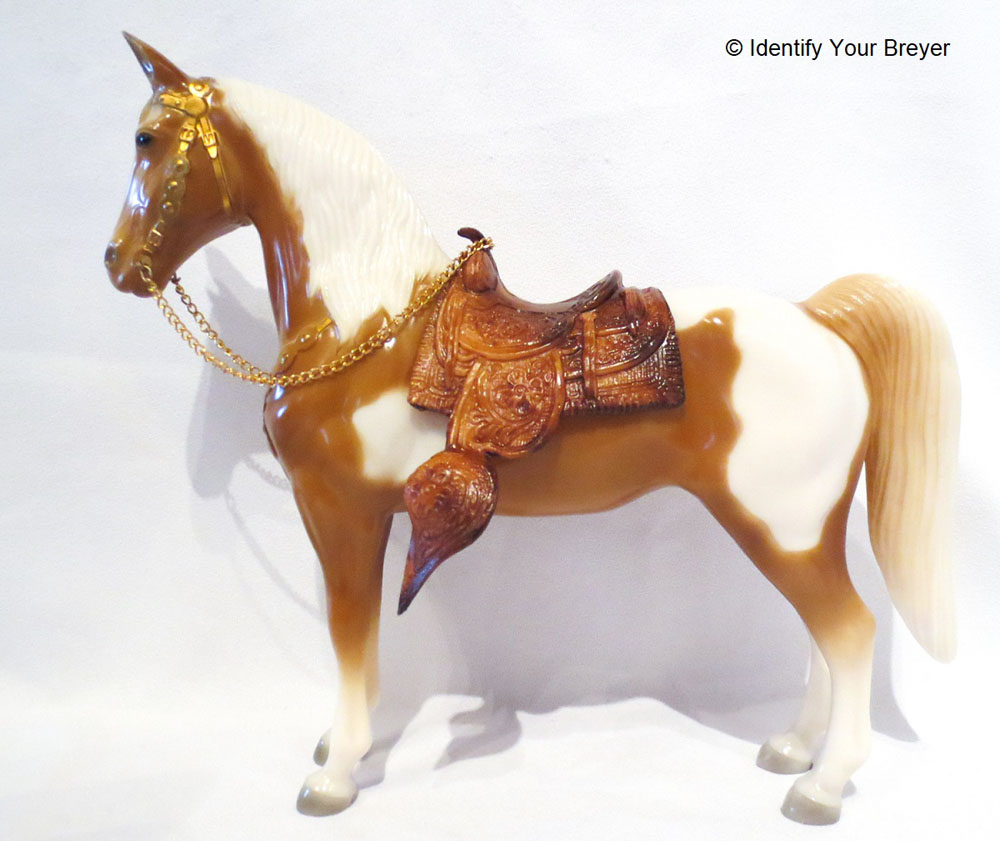
As I mentioned many, many years ago, I picked up this Western Horse at Model Horse Congress back in 1985 or 1986, which was both significantly before the Just About Horses Special Run Palomino Pinto from 1990, and well after the Regular Run release #56, which was discontinued in 1966. 

The fact that he is essentially unfinished (the black paint is very obviously not factory original, in person) and without his original reins tells me he was a Cull, and the fact that that particular shade of Matte Neon Palomino was typical of models from the early 1980s suggests he “escaped” from the factory not long before I had purchased him. 

Even curiouser: the pinto mask/stencil used to create him was also last used in production over ten years earlier!

(I cannot remember if the saddle was a replacement, or came with. Probably a replacement.)

I didn’t think too much about how truly odd he is until recently, though: in fact, he really is one of the weirdest things in my collection. Had he been a very early Test for the JAH release that was shelved? A frivolity that the one of the painters played around with? Were they training, or giving a painting demonstration of how those metal masks worked, with the Western Horse simply being the most convenient test subject? 

Most of the random Test Color Western Horses I see tend to be of the solid variety, and also usually complete. I am presuming he was either an Employee Take-Home, or a model Marney salvaged from the factory as a body. 

Bodies that also happened to be Test Colors, or other such rarities were not that uncommon back then, by the way. The bodies that always freaked me out were the Special Run Culls: I remember seeing a few of the Chestnut Midnight Sun that absolutely messed with my head. 

It’s a body, but it’s also a Rare Special Run! Argh, my brain!

It was not that big a deal for most other hobbyists (who were just happy for the cheap bodies) but now I wonder just how much something like that would go for today, in its original state. Crazy bucks, more than likely; I even remember some of us speculating about that possibility back then. And laughing about it....

Another question I have been asking myself about him lately is: should I restore him? I am not as weirded out as I used to be about naked, or partially naked models sitting on the shelf, and I am not one of those hobbyists who insists that even obviously unrealistic paint jobs require realistically painted eyes.

If I do, I’ll probably strip the black paint off and replace his reins, because I still remain a minimalist when it comes to Original Finish restorations. But not much beyond that: if he was simple discard, a cull of little import, then those scuffs and marks are also an indicator of his history. Fully restoring him would erase all that. 

Just something to think about. 

Sunday, December 5, 2021

The Five-Gaiter’s Friend

FYI: I have not been intentionally absent.

As you might imagine, it’s still absolute chaos here; it feels like all the progress I made over my vacation has been completely obliterated, and I’m both physically and emotionally exhausted. 

I do have a couple of substantial posts “in the pipeline” but to tide you over until I manage to actually get them done, here’s a picture of another recent acquisition:

This cull of the #975 Best Choice release of the Sham mold was purchased from the same seller as my Funky Five-Gaiter. I logged on to eBay, and he was literally right on top of the search page. 

While I am neither a big collector of Culls nor of Shams, dear readers, I took that as a sign.

As you know, my luck with this year’s Web Specials – like so many of you – has been the absolute pits. (Currently glaring at the twenty – twenty! – Midases currently for sale on eBay and MH$P.) I needed to score something special, and this was the opportunity that was presented to me. So I took it.

Will I be keeping him long term? I have no idea. I have friends who would probably be over the moon to have him, and he just might end up with one of them someday. With a few rare exceptions, Culls don’t stick around here too long.

But today? Today he stays.

Wednesday, August 19, 2020

The Chicago Radius

Here’s one of the things I’ve bought during my recent shopping binge:

It’s a really, really nice Cull of the Appaloosa Gelding!

So nice, in fact, I kind of wonder what made him a “Cull” in the first place? The very slightly splotchy left eye? The tiny bit of flashing on his barrel? The rougher than average seams?

If you were a child of the 1970s or 1980s, receiving New in Box Breyers with these kinds of flaws was not unusual, and I often received some that looked far worse.

I am presuming here that this was simply a nicer than average Employee “Take Home”. “Take Homes” were models that Breyer employees took home, as a perk of the job, usually as gifts to children or other family members.

(Things were definitely more lax back then!)

Most of the time these Take-Homes were some flavor of Cull – either deliberately set aside, or pulled from the Cull bin – though occasionally you’ll see a Regular Run model that’s a little bit “off”: the markings might not be quite right, black points might have been added to an otherwise Chestnut model, or not added at all to something that was supposed to be Bay.

Or maybe it didn’t pass some sort of arbitrary quality check – something that was also more lax back then! I could easily imagine that this guy passed through the production process, only to get pulled just before packing and shipping because someone finally noticed that his halter was unpainted.

And sometimes that didn’t happen, either.

So what I am saying is that all this speculation could be so much poppycock, and he could have been bought off the shelf this way, and where he came from could have been a complete coincidence.

Generally I’ve found that most Culls and other Chicago Era Oddballs haven’t wandered too far from Chicago. And I’ve had enough experience finding these sort of oddballs to think there’s a better than average chance that he’s a Cull or Take-Home.

What I am saying is: any odd-looking, pre-1985 Breyer horse found for sale within a three-hour driving radius of Chicago – I sometimes refer to it as “The Chicago Radius” – has a pretty good chance of being one.

(For your information, I live a couple hours beyond The Chicago Radius. However, I do live in an area was blessed with a surfeit of independent toy and hobby stores.)

Thursday, May 31, 2018

Liver Chestnut Scratching Foal Oddity

On the left is your standard, garden-variety #169 Liver Chestnut Scratching Foal, a relatively scarce vintage model who was only in production from 1970 through 1971. This release used to be hard to come by, but then the Internet and eBay happened, so not as much anymore.


They still sell for decent price – especially ones with good shading and detail, or with original boxes and stickers – but the big money in the Scratching Foal game is with either Test Colors or some of the scarcer Fun Foal variations like the Black, Dark Gray, or Blue Roan.

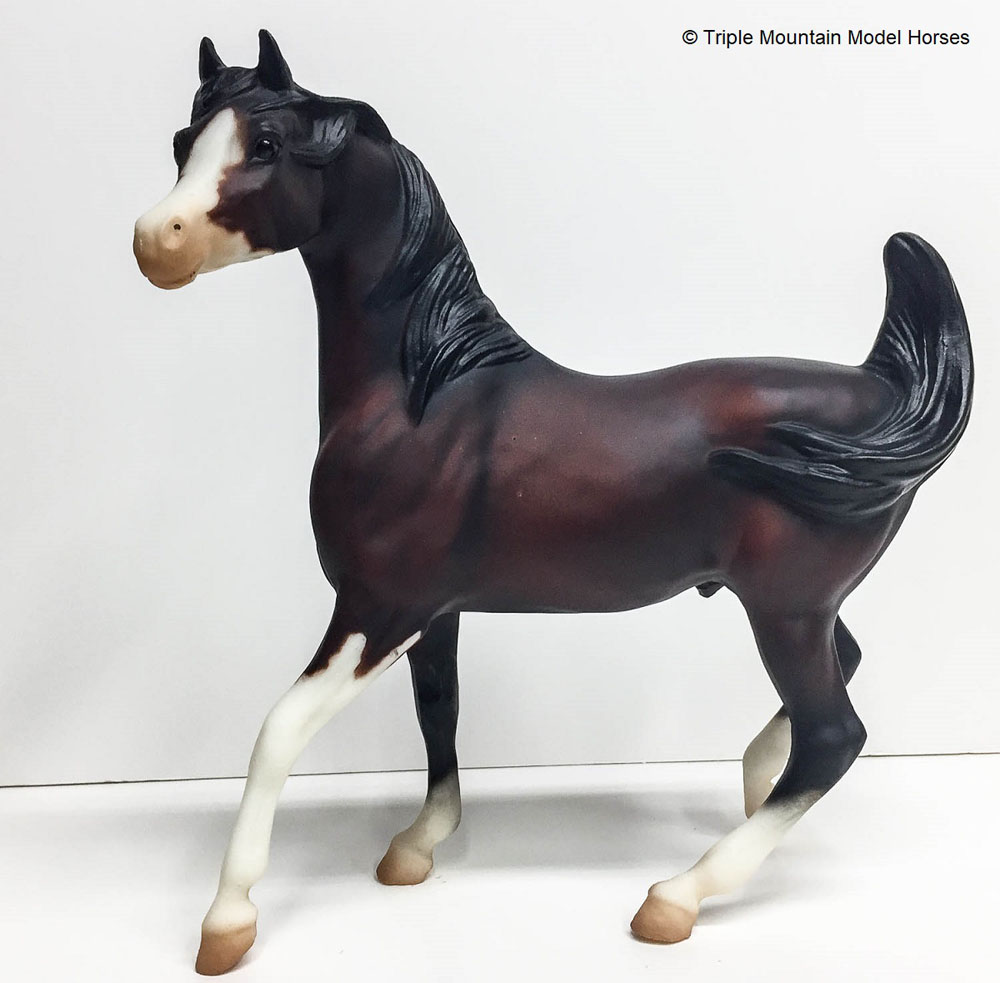
But who is the Foal on the right? I’m not sure! It’s either a Test Color that just happens to be very similar to the Liver Chestnut, or it’s a Liver Chestnut with a factory overhaul, and lots of extra dark shading and added black points.

There were a lot of Special Runs in the 1980s that were basically just updates of previous Regular Runs; the first ones that come to mind are two of the Montgomery Ward Christmas SRs: the Dapple Gray Shire from 1982-1983, and the Alabaster Old Timer from 1983.

There were subtle differences that distinguished those SRs from their Regular Run antecedents: the newer Shires tended to have fewer and more random dapples, and the newer Old Timers didn’t have the heavy gray body shading that the original #200 was known for.

So this subtly different Liver Chestnut Scratching Foal could have been a Test for a similar Special Run that didn’t happen.

The other theory is that – like some other Oddities that have popped up in recent years (the Palomino Family Arabian Mares with black points, et al) – it might have been something that a painter enhanced at the factory, either as a gift or for their own amusement.

There’s also the possibility that it was a Cull that Marney or one of her cohorts salvaged at the Chicago factory: it came out of a collection in Illinois within a reasonable driving distance of Chicago, with other oddities that obviously came straight from the factory. And touching up salvageable Culls with a bit of black paint was very much a Marney thing!

One this is certain, though: it’s not a Test Color for the original release of the Scratching Foal. The earliest Scratching Foals – including my Liver Chestnut one, above left – don’t have a USA mold mark, but my new dark and lovely one does.

Test Colors on the Scratching Foal are a bit hard to come by; the closest I came before was a Cull that I purchased off eBay from the family of a former Breyer contractor, also in the Chicago area.

The funniest thing about this situation was that I was making a few additions and changes to my BreyerFest want list, and the Scratching Foal was one of the molds I wanted to focus on this year!

Wednesday, February 14, 2018

Suckling Foal Oddity

I’ve been keeping busy the past several days by sorting through ephemera – both stuff that was pulled for research purposes, and “new” stuff that I’ve acquired over the past few years that I never got around to properly classifying and filing in the first place.

It’s almost as much fun as cleaning and sorting box lots of horses! Speaking of, I find myself presented with a particularly challenging little filly in a recent box lot acquisition:


The Suckling Foal from the original #3155 Thoroughbred Mare and Foal Set didn’t come in a lot of variations. It does come in Chalky, and it was one of the handful of releases that came in Gray Plastic without a Chalky Basecoat.

(The best known of those being the Elephant and Donkey, of course!)

But other than some slight variations in color and shading (lighter and darker) the Foal’s paintjob was remarkably consistent throughout its twelve-year run (1973-1984).

So when I found this one with two front stockings – well, she clearly had to come home with me.

The rest of the items in the lot weren’t bad either, but did not provide any hint of her origins. The seller was from a location not too far from Chicago, so that opens up the possibility of her being an Employee Take-Home. The paint job on the other side of her neck is a little uneven, too, which would be consistent with her being a finished Cull.

The only problem I have with her is that someone decided to spray some aftermarket gloss finish, and  they did a terrible job of it. Runs, drips, globs, lint and hair? She’s got them all!

Aftermarket gloss is not impossible to remove, but the fact that she’s a more-unusual-than-average oddity makes me extremely apprehensive about trying anything. So on the shelf she goes, with all my other rehab projects...

Friday, February 9, 2018

Another Oddball FAM

Here I thought I was doing pretty good earlier this week when I picked up an inexpensive box lot of unicorns through a local auction house. Even after taking out a few treasures for myself (the Hagens), I should be able to make a nice little profit from the rest of the lot at BreyerFest.

Then I saw what that Mahogany Bay Family Arabian Mare went for on eBay. Yikes! If only I could be that lucky.

Well actually, I have been, but my problem is that the really good stuff tends to stick around. The ability to own a rare and beautiful thing tends to trump whatever financial considerations I have – and it’s usually easier just to sell off things I am not as emotionally invested in, horses or otherwise, until the need passes.

Ironically, one of the models I had been waffling on has been my other Oddball/Test Color FAM, here hanging with a couple of friends:


Isn’t she lovely? She’s basically a mid-1970s Matte Palomino with a Palomino mane and tail, a simple yet surprisingly effective alteration. I assume she was another Factory Employee Take-Home, possibly a Cull that was fished out of the reject bin and finished for gifting.

I picked her up pretty cheaply several years ago on eBay, before Family Arabian Mares of any stripe were a thing. I remember being a little apprehensive about paying that much money for what was essentially a glorified Matte Palomino FAM.

It doesn’t seem as foolish a deal now. (Less than two percent of the Mahogany Mare’s selling price, if you’re curious.) She is staying: she only happens to be on my sales shelving unit because I am still in the process of reorganizing here.

I have to say, though, that I am as shocked as anyone that the Family Arabian Mare – who has been, historically, the least appreciated of the three Family Arabian molds – is now a “hot” item.

This is good for her, though not so good for me. I might have to find another lightly collected, underappreciated and cheap Traditional mold to obsess over now, or at least until this craziness blows over.

Wednesday, January 10, 2018

Another Oddball Stud Spider

Something short today. Work’s been running late this week and my brains feel like mashed potatoes right now.

In spite of my best intentions, I bought a horse this week. You can totally see why:


It’s a Stud Spider with two socks!

Like the #48 Black Morgan, the original Stud Spider release was prone to variations. I’ve seen multiple blanket variations, gray hooves, black hooves, missing stars, and oh goodness, the socks.

Right fore sock, left fore sock, four actual socks, no socks at all? Seen them all before, and own most of them. And now, another! As with the Morgan, an alarming number of Stud Spiders variations have turned up on my doorstep over the years. Few are turned away.

Most variations from the right front sock “norm” were incidental, occurring randomly within day-to-day production. (The four-sock version was allegedly a one-day production error.) They show up in the market with varying frequency; the left front sock variation seems to be the least difficult among them to find.

This two stocking combo is something I haven’t seen – or even had heard of – before. That’s saying something, coming from me.

It’s possible that he was some sort of Chicago factory employee “Take-Home” model. I have good reason to suspect it: it’s from the same Chicago-area seller on eBay who recently sold that oddball Palomino Family Arabian Mare with the Black mane and tail for over $1000.

That particular kind of oddball is actually semi-common: it seems to have been a thing back for employees back then to touch up botched Palominos Culls into quasi-Buckskins. Or even as production salvage jobs: every once and a great while I see a “Bay” Grazing Mare or Foal that suspect started life as a Palomino.

(“If we put black points on this we can totally pass this off as a Bay, right?”)

Friday, May 19, 2017

Splash Cull

Because of recent time constraints, I was expecting to pull the bulk of this year’s sales stock for BreyerFest from the herd (just the usual edge and hedge trimmings, no worries) but my wonderful flea market has other plans:


A framed print of English Triple Crown winner Bahram, by Wesley Dennis, and a Cull(!) of the 1998-1999 release Splash, on the Quarter Horse Gelding mold.

The Gelding was part of a box lot that included ten Traditionals in various states of disrepair. He was only keeper in this lot, while the rest will fill out a body box that is on its way to being as deep as last year’s horde.

He was also the only “interesting” model among them – everything else appears to be garden variety Regular Runs from ca. 1998-2000. While he is not in the best condition, his color is pretty and all his limbs are still intact.

And he’s a Cull. That I found at a flea market 15 minutes from my house. That is about 12 hour drive from New Jersey.

How he got there is a mystery. The dealer wasn’t able to give me any information: he hadn’t even noticed it was any different from the others.

The most curious part of the story is that the rest of the models in the lot were from roughly the same time period.

While it was not unusual for some Culls to make it into retail store stock even at that late a date, it was usually pieces in a more finished state. The hooves, the eyes, or the mane and tail might not be painted, but it could have passed for a finished model otherwise.

Though this dealer certainly didn’t notice, so maybe the previous owner/s did not, either?

A couple of other possibilities include (a) a friend or family member worked at the factory in New Jersey, (b) this might be directly or indirectly related to the “newtoymens” factory escapees.

Or it could be one of those random weird and unexplainable thing that just shows up from time to time. This flea market seems to be good for that.

Friday, November 25, 2016

Traditional Man o' War Cull

Because I apparently can’t help myself, I bought another oddball Man o’ War, too:


This one, unlike the other oddball Man o’ War I purchased earlier this year (the one missing the gold trim on his halter), is quite clearly a Cull. His halter is completely unpainted, his hooves are unfinished (no gray/charcoal overpainting) and his eyes, alas, his eyes:


That big eyeball splotch is what obviously got him tossed into the Cull Bin. All of his other failings – a seam split on his neck, the mildew dappling and most of the scuffs – happened later on in life.

The trimming flaw on top of his noseband was not atypical for the era (mid 1970s) either, but it wouldn’t have been a disqualifier. I’ve seen trimming flaws far worse than that on models from the 1970s that somehow made it through production and onto toy store shelves. Once painted, most average consumers (nonhobbyists) wouldn’t have given it much thought.

That was also the era where I “cut my teeth” as a collector, which goes a long way in explaining why it takes something pretty egregious before I get Reeves on the phone to request a replacement for anything.

So this means that I’ve officially added six Traditional Man o’ Wars to my herd in the past year – four variants/oddities of the original #47 release in addition to the Gold Charm Raffle piece and the Vintage Club Storm.

There were several more that passed through here in box and body lots that for one reason or another – no provenance, no distinguishing features, not pretty enough – didn’t pass muster.

Next year is the 100th anniversary of his birth, so you’d think it’d be logical to assume that we might see another possible Man o’ War release soon. But then again, this is the same company that gave us three Drafts SRs for the Chasing the Chesapeake Event, so maybe I shouldn’t pin my hopes on logic.  

Saturday, October 31, 2015

Black Appaloosa Surprise

It’s going to be a pretty picture day, because I’m still recovering from an unpleasant bit of something or other that’s left me dead tired all week; we had company over yesterday, which also didn’t help.

Anyway, here’s the pretty picture: it’s a cull!


Of the Black Appaloosa Running Stallion. A pretty nice one, too; whatever it was that caused him to remain unfinished is not obvious to me. He even stands really well, unusual for such a notoriously tippy mold.

Sometimes it wasn’t anything at all: things would get missed during the production process, especially on models where the finishing details could be subtle, such as the black(er) eyes and gray(er) hooves of an Appaloosa Running Stallion.

If it was noticed, it still might have been the end of the day, or end of the week, a quota had to be made, or an order had to pushed out of the door. Something like this could have been boxed, shrink-wrapped and sent on his merry way, with nothing illicit about his escape.

From his shading, spotting and coloring I’d guess he was a mid-1970s model, from the “White Picture Box” era (ca. 1973-1978). Every Traditional and Classic model back then was, essentially, a surprise model: sometimes good, sometimes bad, sometimes weird.

This guy was a gift from a friend, at BreyerFest, as a small way of helping me through some of the rough patches this year. She had no idea (or at best, only a faint inkling) of the special place the Black Appaloosa Running Stallion has in my heart. I bought one at the Kentucky Horse Park gift shop during my very first visit there – in 1979!

I still have him (of course) in addition to an early one with a Blue Ribbon Sticker and no USA mark I found at BreyerFest many years later. Interesting: that means all three of my Black Appaloosa Running Stallions (and none of the dozens of others that have passed through my hands, over the years) were acquired in or around the Kentucky Horse Park.

The only slightly bittersweet note to the newest one’s arrival was the revelation of his origins: sometimes a mystery is more powerful and meaningful without a subsequent revelation.

(I wanted to attribute his arrival to Ninjas. Or Fairies. Or the Elevator Gnomes. Maybe I will, the next time the story gets told.)

Saturday, April 18, 2015

Odd Western Horse Cull

I told myself that eBay was for research, and for the picking up of obscure bodies (Still looking for that cheap Traditional Kitten. A Khemosabi now, too.) but this guy ended up on my doorstep earlier this week somehow:


It’s an unpainted factory cull Western Horse, probably an older one from the late 1960s or early 1970s, but we’ll get to that in a moment.

I’m not normally a big buyer of Unpainteds/Blanks. All models start out that way, so the collectibility and/or novelty factors for me are pretty low. The only exceptions I make are for items that were sold that way as a Special Run (like the G1 Draft Horse in 1984), or examples of molds in an older and less modified state.

This Western Horse is one the latter, not the former. He’s definitely not a stripped model: his seams are uncleaned and unfinished, he has a few dark goobers floating in his plastic, and his hind legs are pinched together and bent slightly forward in a way indicative of a fixturing issue.

He is older - look at that lovely camel’s hump! - but how old I am not sure. He does have the USA mark, but we’re not sure when that was etched into the mold. The best guess is that this occurred about the same time the USA was added to most of the other Breyer molds, circa 1970.

I think this piece is roughly from that time period. My working theory is that he might have been part of the sample batch run shortly after the mold was modified. On what piece of evidence does this theory hang on?

He was purchased from a seller in California.

Odd Breyer whatsits have a habit of turning up in California. The first free-range In-Between Mare? Found in California. One of the first Gloss Gray Appaloosa Shetland Ponies discovered? Also California. Some of the earliest and most reliable rumors of Christmas Decorators? In California.

This Western Horse isn’t on par with any of those discoveries: at most, I think he might have been part of a sample batch sent to the Unger & Associates, who started out as one of Breyer’s earliest sales reps, and later became collaborators (Brenda Breyer? That was them.)

I think a lot of the Breyer oddness that comes out of California has something to do with that business relationship, actually.

For all I know, he could have just been another employee take-home or a part of a foster care/adoption donation box. I just him and I haven’t had a chance to e-mail the seller back for any additional information or confirmation of my suspicions.

If I do get any additional information, I’ll let you all know.

Saturday, October 12, 2013

Test Color Teasing

Just to show you that I am not always a complete tease, here are a few of those Test Color photos I mentioned in passing last time:


These are all fairly typical of the kind of Test Colors available to hobbyists in the 1980s, in terms of both molds and colors. Neat, but there’s nothing to them that makes them stand out from the regular Breyer rabble, especially to newer hobbyists or those not particularly versed in Breyer minutiae.

I wouldn’t mind owning any of them, mind you, and I suspect a lot of you feel likewise. Yet I rather doubt most of them would be competitive outside of Collectibility today. (That is a pretty shade of bay on the Phar Lap, though!)

The term "Test Color" is an awfully generic one: at its broadest and least specific, it can refer to any model that was not made as part of a production run. This could even include items that were once in regular production, but were not when it/they were produced. (My NPOD Big Ben might fall into this category, for instance.)

A Test Color could be a Cull, a finished/touched-up Cull, a happy accident (i.e. a mistake) of the painting process, a lunchtime frolic, misinterpreted painting instructions, a gift for a friend or family member, something done to fill up some downtime…

Or it could be an "true" Test Color: an item painted to demonstrate/illustrate/test a new or potential production run item, either a Regular Run or Special Run.

Some newer hobbyists, who are most familiar with the term through the BreyerFest auctions, tend to think of Test Colors almost as Factory Customs, since many of the ones that are offered for auction nowadays have a higher degree of finish than most production items. (I am always amazed that some get a little indignant when the tested color actually, you know, gets used a short time later. What do they think the word Test in Test Color means?)

The models you’re seeing above are likely the kinds of Test Colors that originated via Marney Walerius, a hobbyist who had somewhat free rein at the factory in the 1970s and 1980s. Sometimes she rescued genuine Test Colors from the various nooks and crannies of the facilities. Sometimes she fished stuff out of trash barrels and finished/fixed them.

And sometimes she made them herself: to satisfy a notion, to propose an idea to the Powers That Were, for compensation, or for various promotional purposes (live shows, raffles, tours, prizes, etc.) So in a sense, many Chicago-era Test Colors were Factory Customs, too.

Sorting this all out after the fact, as you can imagine, is something of a headache. An item that’s classified as a Test Color could have been multiple things: it could have been something Marney did on a whim, AND later got used in production somewhere along the line. True Test Colors were often given away as gifts or tokens of appreciation (or compensation!)

In most cases, it’s been easier to refer to a nonstandard model - something that goes above and beyond being just a variation - as a "Test Color", because more often than not, we will never know the specifics of its creation.   

Friday, June 7, 2013

Just Gotta Laugh Sometimes

(Before we begin the festivities here, it has been brought to my attention that the Youth Show prizes are going to be Glossy after all, thus rendering all the commentary about the switch to Semigloss moot. I can only hope that Reeves has been eavesdropping on the various forum discussions about the matter.)

Several days of epic awfulness was capped with me losing my car keys - inside my car. No, no joke. I drove from one job location to another, parked and waited for the supervisor to show up, took the keys out of the ignition, set them down to gather up all my other stuff, and when I got ready to get out of the car, I couldn’t find them.

I had not even opened the door at that point.

Coworkers completed two (two!) epic searches where we essentially tossed the car, but nope, no keys anywhere. Fortunately, I had an emergency key in my wallet, so I was able to get home without having to make a really embarrassing phone call.

But it still made me wonder who or what I could have ticked off in the past week. I’m not one to believe in gypsy curses, but you can make a rough guess at the kind of Google searches I was running last night.

On the plus side, I did get some nice things in the mail today, including a very entertaining batch of old hobby ephemera, a lovely time capsule of my own "golden age" of the hobby, roughly 30 or so years ago. Back when "pix" like this were state-of-the-art for photo showing purposes:

Soup Can Racing!

Still Life with Dead Cow!

Extraterrestrial Performance!

Nope. Not Going There.

And for the history portion of our program today, the kind of epic Culls/Tests/Oddities that we fought epic battles over:

Three Margarita Lunch Day at Breyer Plant!

Lest you are harboring any unkind thoughts, the person who sent this stuff to me is probably looking at all this and laughing right along with you. These photos (except for the Classic Andalusian Mare) aren’t any different, really, than photographs I or anyone else took back then. In fact, as I was doing a quick search through them this afternoon, I kept remarking "Yep, took one just like that, and that, and that…" 

This is photographic evidence of what the hobby looked like. And you know what? Looks like we had a pretty darn good time, in spite of our lack of technical or artistic sophistication.

(Speaking of: for dignity’s sake, I decided to forego all pictures where actual people were shown, because Mullets.)

(You’re welcome.)

Sunday, May 5, 2013

Great Breyer Graveyards

They just listed a few more items from the Big Hobbyist Auction on the Munda’s web site (May 24th) so I’ve decided to temporarily add the Munda’s Auction site to my link list, for your convenience. The listings this go round are slightly better, though much amusement will still be found there. ("Bat Pinto"? Batman had a horse?)

Like a lot of people, I’m currently intrigued and baffled by the eBay auctions of a vendor out in Arizona: what looks like variations, oddities, culls and outright test colors are being auctioned off in rapid succession, and in great quantity. I’ve already bought a couple of what I’d consider
"safe" lots, where I think my potential loss of investment will be minimal if they don’t turn out to be what I think they might be. The first one has already arrived:


A Fawn without spots, and a Doe with darker than normal ears? Yeah, I know, not the most exciting lot of Breyers ever, but remember who you’re talking to here. This is the kind of stuff I eat for breakfast.

There’s been much speculation about these models and their origins. I’ve done a little of it myself over on Blab, but I’ll expand and continue my thoughts here, for the benefit of a wider audience.

There are several locations that seem to be harbors or wellsprings for rare and odd Breyers. Chicago is the first, of course: that’s where the factory was for the first 35 years or so of production. Then there’s New Jersey, the current location of Reeves International, and where full-scale production continued for the next 15 years, give or take, and still continues on a minimal basis.

California is sometimes seen as another one of the Great Breyer Graveyards, though I think its plentitude is exaggerated, a bit. California is BIG, in every sense of the word, so it’s only natural that there’d be slightly more rare and unusual stuff coming out of California than, say, Kansas or Wyoming. I do think that the Decorator saga has its roots out there, due to the Ungers, toy development gurus and longtime Breyer Sales Reps who were also partly responsible for bringing us Brenda Breyer.

The location that has always fascinated me, however, has been Arizona. When I was just getting into the hobby in the late 1970s and early 1980s, I kept hearing stories about crazy things being found at the flea markets in Arizona. I had relatives out in Las Vegas, and whenever it was casually mentioned that we might go on a road trip to visit them, my thoughts always turned to those magical flea markets I heard so much about.
(The furthest west we got was Arkansas. It involved Elvis, the Kentucky Horse Park, a liquor store, and Breyers. Of course.)

A few years ago - when I was working for an antiques dealer, who also was a story unto himself - a number of lots came up on eBay from a seller in Arizona. Lots with multiple pieces of the same item - a half dozen Bassett Hounds, or Benjis, or Charolais Bulls - and one spectacular collection lot with multiple bulls in colors I had never seen before: Brick Reds and Browns and Chocolate Milk Sorrels.

I tried for the lot, but naturally failed: I think it went somewhere in the $4000 to $5000 range, which isn’t as outrageous as it sounds, considering that there were at least 10-12 of those bulls in it, not including the more "normal" looking stuff that was thrown in for good measure. Even at that price, money could have been made.

They looked authentic to me, and apparently, it did to a lot of other people, too.

Since then I’ve always kept a lookout for auctions in the Arizona area, just in case. I’ve come across a few treasures, but I missed this vendor’s auctions earlier this year because I’ve been trying to keep my eBay shopping to a minimum. I was doing so good, until this week!

As to why Arizona, that’s still something of a mystery. Longtime mail-order company Horses International was based in Phoenix, and had many unique Special Runs of its own: perhaps these were samples from the warehouse that somehow came into someone’s possession?

Another theory that I’ve been mulling over is that these were somehow connected to Breyer’s little adventure in Mexico in the late 1970s. Peter Stone got a wild hair and thought that they could move production to Mexico, an endeavor that likely failed due to infrastructure problems. Most - though not all - of these models seem to be from that time period.

It could be that there’s a more mundane reason. Like all of the other Sellers of Unusual Breyers of Dubious Provenance, this seller is not being terribly forthcoming about their origins. Whether it’s because he’s got something to hide, or is just bluffing to cover his lack of knowledge, we also do not know.

All I know is that I performed the Lestoil test on the two most peculiar pieces in my Deer Lot - the Doe with the dark ears, and the spotless Fawn - and nothing but a little dust and dirt came off. 

Wednesday, April 24, 2013

Oh, The Things I See

Something short and rambly today, since I haven’t gotten any appreciable sleep since, oh, Sunday? (Scheduling issues, again. Not just me, but everybody.)

The special project/secret mission/road trip is kinda on hold for a week. Don’t worry, it’s still a go, and you’ll get all the details about it, in good time. A few weeks ago telling myself that I was ready for a new adventure. Silly me, not expecting the Universe to actually honor one of my wishes, for once…

I am aware of the Chalky Dapple Gray Shire on eBay, and I might have some interesting news to share about that particular topic in the not-too-distant future.

Yes, I’ve seen those prototypes on eBay, too. The sound you hear in the background is my check book laughing at me. Not enough money + slow computer + even slower Internet connection = no prototypes for you!

I have also seen those New Jersey cull lots. Culls, I have plenty of, so those I am not muttering to myself about.

I am a bit shocked at some of the prices they’re bringing, since I can remember being able to buy ‘em for 5-6 bucks back in the good old days, when they were little more than remaking fodder. We laughed - really, we did - at the thought that people would pay a lot for them in the future.

Not because we thought they were worthless, but because they were so plentiful at the time, and cheap. We did assume that they were going to go up. Mostly because we had been told that Reeves would put a tighter cap on factory escapees. Fewer culls = increased rarity, and all that jazz.

So funny, I know. I’ve heard the stories, too - about the New Jersey dumpsters being trashpicked, and truckloads of bodies being "rerouted" to the flea market, and not the landfill. The only thing that truly stopped that from happening was moving production overseas. And not having too many crazy hobbyists living within a reasonable driving distance of China.

In spite of that, I do think there’s probably an upper limit to the pricing on culls: there still are a lot of them out there - in and out of collector hands. They’re not everybody’s cup of tea, either. They were discarded for a reason: otherwise unpainted horses with some paint spritzed or splashed on it are not always very attractive.

Most hobbyists like their horses "finished" in some way - even if it’s just a pure, solid color or a faux "stone" or "fantasy" finish.

With that thought in mind, here is a picture that gives you a hint of what I’ll be talking about next time. It’s a topic I touched briefly on Blab, but I’ll elaborate on it here in greater detail, after a night or two of more restful sleep:


Sunday, October 7, 2012

Sometimes, I Have No Clue

I was going to get so much done this weekend, then WHAM - hello, migraine. And not some crawl-in-the-basement-and-sleep-for-three-hours one, either. This sucker lingered.

On top of that, the Vita was sick, too, so at one point during my extended weekend I was outside, nauseous, shambling around in the rain, waiting for her to lose her lunch as well.

So, instead of getting caught up, I am now even further behind. No long, lovingly researched post for you!

Instead, here’s a picture of some oddity I picked up at Model Horse Congress back in 1985 or 1986:


I think he’s a cull, but I’m not entirely sure. (His condition is a little rougher than the photo lets on.) Breyer had stopped using the pinto mask on the Western Horse about 10 years earlier, and it would be a few more before they’d pull it out again for the Chestnut Pinto Just About Horses Special in 1990. So he might actually have been a test for … something else? I knew he wasn’t that old, because his color was not dissimilar to the acidic yellow palominos Breyer was cranking out at the time. 

The reins are obviously not original, but I can’t recall if the saddle was. I honestly can’t remember. That was when I was just starting to hit the flea markets pretty seriously, and Western Horses and Ponies were still fairly plentiful, if not in the best condition. Sometimes I’d buy something just to salvage the reins or saddle from it.

(People were a little less particular about the bodies they were willing to customize back then, too. Partly out of necessity, partly out of youthful exuberance.)

I’m also almost certain that the eyes and hooves were touched up later, too, but I never bothered to "fix" them because I couldn’t be 100 percent sure that they weren’t. Plus, I just couldn’t bear the thought of having an unfinished model standing on my shelves.

I’ve since gotten over that sentiment. This weird old boy's been grandfathered in, though. Sometimes it's best to leave some mysteries to be. 

Monday, February 13, 2012

White Jumping Horses

For your viewing pleasure, pictures of the White Jumping Horses mentioned in the previous post. First, the QVC SR Gem Twist, in a semi-chalky finish:


He’s not super common; one of the many QVC Special Runs that flew under the radar, due to a lack of promotional support. He was one of those weird reissues - like the San Domingo "Traveler" - where they put the paint job distinctive of the original release on a completely different mold.

It’s an interesting, and a not unappealing idea. Five-Gaiter Sorrel on a Clock Saddlebred? Yellow Mount on the modified Stock Horse Stallion? The old Leopard pattern from the POA, on a Bouncer? I would buy most of these.

I suspect others would, too. Especially the Sorrel on the Clock Saddlebred; I think he’d look great in that color. (Semi-gloss - with eyewhites, of course!)

Here’s the Jumping Horse that I found in the Bentley Sales dump bins at Model Horse Congress, back in the Dark Ages. He originally came with a factory unpainted jump, which I still have; when I do display him, I usually put him on one of my spare painted jumps, for a dressier look.


I’d actually classify him as a borderline Test Color/Cull, since he doesn’t have a lot detail on him, outside of his head, and there’s a little roughness to his body texture that suggests he may have spent some time in a cull bin. I still think he’s pretty darn cool, regardless. He was one of my earliest Tests/Culls, so I have a lot of sentimental attachment to him.

Most of my Jumping Horses are not out for display right now, because like a few other molds that shall remain nameless, he takes up way too much shelf space. I used to have a substantial number of variations of the Bay - whose sock variations verge on the countless - until I realized that I’d never be able to display them in a way that would do them justice.

I still have more than an average collector should have, though. Just not as many as I used to.

I’m taking it as a very, very bad sign that I have already given the Best of British Contest Prize Horse a name, in the exceedingly rare possibility that I might win one. It’s based on one of the ideas I’m thinking about for my entry, so of course I can’t tell you what this cool name is.

This idea I’m mulling over at the moment will likely go over the heads of the judges, again; I have a bad habit of being a little too clever for my own good. I sure wish I could figure out what the judging criteria for that contest is, because some people seem to have figured it out.

And regarding the Costume Contests, I think I need to remind some of newer or more casual readers that I was Princess Beatrice last year. I could potentially use it - with a little modification - for either contest, but using it for both might be tacky. I do have another idea for the Poppycock Parade that might be worth pursuing (funny + only slightly inappropriate) but I might not be able to fit the components in the vehicle, on top of all the other things I usually bring along.

Argh! It’s way too early for me to be spending this much brainpower on anything for BreyerFest!

Saturday, September 11, 2010

On a Lark

Lots of good stuff in the JAH this week (including me!), but I’d rather talk about a recent addition to the herd today:


Yeah, a Rugged Lark cull! The money situation being what it is, I shouldn’t have laid out the cash, but I felt sorry for him. He’s about as low on the totem pole of desirability as you can get. And weirdo me, I just had to have him.

I’m pretty sure he’s a cull: his forelock is unpainted, his lower legs were unfinished, and he lacks shading in the usual areas. The paint on his mane is rather sloppy, so that’s how he ended up in the cull bin in the first place. It looks like someone touched up his hooves and face a bit to make him more presentable.

Well, as presentable as a Rugged Lark can be.

His head and neck are pretty tragic, but I don’t completely dislike the mold. It’s the pose that he’s been sculpted in: I find his inherent awkwardness appealing. Too many model horses - OF, customized, resin, whatever - are a little too conventionally or artfully posed, and in the process come off as a little less realistic, at least to me.

I can remember being in my life drawing class, years ago, and the instructor imploring us to not shy away from the awkward poses. (These were people we were dealing with, by the way, not horses. Naked, and rarely the most attractive, either.) Our bodies can get into all sorts of awkward positions, and those positions can be beautiful, too, if done well.

Rugged Lark’s problem is that sculpturally, he’s not done well. I’m not a stickler for anatomical accuracy, but even I have my limits. (Unrealistic and unattractive are two different concepts: unfortunately for Rugged Lark, these concepts collide.) I’ve been tempted to get a Rugged Lark body and clean him up - while retaining his basic body pose and attitude - just to prove my point about the awkwardness. Customizing is something of a low priority in these parts, alas, so the point going to remain unproven for now.

The Rugged Lark mold hasn’t come in a very wide range of colors. Two bays, two chestnuts, a gray, and very briefly in a rather nice dark bay pinto. The only piece anyone even remotely wants is the BreyerFest SR of The Lark Ascending back in 2003, and that’s only because he had a very limited piece run (500) and a pretty nice paint job. I missed him back then, and had hoped to add him to my collection by now but so far, no luck. He's an expensive little bugger, especially on my budget!

For the time being, I’ll just have to settle for my cheaper, funkier, not-quite-bay boy.

Monday, June 28, 2010

Condition Issues

Would you believe I found another MasterCrafters Clock? This one is the "Swinging Playmates:"


I’ve wanted to start a collection of the Breyer-based MasterCrafters stuff for years, but most of the pieces I found were either way too expensive, or way too trashed. And now I’ve found three in the space of one year!

That sort of nonsense happens to me all the time. I spent many fruitless years searching for a Balking Mule, only to find three in the space of a week. There were several consecutive years where my flea market season was not complete without at least one Charcoal Fighting Stallion turning up. And let’s not even get into my issues with the Black Stretched Morgan: I love the mold dearly, but I find so many of them I sometimes feel like they’re stalking me. (Why can’t one - just one! - of them be a Woodgrain?)

I found lots of other good stuff, too, including a gorgeous and extremely matte-finished early Bay Fighting Stallion with footpads; I was a little hesitant to buy him at first because he seemed a bit rough, but he cleaned up well. The only sure keeper in the bunch for me, besides the Clock, is this Classic Arabian Foal cull:


I suspect he was an honest accident, and not a hobbyist’s piece that arrived there via an estate or garage sale. Every once and a great while an unfinished piece will turn up in a family set from the 1970s or 1980s. It was nothing nefarious; quality control was just a little more lax back then.

I bought models off the shelf in the 1970s: rough seams, painting bloopers, fuzzy gray socks were a par for the course. When you were shopping for a potential show horse, you didn’t worry so much about conformation or breed type: what you hoped for was something reasonably free of major paint or body flaws. I roll my eyes every time someone whines that "they don’t make Breyers the way they used to." Yeah, they sure don’t: they make them better.

Speaking of condition issues, the Foal was found in a rather large collection of horses, mostly dating from the 1980s. They were a reasonably decent lot, quality wise, except for one thing: most of them were mildew dappled. It was a shame, since some of them had beautiful paint jobs. The prices were reasonable, so I picked out a few of the choicer items, and left the rest behind.

Mildew dappling is most often seen on models with matte-finished bay, chestnut or palomino paint jobs, usually from the 1970s or 1980s. The mildew attacks and eats at the topmost surface of the paint, creating an effect not unlike resist dapples. Whenever I see a listing on eBay or MHSP that mentions dappling on a vintage model that’s not supposed to be, I almost always assume mildew is at fault. There are a few genuine vintage test colors of dappled non-grays, but they’re pretty rare and fairly distinctive.

Why models of that time period are prone to mildew is unknown. By that time, the clear topcoat that was sprayed over most matte-finished models had been discontinued, and I suspect that that’s what was preventing the mildew from forming before. It "sealed" the plastic from direct exposure to the mildew spores. That might explain the absence of widespread mildew damage on Alabasters and Dapple Grays: they continued to get this topcoat for some time after it was discontinued elsewhere.

There’s not a lot that can be done to reverse mildew damage. I’ve found that a quick, modestly strong bleach bath helps. It doesn’t eliminate much of the dappling, but it does kill off the mildew and keep it from spreading.

My clock also had some condition issues, but they’re mostly internal: like my previous find, the clock mechanism doesn’t work. Oh, the irony - the only one of my three Swingers that works is the rather sad one now residing on my saleslist.

Thursday, January 28, 2010

Some Kind of Blue

I love watching shows about hoarders: there’s something fascinating about the psychology of persons insulating themselves from the world with massive amounts of stuff. I have a lot of stuff, too, but it’s all neatly organized and contained, and I don’t have any issues with purging things when I need to.

Part of the appeal of those shows for me is that I’m currently dealing with a semi-hoarding situation at home: not me, but my family members. It’s come to a head this week with a long-delayed home remodeling project that includes the space in which I work, and keep the larger part of my collection.

Everything in those two rooms has to be removed, and much stink is being made about how much "stuff" I have. The fact that the rooms now being used for storage were already packed to the ceiling with everyone else’s stuff is irrelevant: the mess is somehow all my fault.

It wouldn’t be so bad if the progress was so slow. There’s no impetus to get the job done in a timely fashion; the only person whose life is being severely impacted is mine, and apparently that’s completely okay with everyone else involved.

I’m not quite sure what to do with myself. If the next few weeks - or months - of posts have a more somber tone than usual, now you’ll know why. The one small physical domain where I had a small modicum of control is currently not in my control. And I’m not happy about it.

I may be feeling a bit blue, but this Buckshot isn’t:


The Buckshot mold debuted in 1985, the same year I found - and purchased - this intriguing horse from Marney, at her post-Congress garage sale. He’s probably a cull of the original release of Buckshot; he has all the characteristics of a #415 Buckshot, except that his distinctive blue-gray base color missing.

I presume he’s a cull, and not a test color, because of something you can’t see in the photograph, and something I can only describe to you due to my current technical difficulties: he has a blotchy, blobby blue dorsal stripe. It’s not unattractive or unrealistic, but it was enough to send him to reject bin, and from where Marney must have rescued him.

What I can’t answer is whether he was discarded "as-is," or if Marney found him in a less finished state, and completed the job. She did a lot of that; many culls could be made passable with a touch of black paint.

What’s intriguing about this "accidental" test color is that he may have been more influential than many an intentional one. Within a few years, we had a number of Breyer production pieces in this color, including the #830 Quarter Horse Stallion (on the Adios mold) and the 1989 JAH Special Quarter Horse Yearling.

Breyer usually described models with these paint jobs - both the gray/black, and the chestnut version that slightly preceded it - as roans. But depending on the size of the spots, or the scale of the horse, they were also labeled fleabitten grays, or even Appaloosas. It may not seem like a big deal now, but they represented a startling change of pace from the almost comical "big freckle" roans of the early 1970s.

The problem was that they were not really a good representation of any of those colors or coat patterns. I think most collectors realized that this new painting "style" was a transitional step towards more realistic roan, fleabitten gray, and Appaloosa paint jobs. As Breyer’s painting techniques improved, many of these models from the "light roan" era have been dumped into the fickle, saturated aftermarket.