Showing posts with label Buckshot. Show all posts

Sunday, May 14, 2023

My Little Noriker

This week was a rough one, and I was feeling pretty blue by the end of it. So I decided to make a detour to work yesterday and buy myself something blue to cheer myself up, making the assumption that it was going to be the new Patriotic Web Special Washington. 

There were, indeed, several to nice examples to choose from, but something else blue caught my eye instead: the Blue Roan Brabant!

His paint job is very reminiscent of the original #415 Buckshot, right down to the “is he, or isn’t he?” Appaloosa vibe. So much so that I thought Reeves missed an excellent opportunity to label him a Noriker instead. 

The color for Buckshot was never clearly defined: it was sort of a combination/mashup of Blue Roan, Appaloosa and Grulla, and there was so much variation in the model’s modest four-year run that all of those labels fit to one degree or another, often simultaneously. I am not quite sure they even knew back then anyway: his color was (rather unhelpfully!) labeled Grulla (Blue Roan) in the 1985 catalog. 

The color wasn’t unique to Buckshot: it did appear on a Special Run of the original Hess Belgian in 1986. That release originally was going to be a reinterpretation of the Belgian’s original Smoke color – but with a black mane and tail – but due to customer feedback and some miscommunication, he ended up getting painted like Buckshot instead. 

Thus creating, unintentionally, Breyer’s first “Noriker” release, even if he wasn’t officially labeled or sold that way.

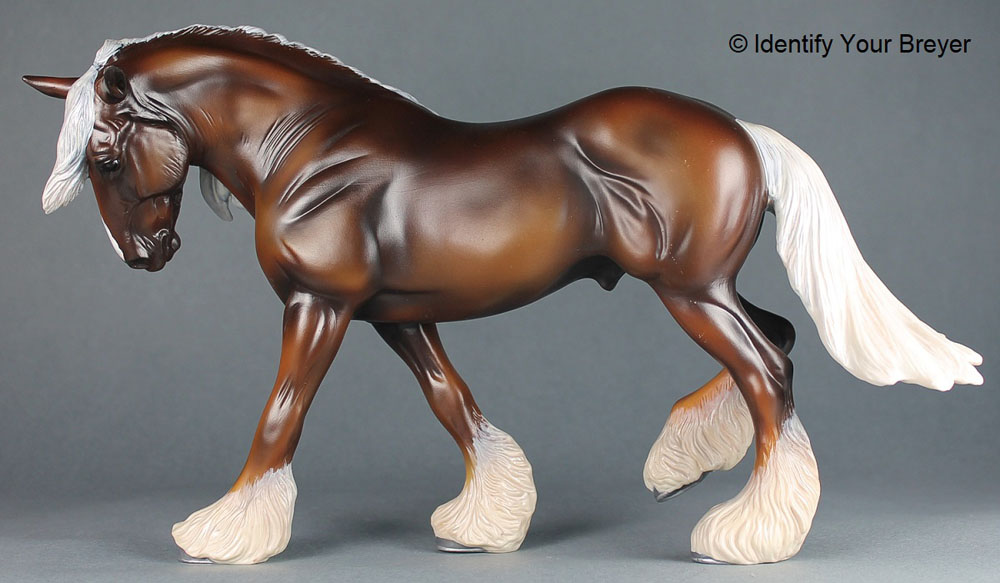
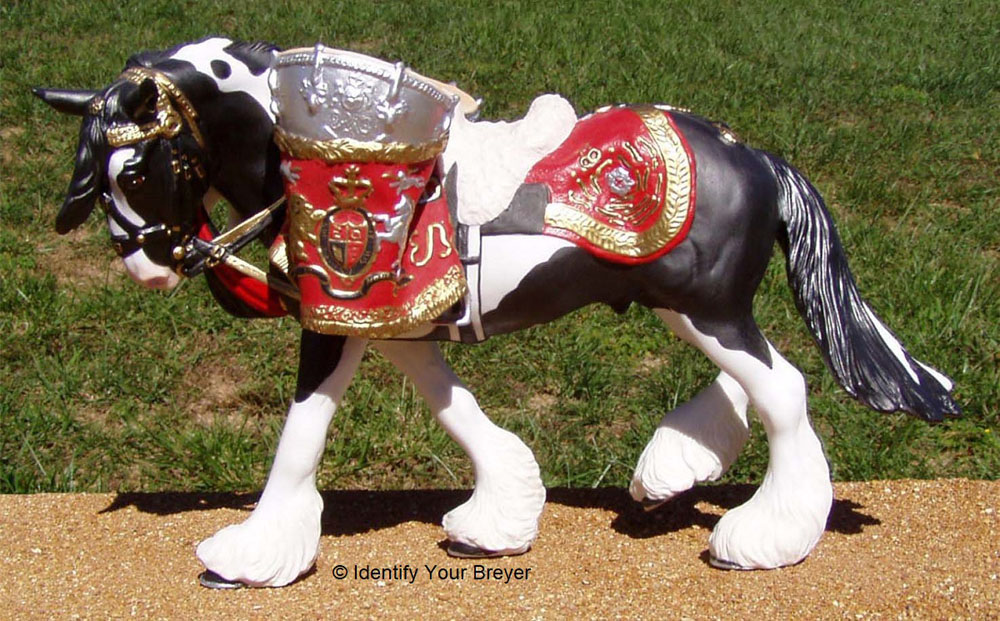
The first true Breyer Noriker was 2001’s Fine Porcelain Model Moritz, an untacked adaptation of Kathleen Moody’s Porcelain Household Cavalry Drum Horse from 1999. The untacked version of the mold was finally translated into plastic for the release of the 2007 Holiday Horse Winter Song. 

Although the mold now known as Othello was later released in Appaloosa as the Redemption Model for the 2010 Treasure Hunt, it wouldn’t be until 2020 that we’d get an Appaloosa Noriker that was identified as such: the BreyerFest Special Run Oak, on the Georg mold. 

Alas, my dear little Brabant has a factory scrape on his chest that probably limits his potential show career; I have plenty enough models in the stable more urgently in need of repair.

Friday, October 25, 2019

The Forgotten Generation

Star Wars tickets were successfully purchased, with a minimum of drama. And why yes, I am super-excited about the SPACE HORSES.

The connection between the model horse community and the science-fiction one is long and well-documented, so I will be very disappointed in you guys (waving hand at entirety of the model horse community) if I don’t see any Orback customs by BreyerFest at the latest. Get to it, everybody!

Anyway.

I only just skimmed my issue of Just About Horses (it arrived yesterday) so I’ll leave that for another time, other than to express the sentiment that I am sure is on the lips – or in the thoughts – of many model horse hobbyists: an injection-molded Akhal-Teke, at last!

No, what I want to discuss today is my annoyance at some of the early 70th Anniversary merchandise, like this Journal here:


(There’s also a blanket and a beach towel.)

Conceptually, these products should appeal to me as both a quilt designer and a Breyer historian. And at first glance, they did.

But then I took a closer look at it, and realized that… this was not terribly well-thought out or well-executed.

I think they started out with the idea of seven different models for each of the seven different decades, but started taking some liberties with it when they realized there weren’t that many horse molds released in the 1950s.

And by the end of it, it looks like they just decided to use whatever silhouettes they had on file.

Not only that, there are a number of historical errors in it. The Family Arabian Stallion probably debuted in 1959; the Family Arabian Mare debuted ca. 1960, not 1958 – that was the Old Mold/Proud Arabian Mare; the Running Mare was probably released in 1962, not 1961; and of course, the Zippo Pine Bar was a 1999 release, not a 2007 one.

(The graphic for Zippo obviously being cribbed from the 30th Anniversary BreyerFest graphic without being properly edited, I presume.)

I am also not thrilled that, like the generation that grew up on them (frantically waves hands) – models from the 1980s were largely ignored. Only four models from that decade were included, but three from the last two years – Bristol, Hamilton and Georg – were?

Not cool, Reeves. 

While it may be true that the 1980s were considered the least artistically successful decade in Breyer History, many of those molds are still in active use today. I’d consider some of them more historically significant – at least, at this moment in time – than newer releases like Latigo or Desatado.

Phar Lap (1985) was used for the first BreyerFest Celebration Horse Dr. Peaches; Buckshot (1985) has appeared as a BreyerFest Raffle Model, Prize Model, and Live Show Benefit Model (Winchester, Pele and Reno, respectively); Roy (1989) was sculpted by the legendary Francis Eustis and recently used as a BreyerFest Celebration Model; and Secretariat (1987) was Chris Hess’s last official sculpt for Breyer and also Secretariat.

So I would have swapped out a few of the 2000/2010 models with a few of those, and maybe included the Fury/Prancer and one of the Nonhorse molds (Boxer or the Brahma Bull) from the 1950s to even things out a bit.

But what do I know, right?

Friday, October 4, 2019

Appaloosa Drafters

Yes, I am aware of the new shrunkified Traditionals and Classics in the latest (Series 3) MiniWhinnies now available at Walmart. And I am trying very hard to not think about them, since (a) I bought too much last week as it is and (b), I do not have time for this nonsense right now.

She’s not a new mold and she’s being released in a quasi-Decorator color (Matte Gray Appaloosa) that’s never been wildly popular among collectors, but I don’t care, Priscilla is my favorite Stablemates Club release this year (so far):


Like Matte Charcoal, Matte Gray Appaloosa doesn’t get a lot of love in the hobby – which is a shame, because when it’s well-executed – as it is here – it can be a very attractive color.

I can remember a time when Draft Horses with Appaloosa marking were an exotic and somewhat daring thing in both the “real” and model horse world. Norikers were one of the first “obscure, but cool” real-horse breeds that one learned about in the hobby back then – primarily as a way to justify some of your customizing choices!

However, the first Original Finish Appaloosa-flavored Draft Horse didn’t appear until 1986 – and it was almost completely by accident:


The Belgian was originally designed to come in a somewhat more mundane shade of gray – a variation of Smoke, actually –as seen in the original Your Horse Source flier:


(Beligans? LOL!)

But apparently that color was not well-received when it was shopped around to mail-order retailers, who requested something “more like Buckshot”.

Buckshot was the hot new item in 1985, mostly because of its fairly complex paint job (for the time). Initially they tried selling it as a Grulla AND a Blue Roan, but somehow forgot to mention the Appaloosa part:


Anyway, long story short, we ended up with… an Appaloosa Belgian! He was something of a thing back then, but he’s not so hard to find now – I just took a quick lookie-loo on eBay and found three, all well under a hundred bucks.

Friday, June 16, 2017

Blue, Not Blue

Apparently there’s a new “surprise” in the Blind Bag Stablemates Assortment that hit Cracker Barrel Stores this week – a metallic blue with black points on the G4 Endurance - Arabian mold.

But the two nearest Cracker Barrels to me are 45 minutes to an hour away, and judging from the reaction he’s causing online, I’m not even going to try. I just can’t take that kind of time out of my day anyway, this close to BreyerFest.

So that makes two “rare” Stablemates that were basically not distributed in my area. The Breyer supply here is good enough that I really can’t complain about getting my fair share of ponies, but I did “cut my teeth” on Stablemates back in the day, so it does hurt a little bit, nevertheless.

I had a ton of other stuff distracting me this week (and coming weekend), so here’s another short tidbit to keep you while I get back to the proverbial grindstone:


This is not the same Buckshot one auctioned off on eBay this week. When I saw the price that one went for, I blinked a few times and went “Oh, really now?”

(As handy as a thousand or so dollars could be right now, mine’s not going anywhere.)

But he’s a useful example to illustrate this point: very few Test Colors are truly unique, especially “vintage” ones. The only thing that really distinguished these two Buckshots from the standard production version is the absence of one step in the painting process: the blue base coat.

So is it possible that there might be more like these guys? I wouldn’t rule it out! Especially when you realize that a model like this is a result of less work being put into a piece, rather than more: basically, they are culls that present as “finished”.

For what it’s worth, the fact that something isn’t unique doesn’t necessarily diminish its value. Sometimes it even enhances it: you might not even consider bidding on something that’s truly “unique”, but something that exists as a group seems within the realm of possibility – and bid-ability.

Thursday, January 12, 2017

In Glorious Black and White

On the heels of last year’s Diorama Contest Prize Pele, we now have Live Show Benefit Horse Reno, on the Buckshot mold. In an intricate Gloss Black Frame Overo Pinto:


I wouldn’t mind taking one of those home! It doesn’t look likely that I’ll be able to attend any live shows this year either, so he’s another Rare Shiny (partially) Black horsey that I’ll just have to admire from afar.

Here’s a little factoid worth pointing out regarding Pele: while the greatest number of entries in the BreyerFest Diorama Contest is usually in the Over-20 Age Bracket, that wasn’t the case last year. I believe it was in the 10-14 Age Bracket!

If the number of entries indicates the general level of interest in the prize itself, it was a younger group of hobbyists who were the most interested in a Buckshot, for once!

A notoriously tipsy, thirty-year-old mold with “artistic” conformation?

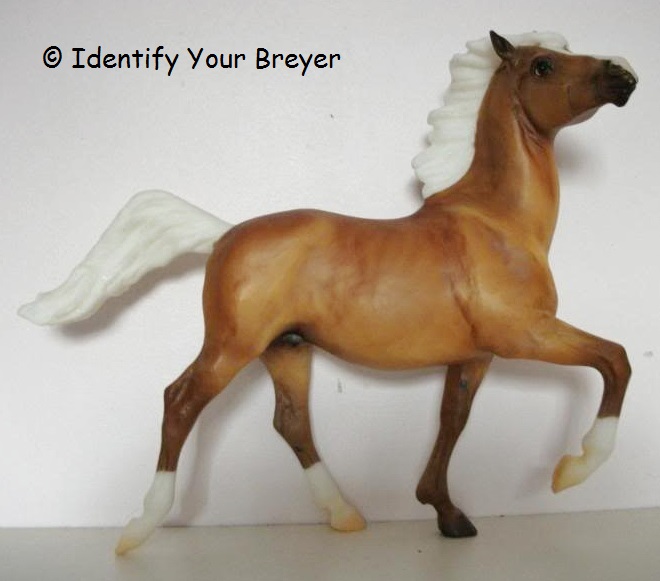
It does seems curious, until you realize that there was a Palomino Buckshot release named Rascal a few years back – in 2009 and 2010, to be specific. He was a part of the “My Favorite Horse” series, which was specifically designed and marketed for younger/newer collectors.

http://www.identifyyourbreyer.com/images/1361a.jpg

Judging from the number of Diorama Contest entries last year, that program obviously succeeded! Some of those kids got a little bit older, stayed in the hobby, retained a fondness for the Buckshot mold, and were motivated enough to enter.

I know some hobbyists are making squishy faces at the thought of another Buckshot prize model, but I think they’re just tailoring the Live Show Benefit Horse to a slightly younger crowd this year. The past two models – 2015’s Western Pony Razzmatazz, and 2016’s Fury Prancer Chase – were more esoteric and targeted for older and/or more experienced hobbyists.

Some of us grayhairs like Reno too. Will he be motivation enough for me to find the time and money to attend a live show this year? That I do not know.

Just one minor housekeeping note here.

Since I am in the busy season at work and consequently not home much, my selling activity will be greatly curtailed or even nil through January and possibly part of February. As soon as I am able, I’ll try to start tossing a few odds and ends up on MHSP.

Saturday, June 18, 2016

Tipsy

This guy arrived in a recent body box lot, and is worth a further examination. Notice anything odd about this #415 Buckshot?


He seems to be a standard issue Buckshot in very good condition with a decent paint job and no significant flaws, other than…


That Hind Hoof. What the heck happened there?

The Buckshot mold is notoriously tippy: he has rather narrow footing, and an elongated pose that ends in an almost solidly-molded tail. It’s like he was designed to tip over.

Part of the problem probably lies with the fact that his sculptor, Bob Scriver, was more accustomed to working in bronze, not in injection-molded plastic. As you might imagine, the weighting and balancing issues are completely different!

Some of that could have been corrected during the actual moldmaking process, but sometimes there is only so much you can do before interfering with the integrity of the original sculpt. And with the sculptor being Bob Scriver, Breyer probably wanted to avoid that.

I have – and have had – a number of Buckshots that stood up just fine. But it doesn’t take much in the way of a variance – fraction of an inch here, a tiny bit of extra plastic there – to make him tip over like me in a pair of platform shoes.

It’s never been a huge issue in the show ring, because he’s never been popular piece to show. I have a couple of Buckshots – an early, extra dark one, and a finished cull/quasi-test – that I did live show, but I “solved” the tipping problem by laying them down on neatly trimmed pieces of fabric.

It was Buckshot: judges understood.

Anyway, Breyer obviously made an attempt to “right” this particular piece by grinding down one of his hooves. It was a technique they used quite frequently on their less stable molds; I have several Pacers, for instance, with all manner of factory hoof deformities.

You would assume that they ground it down to the point where it stood on its own, right? You would think they had to have tested the piece before it finished going through the production process.

The thing was, this technique rarely worked: most vintage models I find with trimmed hooves still don’t stand properly – or at all. As is also the case with this Buckshot.

Either the workbench or carts where the prep work took place were also not level in some way, or they just decided at some point to shrug and say “good enough”.

I’m not sure if any work has been done on the mold recently to correct its tipping issue. The newest of my Buckshots is Monty Robert’s Shy Boy, from 2002-3, and I can’t recall if he was prone to being prone. All of my Buckshots are in storage, because I can’t have anything out right now that cannot tolerate a stampeding terrier.

I’m going to hope and assume that, being prize models and all, that the Diorama Contest Pele models will be upstanding citizens.

Friday, April 1, 2016

At Last, Another BreyerFest Buckshot!

You can tell that the Early Bird Ticket deadline is approaching, with not one but three different releases announced this week.

Two were obvious, or semi-obvious: a Bobbi Jo in a minimal Chestnut Pinto, and the “Samba” Surprise, which suggests to me either the Marwari mold (the Dancing Horse of India) or a Croi Damsha (whose name means Dancing Heart). The only thing dissuading me from those two ideas is that they were both released on very well-received BreyerFest Special Runs last year.

Releasing the same mold as a Special Run in consecutive years is not unheard of, but I’d like to give Reeves a little more credit and originality than that, in spite of evidence to the contrary. (Part of my mild apprehension to the Brahma Bull release Zebu is the name: calling a Brahma Bull release “Zebu” is like naming a Holstein Cow “Dairy”. Really, guys, that is the best you could come up with?)

So it’ll most likely be something else that’s a little less popular and more vaguely prancy, like a Ranch Horse, Rejoice, or Marabella. I also wouldn’t mind a Western Prancing Horse, but I’d rather not spend time tracking down any rare ones that would inevitably show up in a Surprise release, so forget I even mentioned it…

I like the Bobbi Jo, though I thought they’d go with something a little further away from the Premier Club release’s Red Dun Overo, and the Vintage Club Charlie in Chestnut Appaloosa. I do love minimally marked pintos, though, so I’ll definitely keep her under consideration.

But the one release that was a genuine Surprise – and a bit of a delight – was the Diorama Contest prize Pele – a Gloss Dappled Bay on the Buckshot mold?


Well, hello there, handsome. 

Didn’t see that one coming. The Buckshot mold has only been seen once before on the BreyerFest “circuit”, in another Solid and Glossy and Very Scarce release: the Gloss Charcoal Raffle Model Winchester in 1994.

If one thing can be said of the Buckshot mold, Reeves has not been shy about dressing him up in some of the most fabulous patterns and paintjobs, starting with his original release in that funky Blue Roan and/or Grulla Appaloosa. It is so distinct a colorway that it is often referred to it as “Buckshot Blue”.

As far as I can remember (long day) Buckshot Blue has only been used on one other Production item, a Special Run from the mid- to late-1980s onslaught of Special Run mail-order Belgians. (In other words, a Vintage Club release in that color is a bit overdue.)

But as one of Breyer’s more “artistic” molds – indeed, he was originally released as part of the “Artist’s Series” of models in the mid-1980s – Buckshot doesn’t get a lot of hobby-love.

Another factory in his lack of popularity is the fact that he’s also one of the most tippy of the Traditional molds. That’s why, in spite of my fondness for the mold, all of my Buckshots are currently in storage right now. There’s no amount of QuakeHold putty that would save them from The Vita.

I wouldn’t mind winning a Pele, but considering my luck on those sort of things, I won’t worry about the potential storage or display issues unless it actually happens. 

Thursday, May 15, 2014

Hey, It's Smoky!

Feeling a little bit under the weather today; I haven’t had a day off in a while, and I think it’s starting to catch up with me. I did take an extended nap this afternoon, after a quick snack of rice crackers and Vernor’s Ginger Ale, so I’m feeling a bit better now.

Fortunately nothing major - like a last minute Buried Treasure or limited Web Release - happened while I sleeping off whatever came over me this morning. That already happened earlier in the week with the latest batch of Warehouse Finds/Reissues: I came home from work in a less-than-pleasant mood, stayed offline for a while, and when I did log back on - bam! - more Reissues, some of them sold out already.

I did pick up the Missouri Fox Trotter in Palomino, and threw in the Clydesdale Mare I had been mulling over for a while, to make the postage charge more palatable. The original release of the Fox Trotter - Southern Sunrise - was a model I had been interested in acquiring before, but almost all the ones I had seen previous had bland and undistinguished paint jobs with odd pink undertones.

The Reissue looks like it might be more to my liking. The Hagens I found earlier this week were fun and welcome, but nothing beats the New Horse Smell of a freshly unboxed Breyer!

The only Reissue that I missed that bothers me (just a bit) is the Smoky. That was a surprise - both his reissuing, and his popularity. I had not gotten the impression before that he was that much of a "fan favorite" among hobbyists. He’s in an awkward, not-shelf-friendly position, and there haven’t been a huge number of releases of the mold lately.

The most recent was a small group of Florentines raffled off at the Passage to the Pacific Event in California in 2012.

While some of the enthusiasm over his latest release may be more a matter of its scarcity, he does have his fans. I have a couple of friends who are diehard Smoky collectors, and I have a number of them myself: both variations of the original, an unnumbered Ageless Bronze Durango, and the Buckskin Shenandoah without his bald face.

I had at least one Flocked Unicorn at one point, and possibly more, because Bentley Sales had so many of them they were practically giving them away. I’ve long since sold them (cheaply, and with no regrets) because I have issues with Flockies. Those glassy-eyed stares make me shudder.

There is one rare Smoky that I do truly covet: the mold was used to test the original, funky Blue Roan Appaloosa paint job for the Buckshot mold. I don’t know how many were made - not more than a handful, if the case was typical - and the one piece whose location I do know of is very, very beloved by his owner.

From the reference photo floating around, the Smoky Reissue has more shading than the Regular Run, and more neatly airbrushed socks. The first version of the Smoky that the Reissue duplicates, the one with four stockings and dark gray points, tends to have a lot of overspray issues.

If he’s as nice as the photos make him out to be - and so far, that really has been the case with the Reissues - I’ll hold out hope that a few more turn up at BreyerFest.

If not, life goes on.

Thursday, January 28, 2010

Some Kind of Blue

I love watching shows about hoarders: there’s something fascinating about the psychology of persons insulating themselves from the world with massive amounts of stuff. I have a lot of stuff, too, but it’s all neatly organized and contained, and I don’t have any issues with purging things when I need to.

Part of the appeal of those shows for me is that I’m currently dealing with a semi-hoarding situation at home: not me, but my family members. It’s come to a head this week with a long-delayed home remodeling project that includes the space in which I work, and keep the larger part of my collection.

Everything in those two rooms has to be removed, and much stink is being made about how much "stuff" I have. The fact that the rooms now being used for storage were already packed to the ceiling with everyone else’s stuff is irrelevant: the mess is somehow all my fault.

It wouldn’t be so bad if the progress was so slow. There’s no impetus to get the job done in a timely fashion; the only person whose life is being severely impacted is mine, and apparently that’s completely okay with everyone else involved.

I’m not quite sure what to do with myself. If the next few weeks - or months - of posts have a more somber tone than usual, now you’ll know why. The one small physical domain where I had a small modicum of control is currently not in my control. And I’m not happy about it.

I may be feeling a bit blue, but this Buckshot isn’t:


The Buckshot mold debuted in 1985, the same year I found - and purchased - this intriguing horse from Marney, at her post-Congress garage sale. He’s probably a cull of the original release of Buckshot; he has all the characteristics of a #415 Buckshot, except that his distinctive blue-gray base color missing.

I presume he’s a cull, and not a test color, because of something you can’t see in the photograph, and something I can only describe to you due to my current technical difficulties: he has a blotchy, blobby blue dorsal stripe. It’s not unattractive or unrealistic, but it was enough to send him to reject bin, and from where Marney must have rescued him.

What I can’t answer is whether he was discarded "as-is," or if Marney found him in a less finished state, and completed the job. She did a lot of that; many culls could be made passable with a touch of black paint.

What’s intriguing about this "accidental" test color is that he may have been more influential than many an intentional one. Within a few years, we had a number of Breyer production pieces in this color, including the #830 Quarter Horse Stallion (on the Adios mold) and the 1989 JAH Special Quarter Horse Yearling.

Breyer usually described models with these paint jobs - both the gray/black, and the chestnut version that slightly preceded it - as roans. But depending on the size of the spots, or the scale of the horse, they were also labeled fleabitten grays, or even Appaloosas. It may not seem like a big deal now, but they represented a startling change of pace from the almost comical "big freckle" roans of the early 1970s.

The problem was that they were not really a good representation of any of those colors or coat patterns. I think most collectors realized that this new painting "style" was a transitional step towards more realistic roan, fleabitten gray, and Appaloosa paint jobs. As Breyer’s painting techniques improved, many of these models from the "light roan" era have been dumped into the fickle, saturated aftermarket.