Showing posts with label Running Stallion. Show all posts

Monday, August 10, 2020

Harley’s Story

With the weather planning on being hot and sticky all week, I flipped the script and spent most of the weekend working on the garden, and I’m feeling every bit of it today.

Oh, and I think I might have bought another minor grail this weekend, too? I’ll know for sure when it arrives, presumably by the end of the week. I usually go on something of a shopping binge after BreyerFest anyway, but this is absolutely nuts…

I think I might have forgotten to tell you the story about why I purchased a Harley as a part of my pre-BreyerFest shopping binge. And it’s not just because he’s a really nice example with extra mottling around his lips and crisp masking (though that doesn’t hurt!)

The first time I visited the Kentucky Horse Park in 1979, near the end of a particularly infamous family road trip, I bought a Black Appaloosa Running Stallion from the Gift Shop, which happened to be in the International Museum of the Horse at the time. I still have him, of course:

Several years later, I purchased a second Black Appaloosa Running Stallion at BreyerFest, nominally as an upgrade. I was pretty sure he was from 1968, the year he was first issued, since he had a small Blue Ribbon Sticker and no USA mold mark.

Several years after that, I was gifted another Black Appaloosa Running Stallion – this one, a Cull – by a friend who saw I was having a particularly rough time of it at BreyerFest that year. She had no idea, of course, that that particular model had any personal historical significance to me. She just assumed (correctly!) that I’d appreciate a vintage, Chicago Era Cull. 

Early this year, when it looked like a road trip was still a possibility – not just to salvage Summer, but maybe even as a way to recreate the “Redneck Road Trip” that gave me my first Black Appaloosa Running Stallion – I had planned on purchasing another Breyer Black Appaloosa Horse during the “visiting the Kentucky Horse Park” portion of the trip.

The obvious choice being… Harley! Even more obvious because when I purchased my original Running Stallion, I named him Sandman. 

This was not an intentional comic book riff; this was ten years before Neil Gaiman’s The Sandman. In fact, I was on a hiatus from comic books until late 1981, when I randomly bought The Legion of Super-Heroes #284, and The Great Darkness Saga made me fall in love with them all over again.... 

To honor the coincidence inherent in Harley’s name, it’s only fitting and right that I am going to name him Quinn. (BTW, if you get a chance to watch the recent animated Harley Quinn series, I highly recommend it. They somehow managed to make Kite Man… kind of adorable?) 

Friday, May 4, 2018

Partial Overpaint Special Runs

Man, I wanted Koh-i-Noor so bad, but the budget is definitely said nope:


Aside from the free postage, I do like that they added the extra incentive of variations: most will have 4 stockings, but some will have fewer, or none at all!

I’ve been wanting them to do the intentional variation thing for a while now. One of the weaknesses of shipping the bulk of painting to China is that it’s resulted in a almost boring consistency: with strict quotas to meet and Station Samples to match, significant variations like missing (or added) markings are even more of a rarity.

This is, of course, not the first time that Breyer has added some paint touch-ups to overstock and repurposed them as a Special Run. (Beyond Gloss, obviously.) One of the most famous – and one of my favorites! – was the “Golden Bay” Trakehner, made from leftover 1987 Just About Horses Special Run Chestnut Trakehners:


Approximately 467 pieces were made as a Special Run for Small World, who also received an even smaller run (97 pieces) of the 1985/6 JAH Special Run Dapple Gray Cantering Welsh Pony with gold ribbons painted over the original red that year.

A third Partial Overpaint Special Run occurred in 1989, when Black Horse Ranch had a 146-piece run of the 1988 JAH Special Running Stallion, with added black manes and tails.

The Cantering Welsh is almost impossible to find nowadays – there are less than 100 pieces, and it’s the Cantering Welsh Pony.

The BHR Running Stallion is moderately hard: although it’s relatively scarce by nature of its low piece run, prices haven’t been too outrageous when they do come on the market. While his paint job is quite lovely, especially for a late 1980s release, the similarity to the original #129 Bay probably suppresses his value a bit on the secondary market.

With the continuing popularity of the Vintage Club Decorator Gambler’s Choice Sailors, however, that may change. (I haven’t seen enough of the BHRs on the market recently to judge.)

But Koh-i-Noor? I don’t know. The Christmas release that he was leftover from was pretty popular on its own, but 750 pieces feels like a fairly large run compared to other Partial Overpaint SRs.

I see two different possible scenarios happening.

The first is that the stated fact that there are 750 pieces total of this run is going to skew the market. While it won’t necessarily affect the buying habits of most active-hobby hobbyists (who realize 750 is kind of, well, a lot), it will affect more casual collectors, who will see it as A Big Deal. Thus the prices will remain artificially elevated for a while.

(Remember the first JAH Special, the Saddlebred Weanling? Same situation. Prices are still a little too darn high for her, IMHO.)

The same kind of thinking significantly boosted sales of Reeves’s “Limited Edition” models of the 1980s and 1990s, well beyond that of the Regular Run models issued the same year. I remember getting into a super-awkward discussion years ago with a casual collector/dealer at the flea market who insisted that her mint-in-box #833 Dream Weaver was really, really rare because it was a “Limited Edition”!

The second (and more likely) is that – like other similar offers that had random rare variations – the rarities will almost all end up being resold very quickly and at some ridiculous prices, then the bulk of the “ordinary” four-stockinged ones will end up on the secondary market pretty quickly also, and at a minimal mark-up.

I have other things to worry about right now, so whether I get a Koh-i-Noor sooner – or later – is not a looming concern.

Thursday, February 25, 2016

Plain is the New Fancy

I’ve been sick almost to the point of being bedridden the past day and a half – some horrible nastiness at work that finally caught me – and while I now think the worst of it is behind me, it’ll probably be a while before I’m up to full speed again. So if you’ve been expecting a response from me, it might be another day or two yet.

So I will keep it simple today. Here’s a picture of one of my old favorites, the “Alabaster” (White, really) Running Stallion, released from 1968-1971. I liked this release so much I actually bought one at full market price, instead of waiting for the flea market to provide me one:


I am a little baffled by some of the online commentary – instigated by the release of the Croi Damsha Banks Vanilla – that berates Alabaster (and to a degree, Solid Black) paint jobs as lazy. While they are certainly less complex, they are not necessarily “lazy”.

In fact, I’d argue that a soft light Alabaster or White paint job like Banks Vanilla is no less difficult to execute than another color that may require more layers of paint or masking. Most of the work involved in an Alabaster paint job isn’t in the painting technique, but in the prep work.

Since minor flaws or imperfections cannot be hidden or camouflaged by painting or masking, the prep work on the model – the molding, seamwork, deburring, and cleaning – has to be held to a higher standard.

And contrary to common belief, the white plastic itself is not “unpainted”: anyone who has seen a true unpainted model next to a vintage Alabaster knows they are nothing alike. The surface of unpainted models have a certain sparkle or sheen to it that is removed during the production process.

I’m not entirely sure how the process goes today, but in the Chicago years that sheen was usually dealt with by the application of a Clear Matte or Gloss topcoat. Typically it was done after most of the details were paint on, but that was not always so in the case of Alabasters. Often the gray paint was applied last, which is why that gray paint tends to rub so easily.

The application of the Clear Matte topcoat during the Chicago era was inconsistent, however, and sometimes dispensed with altogether with releases that had only minor bits of white, like the Traditional Man o’ War. In the more modern (Reeves) era they have been similarly inconsistent, though most of the Matte-finished releases get “deglossed”, at least.

Saturday, October 31, 2015

Black Appaloosa Surprise

It’s going to be a pretty picture day, because I’m still recovering from an unpleasant bit of something or other that’s left me dead tired all week; we had company over yesterday, which also didn’t help.

Anyway, here’s the pretty picture: it’s a cull!


Of the Black Appaloosa Running Stallion. A pretty nice one, too; whatever it was that caused him to remain unfinished is not obvious to me. He even stands really well, unusual for such a notoriously tippy mold.

Sometimes it wasn’t anything at all: things would get missed during the production process, especially on models where the finishing details could be subtle, such as the black(er) eyes and gray(er) hooves of an Appaloosa Running Stallion.

If it was noticed, it still might have been the end of the day, or end of the week, a quota had to be made, or an order had to pushed out of the door. Something like this could have been boxed, shrink-wrapped and sent on his merry way, with nothing illicit about his escape.

From his shading, spotting and coloring I’d guess he was a mid-1970s model, from the “White Picture Box” era (ca. 1973-1978). Every Traditional and Classic model back then was, essentially, a surprise model: sometimes good, sometimes bad, sometimes weird.

This guy was a gift from a friend, at BreyerFest, as a small way of helping me through some of the rough patches this year. She had no idea (or at best, only a faint inkling) of the special place the Black Appaloosa Running Stallion has in my heart. I bought one at the Kentucky Horse Park gift shop during my very first visit there – in 1979!

I still have him (of course) in addition to an early one with a Blue Ribbon Sticker and no USA mark I found at BreyerFest many years later. Interesting: that means all three of my Black Appaloosa Running Stallions (and none of the dozens of others that have passed through my hands, over the years) were acquired in or around the Kentucky Horse Park.

The only slightly bittersweet note to the newest one’s arrival was the revelation of his origins: sometimes a mystery is more powerful and meaningful without a subsequent revelation.

(I wanted to attribute his arrival to Ninjas. Or Fairies. Or the Elevator Gnomes. Maybe I will, the next time the story gets told.)

Wednesday, June 24, 2015

Hey Sailor

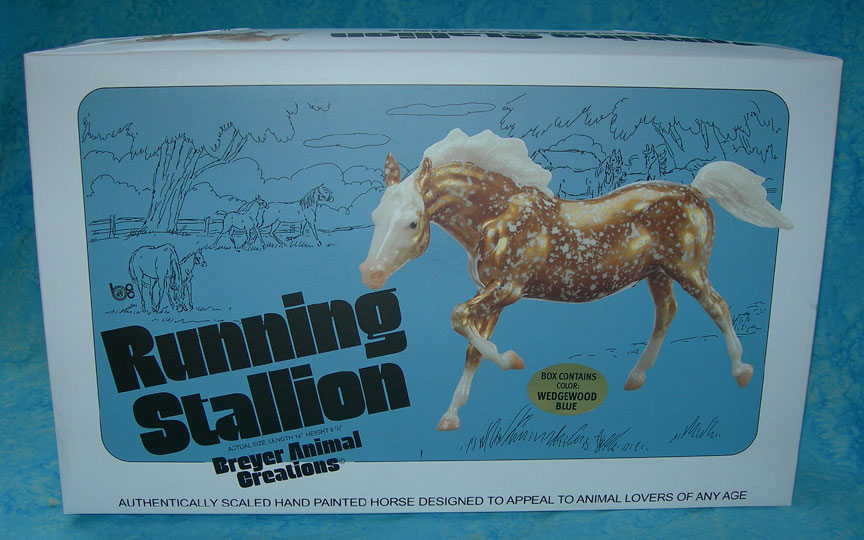
While everyone else is squeeing over the horse itself, it’s the box that the latest Vintage Club release Running Stallion that’s getting me all excited:


They brought back the gold foil sticker, seen only on the earliest examples of the "White Picture Boxes" from ca. 1973. Like, coincidentally, this Black Appaloosa Running Stallion example I sold recently:


The only slightly bothersome thing about the newer box is that the "picture window" is too big. In the originals, the picture window was cropped in such a way to accommodate the identifying mold and color text, or sticker.

It also just looked better, aesthetically. As my art school instructors were so fond of beating into our heads, white space is a design element, too. Don’t be afraid of it! White space improves readability by allowing you to focus on the most essential elements of the design.

Too many designers and artists feel like they need to fill up a page or image area, when all that does is create a lot of visual clutter that you feel obligated to read.

It’s not just about the box: the Breyer web site has a similar problem. Even though the site is relatively "flat" - theoretically, you don’t have to click more than a couple times to find the page you are looking for - finding them in those long lists of hyperlinks and images can be a challenge.

More is not always better.  I'd be willing to click through an extra page or two if it didn't mean staring at a single page for five minutes trying to figure out which one of the fifty-plus links will take me where I need to go.

My Running Stallion is quite nice, by the way. No significant issues - other than a slight roughness on a couple seams, similar to some of my original Running Stallions from the 1970s. Unlike those Running Stallions, though, my "Sailor" stands just fine, even on carpeting! Though I've been lucky in that regard: most of my vintage Running Stallions are not tipsy, at all.

(Maybe because, like the Stretched Morgan, I've found so many over the years that I've been able to pick and choose. Another long story, that one.)

I am please that I got the Wedgewood Blue - my favorite vintage Deco color! But I would not have been unhappy with a Gold Charm, either. From the pictures I’ve seen online, Reeves did a stellar job with the Gold Charms this time around. 

Friday, October 31, 2014

Love, Love, Love?

First they promised us the G1 Draft Horse as the Gift Stablemate for the 2014 Vintage Club. That was easy to rationalize: all the Warehouse finds were from previously molded - and warehoused - bodies. You can fit hundreds of Stablemates in a single storage drum, easy-peasy.

Then they offered us Cosette - the Classic Arabian Mare in Chestnut Pinto. Another Hagen-Renaker mold. An apparently open-ended run, too - though limited to two per customer - but still available on the Breyer web site as of my writing this. Well, maybe that one could have been warehoused too, but I was beginning to have my doubts.

Then they sent us a picture of the cover of the soon-to-be-mailed Just About Horses Annual:


Ooh, a new chestnut Carrick! The Zodiac Collection that they hinted at a while back? I’m cool with that. Fan-niversary - is that what they’re calling the next Exclusive Event, or is it just another themed anniversary promotion? Interesting; whatever it is, I hope the Western Horse is involved. The Maureen Love Story

Whoa, wait a minute. Does that mean what we think it means? 

Then we received notice about the offerings for next year’s Vintage Club:


Oh Good Heavens, a Gloss Palomino Pinto Proud Arabian Mare? I suppose we’ll all find out in a few weeks, as the Annuals make their way out into the world, the circumstances behind the return of the Hagen-Renaker molds. For now, or for good?

Rats, just when I thought it was safe to start upgrading my Proud Arabians!

While everyone is squealing in delight over the Proud Arabian Mare’s return, the model that made me melt into a puddle was the Quarter Horse Gelding. In Black Splash Spot Leopard Appaloosa, like the Western Prancing Horse? Oh, goodness.

The full lineup, in case you haven't heard:
  • Black Splash Spot Leopard Quarter Horse Gelding
  • Gloss Red Bay Pinto 4-eyed Misty and Stormy
  • Gambler’s Choice Decorator Running Stallions
  • Gloss Palomino Pinto Proud Arabian Mare - Yellow Mount pattern
  • Bonus Model: Dark Dapple Gray Loose Mane Cleveland Bay, aka "Murphy"
  • Gift Stablemate: Gloss Alabaster G3 Rearing Andalusian
Interesting that they’re doing a Gambler’s Choice on the Running Stallion; presumably for the benefit of those lucky ones among us who have vintage Running Mares and Foals in need of a match. I thought they'd go with a Gloss/Matte Gambler's Choice first, since there was precedent for that back in the 1960s and 1970s, when they transitioned from mostly Gloss to mostly Matte finishes.

So signing up for the Vintage Club this coming year gets you a rare and lovely PAM, and a super-scarce (125 piece) Decorator? Sounds like a pretty good deal to me!

There goes my hard-earned Paypal balance.

Friday, December 6, 2013

The First Unicorn

There’s another new Special Run on the Breyer web site - a set of Classic Unicorns with sparkly pink blankets, named Bella and Mozart:

http://www.breyerhorses.com/bella_mozart

No word or clue on the quantity count, since Breyer put a 12 piece order limit on it. (No "typing in a ridiculously high number to see how many it will put in my cart" gambit.) I’m intrigued: the price is good, and it’s the Classics Hansel and Gretel Pony molds that I adore. But I really am trying to limit my purchases until the end of the year.

I’m not all that into Unicorns, either, though I’ve been working on this one old Breyer Unicorn rehab project for forever:


He was in my body box for a couple of years. I can understand why: he was beat up, bent up, had a broken leg, and he’s the Running Stallion, whose creative anatomy is too much for even me to bear most of the time - though I have a rather astounding number of examples in my collection.

I don’t go out of my way to find Running Stallions: they find me. I even have a Salesman’s Sample in Bay, somewhere in storage; he’s not substantially different than a standard production run Bay, but he was cheap and came with a really good provenance, so who was I to say no?

Believe it or not, the #210 Running Unicorn was Breyer’s first official "fantasy" horse - one that wasn’t just painted an unrealistic color, but actually came with the extra accoutrements. In the Running Stallion’s case, these were a beard and a horn.

I wasn’t entirely thrilled by his release in 1982; I liked the idea of having a "real" Breyer Unicorn, but did it have to be the long and tipsy Running Stallion, who enjoyed wreaking havoc on my shelves with impromptu games of dominoes?

That was my first priority when I decided to tinker with the Body Box Unicorn: make him stable enough to stand up even to one of Vita’s full-on stampedes. Since then he’s sort of been my go-to project whenever I have leftover epoxy that I do not want to throw away. (Today that came from a repair of one of Mom’s many thrift store lamps. No, there were no horses on it.)

I don’t know where I’m going with him, artistically, other than not painting him some shade of gray or white. I’m not going to do much to him structurally, other than working on his legs a little bit more, and maybe his muzzle. Like most of my other custom projects, he’s not going anywhere, so the only person he has to please is me.

Saturday, May 19, 2012

Clicking Through

Gotta keep it simple today - in addition to trying to work on my BreyerFest paperwork (about half done - yay!) I’ve had to deal with a lot of untidy personal stuff, too. (Identity theft, again. Why do so many people find it awesome to be me? Trust me, it ain’t. Well, most of the time.)

I seem to have forgotten to talk about the survey that was offered to Vintage Club members to help choose, presumably, one of the 2013 Club offerings. For those of you who aren’t in the Vintage Club, or missed the news entirely, the choices were:
  • Gloss Alabaster Quarter Horse Gelding
  • Matte Smoke Five-Gaiter
  • Gloss "Dark Dapple Gray" Running Stallion
  • Gloss Wild Dapple Gray Man o’ War
Naturally, I picked the Man o’ War. I was a little hesitant at first, since he’s awfully close to the original - and fabled - Dapple Gray Man o’ Wars from the early 1970s. I figured that the paint job is different enough from them - Gloss instead of Matte, "wild" dappling instead of lacey and shaded - and the chances of me being able to afford one of those originals is pretty slim.

Based on the online commentary I’ve seen, though, I’m guessing the Running Stallion has the best shot of winning that poll. The Five-Gaiter has a Matte Finish, which rules him out, and both the Man o’ War and the QH Gelding have molded-on halters, which is also big no-no for some people. Among a lot of collectors, too, there’s this desire towards "complete" families, so a Dark Dapple Gray Running Stallion to match the Mare and Foal would seem like the most logical choice.

I would be okay with him, too, though I’d hope then that the others might be offered in some way, too - either as Made-to-Orders or Buried Treasures. (Actually, what I REALLY wanted is the Stretched Morgan in the Appaloosa Performance Horse colorway in the group shot accompanying the newsletter. I have a feeling we haven’t seen the last of him, though.)

Speaking of, apparently Reeves received enough questions about the Buried Treasures - and the "Second Chance" models - to address the issues on its Frequently-Asked-Questions page:
Q24: I heard about some web specials being offered again to members of the Collector Club. What is a "Second Chance" offer?

Recently, we offered our Collector Club members a second chance at purchasing select web special models. We’ve noticed a few questions come up regarding this, and would like to take the opportunity to clear a few things up

Breyer only makes the stated number of special run models. In the event that an individual drawn to purchase a special run isn’t able to purchase, we then select someone from the wait list. However, we do not keep our wait lists indefinitely, and in some cases the individuals chosen do not complete their order. This leaves us with extra web special models (which are not rejects or damaged returns), which we may choose to offer to our Collector Club members; giving them a "second chance" at getting their hands on these great models!

Our recent "second chance" offers (offered at the end of April 2012) were announced on our Facebook and Twitter pages, and were also listed in the Member’s Only section of the website, which can be viewed once you’re logged in as a Collector Club member on BreyerHorses.com. "Second chance" models were offered exclusively to Collector Club members, and limited to one "second chance" model per purchase, while supplies lasted.

So keep your eye on the Member’s Only section of the website and Breyer’s Twitter and Facebook pages, as we may periodically offer specials and surprises like these offers to our members!

Please note – offers and promotions may or may not be advertised in advance.
I like how they tacitly admit at the end of the explanation that more Buried Treasures and other special offers are in the offing. Way to cultivate them page clicks!

Note some of the (other) interesting wording here:
Breyer only makes the stated number of special run models.
I take this statement with a grain of salt. I think they strive to distribute the "stated number" of pieces, but that doesn’t account for returns/replacements for damages. For the record, I believe the shortage/overage on most special runs is very small - a handful of pieces, at most. I’d hesitate to call them statistically insignificant, because it certainly doesn’t feel insignificant if you’re one of the lucky ones who manages to catch one of these stragglers - or just misses out on getting one.
[E]xtra web special models (which are not rejects or damaged returns)
I know it’s considered an "accepted fact" that Reeves redistributes damaged returns, but that’s simply not the case, and it’s a little depressing that they have to point this out on the web site. However, this also does not rule out models that were return out of simple dissatisfaction - aka "buyer’s remorse" - which does happen from time to time.

Tuesday, October 20, 2009

Early Eyewhites

Prior to the mid-1990s, eye detailing was a relatively uncomplicated topic. You had earlier, overpainted two-stroke eyewhites, the slightly later underpainted "masked" eyewhites, and a few examples (usually among the non-animals) of eyeliner eyewhites, which were really just a variation of the two-stroke eyewhites. That were sometimes pink.

Overpainted eyewhites consist of two near-translucent paintstrokes over the back corner of the eye, painted over the black dot eye. As seen on this Bay Running Mare:


Underpainted eyewhites are done by painting the entire back half of the eyeball white, and painting the black dot eye over it. It gives a sharper, more masked look. As seen on this Pacer:


There were some notable exceptions - many of the Dogs, including the Boxer, Poodles, Bloodhound/Bassett Hound and the St. Bernard - had unique and detailed eye treatments. Some of the Dall Sheep and Mountain Goats had a type of brown bi-eye. And the earliest versions of the Fighting Stallion had a little extra airbrushed pinking around the eye (most of which have faded and disappeared over time.)

Nowadays it’s a rare model that doesn’t have some sort of fancy eye detailing - even Stablemates aren’t immune, though mercifully Reeves is backing off on them a little bit (presumably for cost, but also probably because of the freakish scale issues.)

The standard eye treatment, from the mid-1960s until quite recently, was the simple black dot eye, usually glossed. Some of the smaller scale models would have the entire surface of the eye painted black, but most Traditionals got a round or oval shaped dot that left part of the eyeball unpainted, giving the impression of eyewhites. I call these "unpainted" or false eyewhites. They’re most obvious on lighter-colored models, such as this Running Stallion:


Overspray on these types of eyes is common, often giving the appearance of gray or black eyeliner. It may or may not have been intentional.

Setting aside the Dog molds, the earliest known painted eyewhites didn’t appear until ca. 1959. It’s important to note that Breyer was not consistent with the application of eyewhites in its earliest days; some models got them, some didn’t, and there was little rhyme or reason why. Some early models are pretty rare to find with painted eyewhites, like the Buckskin Quarter Horse Gelding and Buckskin Mustang, while others are relatively common, such as the Gloss Charcoal Fighting Stallion. Early glosses are a little more likely to be found with eyewhites than early mattes, but there are exceptions to that rule, too (i.e. the Stretch Morgan!)

Some colors were less likely to have painted eyewhites, too. Virtually all white and Alabaster molds that I’ve seen have had the unpainted variety, and painted eyewhites tend to be rather rare on the whole spectrum of gray-based paint jobs (except the Smoke Belgian. Go figure.)

I haven’t done any elaborate charting of eyewhites to determine timing or rarity; there might have been an eyewhite gap between the earlier overpainted eyewhites and the later underpainted ones, but I haven’t been able to verify or deny it because of the consistency issue.

Painted eyewhites of all types - again, excluding the non-horse exceptions - seem to have been discontinued by 1968; the Traditional Man o’ War and Pacer, both of whom debuted in 1967, were the last regular run horses issued with factory eyewhites until the 1990s.