Showing posts with label Alabaster. Show all posts

Monday, February 6, 2023

Whiter Shades

That was a surprisingly productive weekend, especially considering it was only 24 hours long for me. Finally finished that one stupid quilt project that refused to be finished, started another, cleaned out some old financial paperwork, and did a bit of prep work on my taxes!

I know I told myself not to buy stuff this year, but (alas) I relented again. My rationale this time: it was cheap and something I wanted!

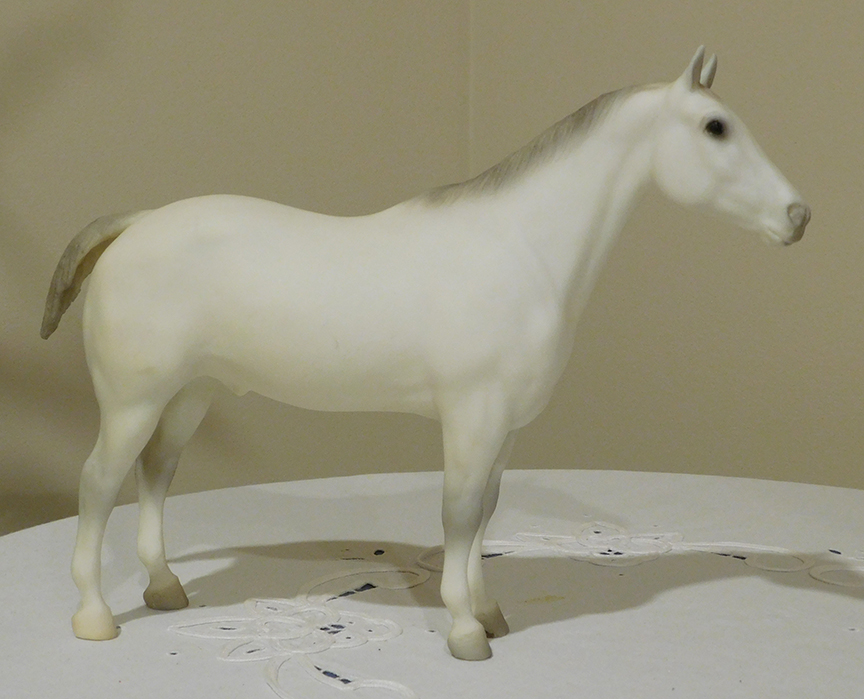
He’s the later black-eyed version with not a lot of shading, but he’s snowy white and in excellent condition, other than a couple of small stains and hoof edge rubs. And I got him for about the current cost of an off-the-shelf Traditional.

I’ll still need to get the original pink-eyed “Albino” version one of these days, but I suspect I’ll have to cough up a little more cash for that one. They command slightly higher prices not just because they’re earlier pieces, but because they tend to look a little bit fancier, with the pink eyes and extra shading.

I’ve noticed that regardless of the variation – black-eye or pink-eye – the White Five-Gaiters don’t seem to yellow as much as other White/Alabaster/Albino models from the same era. 

Even back then Breyer was aware of Cellulose Acetate’s tendency to yellow or mellow over time, especially when they used a lot of regrind (reground, recycled plastic). I wonder if they purposefully used fresh CA whenever they manufactured the Albino Five-Gaiter because the yellowing would be just that much more noticeable? 

Or was it the fact that he wasn’t as popular as his Palomino or Sorrel siblings? The Albino Five-Gaiter was discontinued by the end of 1966, while the Palomino stuck around through 1971, and the Sorrel until 1986. Fewer models = fewer models that will turn yellow.

Or with him being one of the fancier paint jobs of the era, maybe the majority of them lived the decorative life in a window?

There is also the strong possibility that it is all just a coincidence and I am reading way too much into it. That happens a lot in historical research, especially when so much of the evidence is lost and we have to deduce things from what was left behind: in our case, the models themselves.

Monday, November 28, 2022

More Exceptions To The Rule

Pretty excited about this little bag of mostly Hartland Tinymites!

I’m hoping there are at least some upgrades in here somewhere. (I see no Barkies, alas. I really need more Barkies!) If not, I’ll still have fun cleaning them up and sorting them out for the sales list.

Yes, I am a dork. Is that even a question? 

Here’s the other item that came with it, a lovely early Alabaster Proud Arabian Stallion with extra shading. He’s not perfect-perfect, but he’s pretty close, and I couldn’t argue with his price one bit:

That now means I have examples of the Proud Arabian Stallion in all three of his original release colors in acceptable – or more than acceptable – condition. 

That is not the case with the Proud Arabian Mare, and I doubt it ever will be. I find that bothersome, but not enough to spend the extra money to change that. I’ll find them at a price I’m comfortable with, and not a moment sooner.

(I have a lovely Dapple Gray, an adequate Mahogany Bay, and nicely shaded but battered Alabaster. And let’s not even discuss the Chalky variations…)

As I’ve mentioned several times before, vintage Alabasters are notoriously difficult to find in good condition, and the Proud Arabians are no exception. Considering the popularity of those molds in the 1970s, maybe even moreso!

I can’t count how many Alabaster Proud Arabian Stallions I’ve had in my collecting lifetime, but it’s been a lot, and they’ve come with the full gamut of problems: heavily yellowed, rubs, chipped ears, weird paint flaws, or (most commonly) scuffs galore. 

I also wanted an earlier example, rather than a later one: ones manufactured near the end of his production run in 1981 only had a bit of shading on the mane, tail, head and hooves. Very early examples – like the new guy – obviously have significantly more. 

The new guy isn’t quite as heavily shaded as some I’ve seen, but other than that (and a few stray marks) I have nothing to complain about. And he’s so white, he nearly glows! I am very happy to have made an exception for him. 

I also bought some Stablemates and a few random accessories (socks and blankets) from Breyer’s Black Friday sale: combined with a new mini Shop Vac I purchased in a store on actual Black Friday (half price!), that will probably comprise my Christmas Gift to myself this year.

Monday, May 9, 2022

Black and White and Gray All Over

And now, George Pérez. I mean, I’ve known that one was coming since late last year, but it hits hard in a different way, because I actually met him once. It is one of my most delightful convention memories, in fact. 

He was good friends with some artist/creator friends of mine. I was sitting with my friends in the Artist’s Alley at the Motor City Comic Con one year, just goofing around as they were fielding questions and sketch requests. George, who was one of the featured guests that year, just walks up to the table and starts singing show tunes. And my friend Mercy starts singing show tunes back. 

What a strange and magical moment it was: stuck in the middle of an impromptu Broadway medley with George Pérez! 

(No pictures were taken to record the event, alas. I think I would have been too dumbstruck to take any, even if I had brought my camera.)

This whole weekend was kind of downbeat, when I think about it. First, most of my seedling have shriveled up and died for reasons I absolutely cannot fathom. I’ve had seedling failures before, but nothing like this. All I can hope for at this point is that I can salvage something. Anything, really.

After (finally!) finishing up my sales list inventory, I also came to the sad conclusion that I will not be able to bring everything to BreyerFest as I had hoped. There’s just too much stuff – nearly nine pages of it, and that does not include the most recent collection pulls! So I’ll have to make some hard decisions on what I can and cannot fit in the car. Selling things online is currently not an option, at least until late Summer or early Fall. 

On a more cheerful note, here are two other pieces from the collection that brought me my Charcoal Running Foal:

A few years ago I discovered that I did not possess a complete Gloss Charcoal Family Arabian Family, as I had thought. I was hoping to find a complete family to purchase at some point to remedy this situation, but like so many things, I never got around to it.

Although the Foal above is not an exact match for my Mare (who is currently in storage), I really doubt that I could find better, and I am not going to try: bright white, perfect pinking, minimal molding flaws.

I’ve had several Alabaster Family Arabian Mares – both Gloss and Matte – and this example is also one of the best I’ve seen. Quality vintage Alabasters on any mold are challenging, but on Family Arabians even moreso, since they were tailored specifically for the toy market. 

I’m not at all worried about matching up my Alabaster Family Arabians, though. I have an insane number of Alabaster Foals – Matte and Gloss – as a consequence of a research project that went a little too far (don’t ask!). My Gloss Alabaster Family Arabian Stallion is actually an Old Mold Stallion with a crazy amount of shading – the kind you normally see on vintage Fighting Stallions, Five-Gaiters or Rearing Mustangs – and I just don’t think it’s likely I can anything that can even remotely match him. 

He does have a matching Old Mold Foal for company who is also pretty nice. My Old Mold Mare is… potentially upgradeable, and I’ll leave it at that. (You would not think that the Alabaster Old Mold Mare would be such a tough nut to crack, but she is for me.)

Monday, April 25, 2022

Alabaster Performance Horse

The garden looks less terrible now – not good, but also not completely embarrassing. And it looks like all I’ll have to replace are the Verbascums and the Lupines, which is strange because those are two perennials I thought could survive an actual nuclear winter. 

(And good news for me, those are two I can direct sow!)

But that will have to wait until next weekend; the weather is turning cold again for a few days, and I have other things to worry about between now and then. Like recompiling my sales list and writing rough first drafts of articles for this year’s Sampler. 

After taking a good, long look at all the places I want to go and stuff I want to do in the month of May, I finally decided against participating in the BreyerFest Breakables Photo Show: I think it might be one activity too far for me. There’s always next year, I guess.

I’m not in a super-talkative mood today – my schedule switched over to days this week*, and I’m still feeling a little jet-lagged – so here’s a picture of an old friend:

Even by the standards of the late 1980s, the Horses International Special Run Appaloosa Performance Horses were kind of boring, but I loved them anyway. The mold is very much in keeping with the unrefined, rat-tailed Appaloosas of my youth, and I’ll always choose him over the more modern Appaloosas. 

Three of those four releases were in solid colors. Although the mold has had its share of solid-colored Test Colors over the years, the Horses International SRs have been the only solid-colored production run pieces on the Appaloosa Performance Horse mold, so far. 

The Alabaster was clearly the most boring of the original four – if there was an award or class for “Most Generic-Looking Special Run”, he’d definitely be a contender. But I love the subtle touch of that single, natural-colored hind hoof.

*I have been told that this is temporary. We will see. 

Saturday, March 19, 2022

The Other Guy

I didn’t get pulled from the waitlist for Robin and Nestling either, which at this point is like saying “water is wet”. So, moving on…

In more cheerful news, the wild strawberry seeds I purchased germinated! I’m not a huge fan of strawberries in general, but since I’ve been told that growing any other types of berries is off limits, strawberries it is. 

I also have at least four Berkheya “Zulu Warriors” and one Heliotrope. Technically we’re in between a Zone 5 and 6 here, so I’m probably taking a chance with the Berkheyas. But we do appear to live in a weird little microclimate – the Ageratum I started years ago perennialized! – and the plants are so neat looking that I figured I might as well give it a chance. 

Okay, back to horse stuff. 

I found out about the BreyerFest Workshops before most of the popular ones sold out, but I decided to heed my own advice and not overschedule myself. I’ll wait until after my first live show this year – and the Volunteer selection process – before I decide what else I want to do during the weekend, beside socializing and shopping. 

I was tempted by the Carousel workshops, because once I get caught up on my sewing projects I want to jump into the Little Bits/Paddock Pal scale carousel I’ve been slowly accumulating supplies for. 

Some of the webinar and pre-recorded workshops are also tempting, but as I mentioned before, I’m hesitant to spend much time online at an in-person event. 

Actually, I’m kind of hoping that they include some in-person only competitions, like they did at BreyerWest with the Stablemate Painting. Though I wouldn’t necessarily compete in that one personally because painting is my least favorite part of the customizing process! 

I think that’s one thing that BreyerFest is missing: the spirit of spontaneous competition. Most of the competitions we have at BreyerFest now hinge on a great deal of advance preparation. Things like the Costume Contest, the Live Show, and the Customs Contest all take weeks or months of work. The 5K doesn’t necessarily, but it’s also more of a physical than a creative exercise. I don’t know about you, but by Sunday morning I’m exhausted!   

As a reward for slogging through all this, here’s the other half of the Fighting Stallion lot that included the Gloss from the post previous:

I already had a pretty nice #30 Alabaster, but the deal was too good to pass up, and this example is a little bit different from that one: he doesn’t have the USA mold mark. I’m still uncertain that I am going to keep him, which is why he’s gotten the privilege of window time: keepers can wait, potential sales items cannot.

Unlike the Gloss, the limited amount of gray paint on the Matte version of the White/Alabaster Fighter was painted first and then sealed with a Matte topcoat. (White plastic is not necessarily unpainted or bare plastic, she says for the millionth time…) 

The Matte topcoat wasn’t a cure-all, however: Matte models tend to yellow more quickly and profoundly than the Glosses do, but they also un-yellow pretty quickly too, as long as the weather cooperates. 

Thursday, March 17, 2022

Big and Little

While I was prepared for the inevitable disappointment regarding Robin and Nestling, I found myself more bummed than I wanted to be when I logged into my account and saw the photo list of the year’s previous “Special Run Lottery” models. I noticed I had only been picked for one of the past ten (Zugspitze).

And I know my luck has been better than many, even getting that one. But seeing the visual tally like that definitely makes you think about collecting something more attainable, like Van Goghs or Fabergé Eggs. 

But let’s focus on what we can have, rather than what we can’t. Here’s another not-so-recent acquisition I’ve been hesitant to put on display because he’s still almost as yellow as the day I got him, because both sunlight and window space have been a premium since the day he’s arrived:

Because they usually painted the mane and tail and hooves after they applied the Gloss, finding Vintage Alabasters in good or better condition can be difficult, and matching the gray paint is almost equally difficult.  

Being yellow, fortunately, is the only thing really wrong with this guy, which is why I bought him in the first place. (He is a lot yellower in person than the camera shows. Darn you, camera!) He came pretty cheap, too – less than a modern Traditional at retail. Part of the reason for the cheapness was because the photographs accompanying the auction were not good.

But I noticed his mane, tail and hooves were in excellent condition, and all of the other marks appeared to be mostly surface issues, so it felt like a pretty safe bet. And even if he wasn’t all that, all I had to do was clean him up, de-yellow him, and I’d be able to at least get my money back and maybe a small bit extra to cover my time and efforts.

Like my Semi-Gloss Bay Running Mare with eyewhites, there is also a chance that making the plunge with this purchase will improve the odds of me making a significant upgrade in the near future. I mean, he is pretty sweet, but is not minty-mint, after all...

(The story, if you did not hear it before: after finally spending a nice chunk on what I thought was a pretty good Bay Running Mare, I ended up upgrading her twice within the space of a year, ending with a darn-near-perfect example for eight bucks at the local flea market.)

The only regrettable thing about his purchase is that this Winter has been pretty dark even by Michigan standards, and all the plants and other even-more-yellowed models residing in the window haven’t been doing that well. The seedlings have been moved to grow lights and are doing much better, but the Fighter will have to wait until the weather is warm enough to move the bigger plants outside.

While I’m at it, here’s a picture of the Stablemates Club Dax, as well. You know I was initially a little underwhelmed by him (I am all about the Gambler’s Choice Fjord and Tiny Fireheart!) but he’s much nicer in person than I thought he’d be, and that’s a happy surprise. The new box design is pretty keen, too.

Sunday, January 3, 2021

Soap, Water and Sunlight

You know me, I love a good fixer-upper, and I couldn’t resist this one when I found him on eBay for less than a price of a new Traditional at current retail:

While I am certainly not averse to a challenge, there’s nothing better than finding a rare model for cheap who only needs soap, water and sunlight!

The soap and water part almost done; the hard part now is in finding an open windowsill. Many members of my “dirty pony box lot” are currently occupying most of the available real estate, and they are as yellow – or even more so – than the new kid.

But I hope to sell most of those guys this year, and the Mustang is staying, so I’ll just have to be patient.

The #85 Alabaster or “Albino” Mustang isn’t a particularly rare vintage model: he was made from ca. 1961 through 1966, and that was a respectable run for models made in that era. The hardest part is finding one without significant rubs in his gray body shading and mane and tail.

Because it requires a light and delicate touch, gray shading on white or nearly white models can be quite fragile, especially on Matte-Finished models from the 1970s onward. Typically, the gray shading was one of the last layers of paint added to the model, sometimes on top of the matte clear coat that gave those models their soft, powdery-matte finishes in the first place.

Gloss-finished models, on the other hand, are a bit of crapshoot. Sometimes the gray shading was applied first and then the model was glossed, and sometimes the gray shading was applied over the Gloss. 

The ones with the gray shading under the Gloss, understandably, tend to weather the years better than the ones with the shading over the Gloss. 

My newest addition appears to be the “shaded under” version, but I’m still taking my time cleaning him – partly to be cautious, but also because I’m rather enjoying the process.  

Sunday, November 22, 2020

Rollercoaster

This week’s been a rollercoaster.

Up: I did get drawn for the La Molina and Masella! 

Down: I don’t have a Benasque, and I’m not about to go wandering through that minefield. I can actually afford it right now, but paying $600+ for a 350-piece release is not something I want to be a party to.

Up: I finally found the Walmart Bay Stablemate G3 Quarter Horse. Now I can see why he was such a toughie to get – the color is dark, rich and slightly metallic, and elevates an otherwise blah release into something special. 

This fellow (gal?) is almost Stablemates Club quality, not something I would have expected from a Walmart release. Woo-hoo, new Stablemate office desk buddy!

Down: Reeves decided to drop early access to the better bits of their Black Friday sale in the middle of the day during a workweek. Awesome for people who have access to the Internet at work or are glued to their phones 24/7. The rest of us? No Fylkirs for you!

Then there’s the latest Test Color Purchase Raffle Piece, on the Hess Belgian:

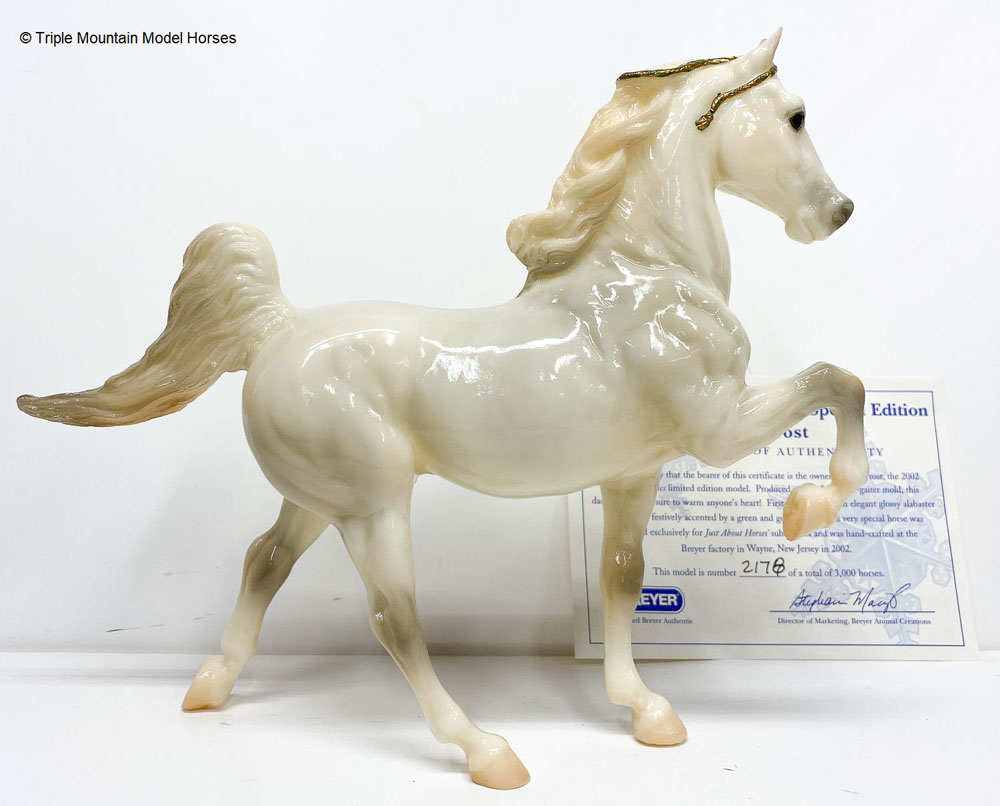
It’s obviously a Test for the 2002 Just About Horses Special Run First Frost, on the Five-Gaiter, and why they didn’t acknowledge this on the web site is a bit of a mystery to me, but whatever. 

First Frost was one of those Just About Horses releases that I bought first, and fell in love with later. It’s the kind of color that improves every model it gets put on, and I’ve been baffled by the fact that it hasn’t been used more since then. I’m guessing because it is hard to photograph well?

While I’m really trying to not get my hopes up, I’m actually in a position right now that I could comfortably pull off a $1000 Test Color purchase. And me being actually part (human) Belgian myself, I think it would be totally fitting.

But alas, my luck doesn’t really run that way. While it does sometimes seems like I have magical powers, they’re rarely of the kind that seems to benefit me directly. So – like everyone else who hopes to get drawn – I find myself wondering what this coaster has in store for me around the next turn. 

Monday, May 28, 2018

Alabaster Foundation Stallion

Although I did “win” a Rialto, I had to give him up for a multitude of reasons; seeing just how lovely he is from the in-hand pictures is making me wince even more than I usually do and I probably should just stop looking at those pictures, already.

(I’m hoping karma doesn’t bite me in the butt over that decision to pass, but I’m the kind of person who has to have contingency plans for my contingency plans, so… yeah, probably.)

I was tasked with dusting over the weekend (long story) and as I was finishing up very late last night, I paused to consider this pretty little SR from years past:


It’s the Special Run Alabaster Foundation Stallion, from 1985. About 700 pieces were made for the mail-order company Horses International in Arizona, though some were also sold elsewhere.

In terms of color, shading, quantities, distribution pattern et al, this model was typical of Special Runs sold in the 1980s. These were the kinds of Special Runs we got back then, and were happy to get them!

(Shakes fist at passing cloud.)

He pales in comparison to recent releases like Rialto – whose glossy, roany, elaborately masked paint job and hand-painted eyes would have blown our minds in 1985. Most customs didn’t have that level of detail back then!

Of course, the Rialto costs over a dozen times what the Alabaster Foundation Stallion cost – then, and now. (The original price for the Alabaster was $12.50, not including postage.)

That Foundation Stallion is not easy to find nowadays, but only because no one is looking for someone like him. I have known the feeling all too well, lately….

The Alabaster Foundation Stallion falls into that hole of undesirability a lot of Special Runs from the 1980s now do: a little too common to be considered rare, with a paint job considered too bland/boring to modern tastes, on an older mold that’s not all that popular at the moment.

He’s no Rialto, but I still love him.

Sunday, December 4, 2016

My Alabaster Cantering Welsh Pony

I’ve been trying to get caught up in my paperwork, but with little success; every time I pick up a horse to examine it, I end up losing valuable time just staring at the darn thing. One that’s been particularly hard to get past has been my Alabaster Vintage Club Cantering Welsh Pony My Girl:


When they were first announced, I was hoping to get the Palomino, but I have to say that I am exceedingly pleased that I received the Alabaster instead. In fact, she’s been such a distraction in my office that I’ve had to pack her back in her box and tuck her away from my sometimes less-than-dainty fingers.

The only minor quibble I had with her – and the original reason I was hesitant to deem the Alabaster my first choice – was that she didn’t have much in the way of body shading as the original White and Alabaster releases did, especially examples from the early 1960s. Even last year’s now highly-coveted Bonus Vintage Club Stablemate Bravo had some!

But when I opened her up, that lack of body shading was forgiven. In fact, she reminded me a lot of the Semi-Chalky Alabaster Running Mare I picked up last year, who has also become another fast favorite of mine. (Her yellowy parts whitened up real nice in the window, by the way!)

In every other respect they nailed the color, other than the name of the color on the box itself. As I explained earlier this year (first in the Sampler, then here) it should have been “White”.

I only finally figured that little nugget of trivia out this year – that the term “Gloss Alabaster” is a recent invention, and that in the 1960s those models were almost always labeled “White” – so that mistake, as it were, is easily forgiven.

Saturday, October 15, 2016

A Short History of Alabaster: Part II

For some reason this did not drop as scheduled on Saturday. So here is the conclusion, four days late....

I don’t think it was a popularity issue that doomed the “new” White paint job, but a manufacturing one: it was hard color to maintain consistency from model to model and the gray paint, applied over (not under) the Matte topcoat, rubbed off easily.

Confusing? Yes, very.

Honestly, this color confusion shouldn’t really be too surprising: we are talking about a company that had a hard time distinguishing between Bay and Chestnut. Having all these different names for a color as allegedly uncomplicated as White? Just par for the course.

Some argument could be made that Alabaster was in itself just another one of Breyer’s “Decorator” colors, albeit its simplest and most subtle. Like Smoke and Charcoal, Alabaster is not a term that was used in the real horse world to any significant degree, and bears only a coincidental resemblance to colors horses actually come in.

Matte finishes were still relatively uncommon at the time and used then primarily as a sealing topcoat for Woodgrains. The term might have been invented to help call out what was then something unusual and distinctive. Or as I’ve speculated with the color Charcoal, the term may have come from an offhand reference in a book or magazine.

Another point in favor of labeling Alabaster a Decorator color is that the term Smoke – another quasi-realistic color – debuted on the Running Mare and Foal at exactly the same time as Alabaster, and was even paired and marketed with it in deliberately mismatched Mare and Foal sets.


Then there is the matter of Gloss Alabaster: believe it or not, this term never comes up in early Breyer ephemera. It appears to be a hobbyist creation: through the 1960s and until Gloss finishes were phased out, Breyer always referred to Gloss Alabasters as White.

There were a number of reasons why white-colored horses, in all their names and forms, became a staple in the Breyer line through the 1960s and 1970s.

First and foremost: yes, they were a little cheaper to manufacture. They required fewer painting steps, and less paint. There was also less production waste. In an era where multiple simultaneous releases of a mold were the norm, it was common practice to set aside lighter-colored culls to repaint with a darker color later, rather than discarding or regrinding them.

But white was one of the most popular horse colors with the general public too, partly fueled by pop culture figures like The Lone Ranger’s Silver and Hopalong Cassidy’s Topper.

Although derided in recent years as a cheap, plain, and (at times) a downright lazy color to paint, careful examination reveals that too is not as simple as it seems. The simplicity of the color itself is a deceit: unlike other paint jobs, there’s no place for a minor decorating or molding flaw to hide.

In effect, we see the mold as the moldmaker sees it: no more, no less. That so many molds still succeed and delight is a testament to the craftsmen who helped bring them to life in the first place.

Wednesday, October 12, 2016

A Short History of Alabaster: Part I

Since I am going to either be away, or occupied with other things through the weekend, I will be queuing up the article I wrote about the history of Alabaster for this year’s Sampler.

Even though Breyer’s history began with a white Western Horse, the term “Alabaster” – the word hobbyists most commonly use to describe white-colored Breyer horses – did not appear in any official Breyer ephemera until ca. 1962.

My recent research has determined the reason why: “Alabaster” was created as a descriptor not just of a color, but a finish. In short, Matte White = Alabaster.

The history of Breyer’s plainest and most basic color, however, is far more complicated than that.

The earliest white-colored Breyer horses of the 1950s were literally White, in both form and name. Models like the Western Horse, Western Pony and Fury Prancer were uniformly described in the ephemera of the time as White: and they were, save for a few touches of gray shading on the hooves and head.

It wasn’t until 1958 that models with more extensive gray shading arrived, in the form of the Old Mold Mare and Foal (and a year later, on the Stallion). While the paint job on the Old Mold Family was very similar to the color we think of as Alabaster (gray manes, tails and body shading) they still weren’t labeled that way. The early ephemera still referred to them as White.


Other white-colored models began to show up shortly after but they were not labeled Alabaster, either. The Shetland Pony, with her gray mane and tail and pink hooves and muzzle, was still White. The Mustang and Five-Gaiter were described as Albino, presumably because the earliest pieces were issued with dark pink eyes, not black ones.

It wasn’t until ca. 1962 that the term “Alabaster” finally appeared in print, to describe the brand new Running Mare and Foal, and a revamped White Fighting Stallion.


What did these three releases have in common? The Running Mare and Foal and the re-released Fighting Stallion all came in a Matte finish. They were followed shortly afterwards by the Rearing Stallion (1965) and Running Stallion (1968), both Matte, and “Alabaster”.

It wasn’t until 1969 that the Family Arabians and the Shetland Pony – among the last remaining glossy White pieces in the Breyer line – were officially labeled Alabasters in existing ephemera. This is almost exactly the same time that Breyer officially began phasing out gloss.

1968 Pricelist:


1969 Pricelist:


I do not think this was a coincidence. Especially since the third white release in the line at the time – the Western Pony – remained glossy. And was still labeled as White.

There seems to be quite a bit of evidence that Breyer was being careful and nuanced when it came to their color terminology in the late 1960s and early 1970s, especially with their expanding repertoire of gray-based colors. One that expanded further with the release of the matte Dapple Gray paint job on the Proud Arabian Stallion in 1971.

To complicate matters even more, the term White was still being used. In spite of the fact that neither the Old Timer (released in 1966) nor the Indian Pony (released in 1970) ever came in a Gloss Finish, they were both consistently described in catalogs and other price lists as White well into the 1970s.


What I think was going on there was that a decision was made to turn that particular descriptor into a term for a matte white finish with heavy, almost Smoke-like body shading.

This “new” White didn’t last long: all subsequent “white” releases in the 1970s and 1980s were labeled Alabaster, regardless of the amount of gray shading they came with.

Thursday, February 25, 2016

Plain is the New Fancy

I’ve been sick almost to the point of being bedridden the past day and a half – some horrible nastiness at work that finally caught me – and while I now think the worst of it is behind me, it’ll probably be a while before I’m up to full speed again. So if you’ve been expecting a response from me, it might be another day or two yet.

So I will keep it simple today. Here’s a picture of one of my old favorites, the “Alabaster” (White, really) Running Stallion, released from 1968-1971. I liked this release so much I actually bought one at full market price, instead of waiting for the flea market to provide me one:


I am a little baffled by some of the online commentary – instigated by the release of the Croi Damsha Banks Vanilla – that berates Alabaster (and to a degree, Solid Black) paint jobs as lazy. While they are certainly less complex, they are not necessarily “lazy”.

In fact, I’d argue that a soft light Alabaster or White paint job like Banks Vanilla is no less difficult to execute than another color that may require more layers of paint or masking. Most of the work involved in an Alabaster paint job isn’t in the painting technique, but in the prep work.

Since minor flaws or imperfections cannot be hidden or camouflaged by painting or masking, the prep work on the model – the molding, seamwork, deburring, and cleaning – has to be held to a higher standard.

And contrary to common belief, the white plastic itself is not “unpainted”: anyone who has seen a true unpainted model next to a vintage Alabaster knows they are nothing alike. The surface of unpainted models have a certain sparkle or sheen to it that is removed during the production process.

I’m not entirely sure how the process goes today, but in the Chicago years that sheen was usually dealt with by the application of a Clear Matte or Gloss topcoat. Typically it was done after most of the details were paint on, but that was not always so in the case of Alabasters. Often the gray paint was applied last, which is why that gray paint tends to rub so easily.

The application of the Clear Matte topcoat during the Chicago era was inconsistent, however, and sometimes dispensed with altogether with releases that had only minor bits of white, like the Traditional Man o’ War. In the more modern (Reeves) era they have been similarly inconsistent, though most of the Matte-finished releases get “deglossed”, at least.

Monday, December 7, 2015

Uncatchables

There are some models that are determined to elude your grasp, and I just going to have to accept that the Mini Falhófnir is one of them. My Vintage Club Bravo came in the interim, and he will have to sate my Stablemates fix, for now:


I was a little concerned that they might not attempt the muscle line shading on this little guy, but it’s there. Yay! Now that the painters have had a little practice with that color, here’s hoping we’ll be more Glossy Line Shaded Alabasters in the near future.

It’s definitely one of the more underused of the “vintage” colors, and it’s hard to think of a model that wouldn’t look good in it, in any scale.

It can be a hard mental hurdle for a lot of hobbyists to overcome, but having a few “uncatchables” on your want list is not a bad thing. It would be very boring for me, personally, if every model I ever wanted just fell into my lap. The chase is part of the fun!

And it’s so very satisfying when you do finally snag one your elusive little buggers, especially if it’s at a fraction of its price when it was hot and/or new.

Speaking of gloss light gray goodness, apparently there are some Glossy Icelandic Elskas floating around. I’ve been fortunate enough to see quite a few Elskas locally, but nary a one in Gloss. I’m guessing that the Gloss percentage for the run is significantly lower than it has been for other more recent releases with random Glossies, like the Bay Giselle and Gilen set from a couple years back. (I saw another one in a store not that long ago, actually!)

I wouldn’t mind finding her, but I’m not going to go out of my way looking for her, either. If she’s as rare as I suspect she is, I really don’t have enough time in the day. Especially when I have to deal with this mayhem-generating monster:


Yesterday she got into a goodie bag stashed in my bedroom – necessitating an emergency run to the vet – and today she’s been hellbent on taking down the Christmas tree one ornament at a time. After all that, then she has the audacity to still be this adorable when she naps.

Anyway, I do want to get myself one more “store-bought” horse for the year, but I’m eyeing something a little more mundane like a Foiled Again, a Glitterati, or that pretty Indian Pony Performance Horse with the nice dappling who’s been giving me That Look the last few times I visited him at one of my local toy store haunts.

He’s not the Chalky variation – another one of my uncatchables – but he is pretty, affordable, available, and one of my favorite molds. Not seeing any downsides there.

Thursday, November 19, 2015

Vanilla, Valegro and Emma

I’ve been casually recompiling my want list – on a notepad next to the keyboard – and I was struck the other day at how random it was. AA Omner and the Black Pinto Picture Perfect Clyde Mare. The Black Stallion “Majestic Arabian” and the Bay Western Prancer “Prince”. Flim Flam and Galiceno Ponies.

Old and new, fancy and plain, “showable” and not. Those sorts of things.

Since most of my spare cash needs to be allocated elsewhere right now, it makes sense that I’m being drawn to what are, for the most part, cheaper and more readily available models. We all need a “horse fix” every once and a while, all the better if it happens to be inexpensive and easily obtainable!

We get so caught up in the models of the moment – this week, the Silver Filigree Croi Damsha Sugarloaf – that we sometimes miss the beauty in older or more common pieces. The ones that end up littering sales lists and eBay, begging for takers.

This is just a roundabout way of saying that I’m skipping out on the Sugarloaf drawing. She’s lovely, but there will be more new lovelies coming in the near future – including the new Fell Pony Carltonlima Emma, who’ll probably be one of my 2016 obsessions. She is being shipped and sold in the UK first, like Valegro and Banks Vanilla.

Pictures of in-hand models here:

http://chestnutridgeblog.blogspot.co.uk/2015/11/valegro-emma-vanilla-in-flesh.html?m=1

So cute, so little, so fluffy! She’s like a jazzed up, modern take on the Haflinger Pony, whom she is just a tad bit smaller than.

Banks Vanilla is the first Regular Run release of the Croi Damsha mold, in Matte Alabaster: all three previous Production Runs were Club-limited or Special Runs. Though search engines queries for that one are going to be rather frustrating, and possibly dangerous to your New Year’s-related weight loss resolutions. (If ever there was reason for an ice cream cross-promotion, this model is it!)

I find the Banks Vanilla is very appealing, by the way; I know a lot of people are complaining that the paint job is “too plain”. But I like how it hearkens back to the soft Matte Alabaster paint jobs of the 1970s.

Frankly, I’d like to see more plainer paint jobs than the fancier ones, if only because there’s less room for error, and more room for variation. I also think the sculpting on the mold is strong enough that a lot of shading is more of a bonus than a necessity.

As is the case in every other new release, it’s wisest to wait and see before passing final judgment.

Sunday, October 18, 2015

Intensity

The first big box lot is in the house and it was…challenging. Everything was dirty, one horse was partially filled with sand (!) and many of them are a very entertaining and/or distressing shade of yellow. This Alabaster Family Mare and Foal set is a perfect illustration of what I was dealing with here:


The snowy-white FAF next to them is there for comparison: he was a previous restoration project who turned out almost perfect. (His muzzle is unretouched – it really came that way, that gray!)

At this point, I’m not sure if I even want to do any work on this pair. In fact, I’m seriously considering keeping them “as-is” (dust and all) for any demonstrations I may be called in to do in the future: they are such perfect examples of the grungiest Breyers can be.

They are textbook candidates for restoration, too: in excellent condition, underneath the yellow and the grime. (Aroma-free, too. Thank goodness.)

I don’t even see many significant rubs or scuffs in the gray areas, which is very unusual for Breyer Alabasters of this age. For some peculiar reason, Breyer often painted the gray areas of their Alabasters after glossing and not before, leaving them unprotected and very susceptible to rubs.

Cleaning those gray areas is one of the biggest Breyer restoration challenges: a little bit too much pressure with a cotton swab or toothbrush, and you can kiss that beautiful shading goodbye!

One technique I’ve found that keeps additional damage to a minimum is a variation of “power washing”: warm water, mixed with either a high-quality dishsoap (like Dawn) or a degreaser like Lestoil, repeatedly applied with a squirt bottle at close range.

I usually do it on a towel or in a shallow pan to contain the mess, rubbing and blotting only when absolutely necessary, if at all. I managed to clean a very dirty Horse-Over Clock this way, keeping the super-delicate “patinated” mane and tail intact.

I love doing this kind of restoration work – making the once beautiful, beautiful again – but that box lot took a lot out of me. I sure hope the next batch is a little less intense.

Monday, April 7, 2014

Vanilla is Good, Too

That’s all I’m saying about today: that box of Reissues can’t arrive soon enough. I’m so opening all the boxes and going full carpet herd with them.

Anyway, happier thoughts. Like the latest in what appears to be an unending stream of Store Specials - Novelisto D!


It’s yet another variation of the Brishen Multi-Mold, with the original Brishen mane and tail, but the Laredo legs.

And I like him. The front legs still give off that "Barbie Horse" vibe, but the combination of the various parts, with the plain - yet elegant - glossy White/Alabaster paint job is wonderful. It appears that I’m not the only one who thinks so. He seems to have jumped (or flown?) onto a lot of hobbyists’ To-Buy lists, too.

We haven’t seen many plain, unfancified White or Alabaster paint jobs in recent years; most Aged Gray or White models nowadays have some embellishment to them. They’re Chalkied, Pearled, Dappled, Shaded, or some combination thereof.

Some of them have been quite beautiful; the BreyerFest Pecos and the Gladwin Lucky Lady are both big favorites in my barn.

But sometimes, plain old vanilla is good too. The first "Vintage" model I ever saw - one that I hadn’t seen in a store or in a catalog - was a Matte Alabaster Family Arabian Stallion. A classmate on the bus took one to school one day, and I was entranced. Shortly afterwards we struck up a conversation, and many entertaining lunch room conferences were had, often spend ogling over the latest Breyer Collector’s Manual.

She and her friend even showed their models, which blew my mind and led me to finally subscribe to Just About Horses, which led me … here. So I guess it shouldn’t shock that I have about a half dozen variations of that model now: Gloss, to Matte, to Special Run. It wasn’t intentional, not at first.

Novelisto D is the horse that played the part of Athansor, a mystical, time-traveling flying horse in the recent film adaptation of Mark Helprin’s Winter’s Tale.

I read the novel not long after it came out - because it was a fantasy novel with a horse in it, duh! While I was impressed with the beauty of the language and the scope of the story, the novel I read shortly after - John Crowley’s Little, Big - had a much bigger impact on me, emotionally and artistically. Even if it did have fewer flying horses in it.

The Winter’s Tale film came and went, which is what I expected to happen; it’s not the kind of book that’s easily adaptable to a compact two-hour theatrical release. Genre fantasy is a tough sell cinematically, but literary fantasy even moreso. Because of my schedule, I didn’t get a chance to see the film in its brief theatrical run, but I’ll be more than happy to add the horse to my herd in the meantime.

Wednesday, March 12, 2014

Snowflakes

Wait, I got picked for an Aphrodite? How did that happen? It has been so long since I’ve won one of these opportunities that I’m not quite sure what to do with myself now. (I’m not counting the Glossy Lucy Mule, since the variables weren’t the same, i.e. it was drawing from a smaller pool of potential winners.)

I see some people are willing to trade their Gris Gris for an Aphrodite; this notion is not unappealing to me.

The "win" also makes up for the past few days, which were of exceeding roughness. I spent a good chunk of Sunday at the vet; Vita’s pancreatitis flared up again. I haven’t been sleeping well, and people at work were working themselves into a lather (again) about the snow today.

I don’t particularly like talking about the weather. But I really don’t like it when people start believing what some random old guy says about the weather while standing in line at CVS. I have plenty enough experience with Random Old Guys at the flea market who also pontificate about the weather to know better.

(The weather was unpleasant today, indeed, but apocalyptic? No.)

Anyway, here’s a picture of a more pleasant and believable (and less opinionated!) Random Old Guy from Marney’s album:


It is not Dune, the Collector’s Edition model from 2000. It’s a Test Color either made or found by Marney, presumably some time in the late 1980s. (The photo itself is not dated, but is of a style similar to those from that era.) He predates Dune by ten to fifteen years, or more.

It’s doubtful Reeves was aware of the existence of this Test Color before making Dune. Both likely stemmed from the same logical and obvious notion: Why don’t we put an "Old Mold" color on the "New Mold" Arabian Stallion?

The fact that a Test Color did later become a Production Run doesn’t diminish the fact that this Test Color is still a Test Color. Perhaps not so good for the monetary fortunes of the person who now owns this guy, and who now must explain for eternity to anyone who sees it that what they think they see is not what they actually see.

But that’s one of the risks you take in buying a Test Color. And partly why so many of the Test Colors that I own are pieces that were once unique and special snowflakes, but now are not. I’m perfectly content with that - in fact, I prefer it. I like to think of every model I own as being unique and special, whether they’re a Regular Run, Special Run, Test Color or Oddity.

Ask me about any Random Old Guy or Gal in my collection, no matter how common, and you’re going to get a pretty detailed backstory about why he/she/it is special regardless.

Hmm, interesting. I just realized that the Proud Arabian Stallion has been issued - or proposed - on every original "Old Mold" color except Gloss Shaded Alabaster. Gloss Honey Bay "Dune", the Vintage Club Gray Appaloosa "Harlequin", and the possible Woodgrain Test Color piece/s from the mid-1970s. (Charcoal and Palomino didn’t get released on the Family Arabians until 1961, at the earliest.)

I’m wondering if they think that its similarity to the Regular Run Matte Alabaster might cause a Gloss release to be not that well-received? Silly Reeves - give him the same details as the Retro Release Racehorse I proposed recently, and he’ll be plenty different - and plenty popular.

Monday, March 3, 2014

Sweetest Thing

This cold is kicking me in the pants so hard it’s leaving shoeprints. I normally don’t miss a lot of work for illness - because I don’t get sick enough to merit it, usually - but I had to go home at lunch on Friday. We were already short-staffed, but I barely had enough energy to drive home, much less work another four hours.

Massive amounts of juice, soup and sleep have made me marginally functional today; I’ll see how I feel in the morning before deciding if a trip to the doctor is necessary. (Some credit is also due to the tender care of "Nurse" Vita, who barely left my side all weekend. Such a good girl, Vita!)

Understandably, I haven’t been online too much; I skimmed some of the Big Easy Bash stuff lightly, mostly out of professional interest. Anything more than that would not have been beneficial to my mental state anyway. (While I know on some level that I could have a free pass to the Sample Room any time I wanted to, probably, it’s 12 hours away and not something I can do on a whim. Sigh.)

It appears that the Gooitzen Celebration Models for BreyerFest WILL be Glossy. That’s a nice touch; there were a few years - 2001 through 2003 - where they sort of experimented with high semi-gloss finishes (Atlantis Bay V, RSV Inolvidable, Gladwin Lucky Gray Lady), but all of the others before and since have been Matte.

That still leaves us with the question of what they are going to do for Costume Prize models; I wouldn’t mind the Matte, but I know I’m outnumbered on that. (For now!) It’s not going to change my mind on whether or not I’m participating this year or not: I will, unequivocally. I am having some difficulty finding the components I need for my concept, however. (No hints, sorry. Some secrets have to stay that way.)

The only other bit of news that caught my eye was that there was a #36 Racehorse in the Special Run mix at the event - a Gloss Dapple Gray Pinto one? - and wonder of wonders, people were really digging him/her.

It could just be the combo of pretty paint job + limited quantities doing its job there, but it gives me hope that they might indeed pull off a Retro Release of one in the near future. The mold doesn’t have the panache of the Fury/Prancer or the classic "Old School" look of the Western Pony, so I had discounted the possibility before. The poor sweet thing barely has any personality at all, though I thought Reeves did an able job of giving it some with the 1997 Just About Horses Special Phantom.


If the Powers-That-Be are considering a Retro Release, may I recommend a Shaded Alabaster/Albino? Not only would it be a suitably Retro paint job that we haven't seen yet, linear muscle shading like the Old Molds and earlier Albino Five-Gaiters and Mustangs had would also compensate for the Racehorse mold’s lack of anatomical specificity. Lipliner would be a no-brainer, of course - a little smile to brighten the blankest of Breyer faces! 

Released in quantities sufficiently large that I can actually afford one would be nice, too. This latest Special - like the last (Gatsby’s Daisy, in 2000), is most definitely going to stay out of my price range.

Tuesday, May 3, 2011

Old and Cranky

I’ve been in a bit of a funk for the past couple of days. Aside from a rough work schedule that completely messed up my sleep cycle, it rained - almost on cue - on Sunday morning. Grr. Nearly a month’s worth of flea marketing, lost. It’s nice that I’ve gotten so much work on the garden done, because it did need it. But darn it, I seriously need a cheap pony fix!

I did pick up a halfway decent archive/reference lot on eBay last week; lots of duplicate material (finally, something to sell!) but some previously unowned stuff, too. I haven’t had a chance to go through the "new" material in detail yet, but I’m pretty sure there’s a couple of future blog posts in there somewhere.

(What always cracks me up whenever I sort through one of these archives is when I find some of my own material in it. Duh - don’t need an extra copy of THAT!)

Because I am lazy, tired, cranky and just not into it today, here’s another semi-obscure Special Run for your enjoyment, on a rather appropriate mold: Old Timer!


It’s the Special Run Alabaster Old Timer, from the 1983 Montgomery Wards Christmas Catalog. Most hobbyists just assume he’s a reissue of the Regular Run #200 Alabaster Old Timer, which ran from 1966 through 1976. When compared to a Regular Run - here, my Old Timer cull - the difference becomes quite obvious:


Older Alabaster Old Timers have body shading, while the SR does not. Older Old Timers have so much, sometimes, that it seems wrong to call them Alabasters. It’s more like a softer, paler version of the "Slate Gray" color that first appeared on the #191 Bucking Bronco, who also debuted in 1966. (A coincidence?)

(The hats are different, too, I know - later hats don’t come with a painted hatband. But they’re not that reliable an indicator of oldness, since they are so easy to lose, switch or replace.)

Earlier Gloss Alabaster paint jobs, on models such as the Five-Gaiter, Mustang, and Old Molds, did come with variable amounts of gray shading, but rarely as extensive and consistent as the #200 Old Timers. Other contemporary Matte Alabaster paint jobs were all over the map: the Family Arabians rarely showed much shading, but the earliest releases of the Proud Arabians did. The slightly later Classic Andalusian Stallion and Lipizzan varied from model to model and year to year (with earlier pieces tending towards the more dramatic). But Classic Johars tended to be pretty tame.

In short, it’s hard to say whether the color on the SR Old Timer meant to be different from the original, or was just a consequence of the time period it was manufactured in. More the latter than the former, I'm guessing.