Showing posts with label Palomino. Show all posts

Monday, October 16, 2023

Point of View

For the record, and to clarify: I don’t dislike the new Stablemate version of Othello. I am just bemused and confused by the excitement over him, in much the same way I see some of my friends gushing over guacamole. 

I appreciate a good guacamole as much as the next person, but I don’t quite get why people get so animated about it. It’s just avocado dip, people, not the Fountain of Youth…

Nothing new here, model-horse wise; I spent the weekend crafting and customizing. I briefly considered participating in the Breyer Fun Day on Saturday, but I decided to stick to my original plan and work on old stuff instead. 

I didn’t make much progress, but I did make some: I even had an old FAM custom project surprise me by being nicer than I expected after the first coat of primer. She’s still not good, but I despair about her prospects less, so that’s something. 

The only other thing worth reporting here is that my Thunderbird arrived: I got Gloss Palomino, which amuses me partly because… well, it’s a long story, and today doesn’t quite feel like the day to go into it. (I had a rough bout of insomnia last night, and I am exhausted.)

My only quibble with him is a minor one: I would have preferred gray hooves, rather than the pinkish/natural ones. I know that both variations existed in the pre-Reeves era: the natural/pink hooves were generally reserved for “fancier” molds like the Fighting Stallion and Five-Gaiter, and the gray hooves used on pieces more tailored to kids, like the Family Arabians. 

But by the mid-1980s that distinction was largely tossed out the window: the Special Run Palomino Pacer and Shire were definitely not items designed for little kids! 

Since the Silver is basically a modernized version of the Fighting Stallion, going with the more natural hooves made sense. Still, it would have been fun to see that variation, even if it did not exist historically; it did with the Rearing Stallion, but that is because he remained in production into the 1980s, and the Palomino Fighter was gone by the end of 1973. (And in Gloss, even earlier than that.)

But personally, I find the gray hooves feel more “iconic” than the pink/natural, in the same way I see the black hooves on old (unpointed) Breyer Gloss Bays. While Gloss Bays with gray hooves do exist (hello, Clydesdale Stallion), I just like the way the black hooves pair with it. 

Saturday, December 28, 2019

Palomino Hamilton

Since I am basically tapped out, and trying to end the year with as little credit card debt as possible, I passed on the Ambrose.

I had a feeling they were going to drop one more bombshell on us before the end of the year. I’m still sorting out my decidedly feelings about the whole thing, so I am going to talk about another topic I’ve put off for a while: the Palomino Hamilton.

If there’s one thing I’d like to say to the rest of the hobby that would actually get listened to and followed, it’d be: chill out about this Hamilton already, people.


If what happened with the first run of the Collector’s Club Appreciation Glossies is any indication, I think Reeves has the situation under control, and production will be calibrated accordingly: a little more of this, a little less of that, with the Pinto Smarty Jones chase piece remaining the rarest, regardless.

I am not going to worry about it until the middle of the year at least, and possibly not until after BreyerFest, when I presume the bulk of production on this particular Gambler’s Choice run will be concluded. And for those of your afeared that a substantial chunk of those will be going to Dremel-happy customizers, I wouldn’t count out another production item on the mold by the end of 2020, either. 

Seattle Soiree Special? Tractor Supply? Brick and Mortar? Any one of the multitudes of Holiday releases? It’s going to happen, people. Plenty of Hamiltons for everybody, whatever your hobby persuasion!

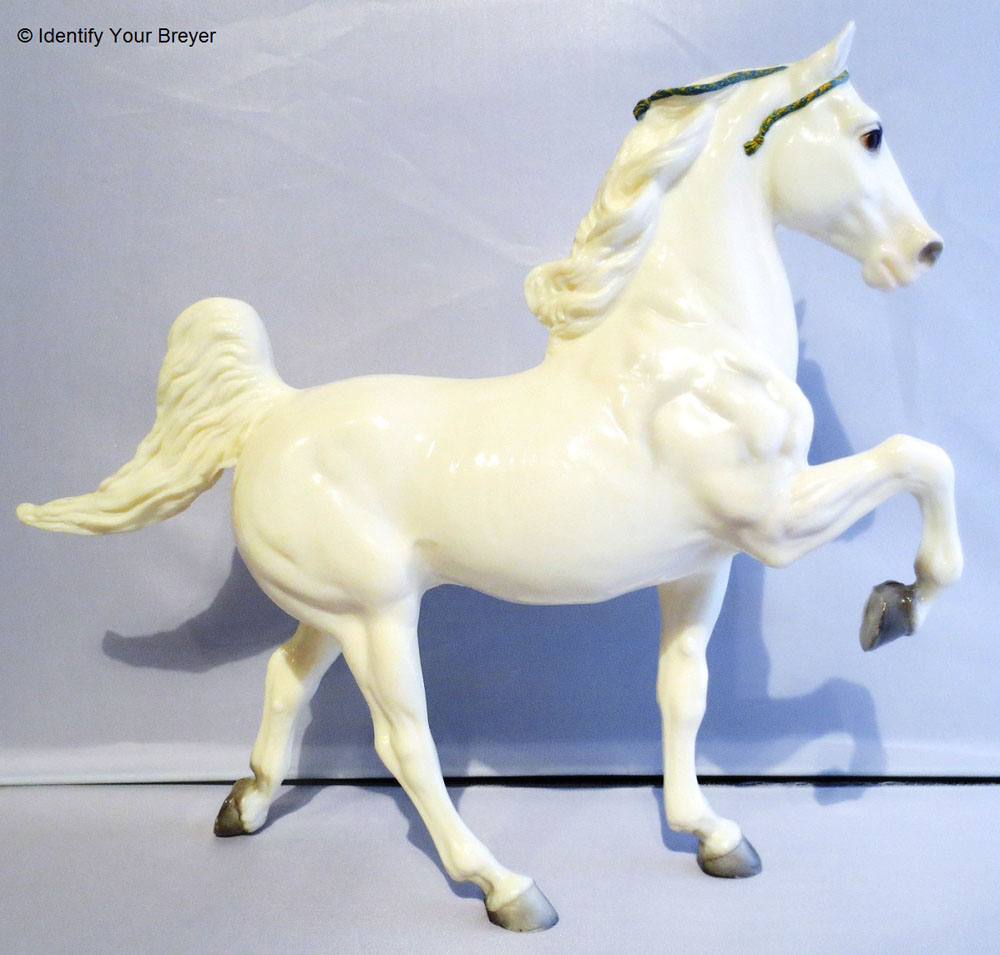
What I find kind of fascinating about this particular release of Hamilton is that he is an intentional callback to another iconic Breyer release: the #53 Palomino Five-Gaiter!

That release used to be such a cornerstone of many hobbyists’ collections in the 1970s and 1980s along with his brother, the #51 Albino, until the mold’s recent fall from favor.

What was interesting about the #53 Palomino was that it was made well into the “Matte Finish” era, not being discontinued until 1971. As far as I know, it was never officially made in a Matte version – sure, I’ve heard the rumors, but I’ve never actually seen one in person.

Later ones are definitely a different shade of Palomino than earlier ones, though some of that can be attributed to the fugitive nature of the Palomino paint Breyer used back then. (Under normal/average environmental conditions, early Breyer Palominos tend to turn slightly brownish with age, to a more golden honey color.)

But yeah, I am definitely not going to get my dander up about the Palomino Hamilton until I absolutely have to. And probably not then, either, likely because we will be obsessed with another (real or perceived) Reeves marketing flub by then.

Friday, February 9, 2018

Another Oddball FAM

Here I thought I was doing pretty good earlier this week when I picked up an inexpensive box lot of unicorns through a local auction house. Even after taking out a few treasures for myself (the Hagens), I should be able to make a nice little profit from the rest of the lot at BreyerFest.

Then I saw what that Mahogany Bay Family Arabian Mare went for on eBay. Yikes! If only I could be that lucky.

Well actually, I have been, but my problem is that the really good stuff tends to stick around. The ability to own a rare and beautiful thing tends to trump whatever financial considerations I have – and it’s usually easier just to sell off things I am not as emotionally invested in, horses or otherwise, until the need passes.

Ironically, one of the models I had been waffling on has been my other Oddball/Test Color FAM, here hanging with a couple of friends:


Isn’t she lovely? She’s basically a mid-1970s Matte Palomino with a Palomino mane and tail, a simple yet surprisingly effective alteration. I assume she was another Factory Employee Take-Home, possibly a Cull that was fished out of the reject bin and finished for gifting.

I picked her up pretty cheaply several years ago on eBay, before Family Arabian Mares of any stripe were a thing. I remember being a little apprehensive about paying that much money for what was essentially a glorified Matte Palomino FAM.

It doesn’t seem as foolish a deal now. (Less than two percent of the Mahogany Mare’s selling price, if you’re curious.) She is staying: she only happens to be on my sales shelving unit because I am still in the process of reorganizing here.

I have to say, though, that I am as shocked as anyone that the Family Arabian Mare – who has been, historically, the least appreciated of the three Family Arabian molds – is now a “hot” item.

This is good for her, though not so good for me. I might have to find another lightly collected, underappreciated and cheap Traditional mold to obsess over now, or at least until this craziness blows over.

Saturday, December 24, 2016

Winter Wonderland and His Hooves

Last week at work, after having to listen to the local radio station that plays Christmas music all day play “Winter Wonderland” for the umpteenth time, I turned to a coworker and said “If they play this song one more time, I swear, someone’s gonna get hurt…”

It’s not that I dislike that song, particularly, but sound repetition drives me crazy.

So what shows up on the Internet this week? Pictures of next year’s Holiday Horse, named (naturally) Winter Wonderland:


The past few Holiday Horses haven’t done much for me. Though I liked the partial Chalky Mulberry Esprit in the Bayberry and Roses set in 2014, the decorations/“costume” it came with screamed “We got such a deal on ribbon this year”. This year’s Woodland Splendor, on the Lonesome Glory, was more my Mother’s style of holiday decorating, not mine.

(Feathers. Always with the feathers…)

But you know what? I love Winter Wonderland. A Pearlescent Palomino Totilas covered in white fake fur and owls? It sounds as absurd as the Holiday Horses that preceded him, but this one somehow works for me. I want to rein in my horse spending a bit more next year, but Winter Wonderland still makes it on my want list.

I especially like the gray hooves, which are a nice Vintage touch. Gray hooves used to be the standard hoof color for Palomino paint jobs, pre-Reeves (ca. 1984/5). There were some exceptions – most notably the Fighting Stallion, Five-Gaiter, and earlier examples of the Rearing Stallion – but if any model was issued in a generic Palomino paint job in the 1970s or 1980s, gray hooves were the norm.

Gray hooves on Palominos were never completely phased out, and they still turn up on releases with solid-colored legs. But tan or pink-hued hooves are now more likely to be seen on legs with socks or stockings.

So that’s why that little touch on Winter Wonderland stood out so much to me.

One thing I’ve found aggravating about some of the more recent Vintage-styled releases is that while they get the general concepts correct, the littlest details often go wrong.

Hoof color has been one of those littlest details. For instance, for some strange reason Reeves can’t grok the idea that Gloss Honey Bays usually came with Black hooves, not Gray ones. The Vintage Club Honey Bay Cantering Welsh Pony, for instance:

http://www.identifyyourbreyer.com/images/712169bay1.jpg

Yeah, yeah, I know that several Matte Bays from the 1960s and 1970s came with Gray hooves, like the Grazing Mare and Foal and the Stretched Morgan. But Glosses were almost always Black, darn it!

But they do seem to grasp the overall picture of Vintage Palomino paint jobs, and Winter Wonderland is more evidence of that. (Yes, I am still hoping for a Vintage Club SR in Neon Yellow Matte Palomino.)

Tuesday, January 6, 2015

More is Not Always Better

This model was one of the unexpected delights of a recent box lot:


Easily the prettiest Gloss Palomino Fighting Stallion I’ve ever owned! I knew he was in there when I purchased the lot, but since I haven’t had much luck with Gloss Palomino Fighters, I wasn’t expecting much.

What makes him outstanding isn’t necessarily his condition. He’s not perfect - there’s yellowing, and a few minor rubs - but the amount of money and/or effort I’d need to upgrade him to a "live show quality/live show ready" piece means he’s probably sticking around a while.

His color is really nice - sort of halfway between the Orangey Palomino he was when he was issued, and the Honey most of the early Gloss Palominos turn into. He’s deeply glossed too, typical of earlier pieces, ca. 1961/2. (He was a part of the ca. 1959-1962 box lot, so that makes sense.)

No, what makes him swoon-worthy is his body shading: this model has some of the nicest body shading I’ve seen on any Vintage, Original Finish model. Whoever painted him was either one of the better painters on staff, or was having an exceptional day at work.

"Body Shading" is the term I use to describe monochromatic (single color) paint jobs where shading is achieved by working with the musculature of the model itself, and using the underlying plastic as a secondary color. Lighter areas are lighter because there’s less paint there, and darker areas are darker because there’s more.

All it took for a richly shaded finish back then was a single color, applied with a deft touch. Some practice and talent played a part too, obviously; I’ve had my share of flat-looking Vintage pieces, especially on the Palomino Fighter. That’s why this guy stands out so for me!

The "Body Shading" technique was the primary way of shading models throughout the 1960s and early 1970s, but not the only way. With Alabaster models, for example, they had to take the opposite approach: contrast was achieved by shading the grooves of the musculature directly, usually with a fine gray line.

Executing the "Linear Shading" technique well also took some skills and practice; I’ve seen a few examples that looked like they were tagged by unusually incompetent graffiti artists. 

Both techniques are still used today, but usually in tandem with other techniques, and multiple layers of paint. As this Fighting Stallion shows, more is not always better.

Monday, December 22, 2014

Original States

Before I forget, here’s my Banff:


As others have pointed out, he still has the "B" mold marks on his horns, 30 or so years after that experimentation with different plastic ended. But they did remove the U.S.A. mark in the meantime!

The difference there is that the B mark was originally for internal inventorying purposes (keeping two incompatible plastics from mixing) and may still serve a function in making sure the separately molded horns go in the right slots during production. The USA mark was to comply with import/export laws. Reeves might have run afoul of the government if they hadn’t removed it.

(Speaking of the removal of the USA marks in general, it is so weird for me to see newer hobbyists refer to models with USA marks as "older"! Well, technically, I guess…)

Since the Family Arabian posts have been going over so well, here’s another: how about a look at a matching set of FASes, from that fascinating ca. 1959-1962 collection I bought a little while back?


The Charcoal and Palomino Family Arabians didn’t debut until either 1961 or 1962; the 1959-1962 ephemera gap leaves the exact date up to debate. Although Palomino had been a part of the Breyer color palette from the very beginning, Charcoal didn’t debut until ca. 1961, appearing on both the Fighting Stallion and the Rearing Mustang.

Breyer’s Black Pintos prior to 1961 did come with white manes and white/partially white tails. Unlike the Charcoals that followed, the black paint on the Pintos tended to be unshaded, or at the very least undifferentiated (no black or blue undertones).

What’s interesting about the simultaneous appearance of the Palomino and Charcoal (aka Charcoal Palomino, on some early mail-order sheets) is that they both used the same mane stencils/masks. All of the other colors manufactured on the Family Arabians/Old Mold Arabians didn’t need them; the only other masks they did use on the Arabians prior were the facial markings for the Bays.

The near side of the neck is plain, by the way, with none of the extra stenciled tendrils or hairs that show up on other examples. The outline of these stencils did change significantly over the years, especially on the near side; other hobbyists have done a better job of tracking those changes, though.

What I like about these guys - and part of the reason they're sticking around - is that they likely show us the "original state" of the stencils. At least until further research proves otherwise.

You know how that goes.

Monday, November 24, 2014

Red Shift

Just to show you that the Five-Gaiter thing wasn’t me being a pill about condition, here’s a box lot baby I do intend to keep:


A poor three-legged Bay Old Mold Foal! Minus the missing leg, he’s in not bad condition - it’s just the typical ear-nose-hoof rubs and stuff. Since I have had a notoriously hard time finding Old Mold Mares and Foals in any other color than Alabaster, a three-legged Bay Foal is a treasure. He can keep my ragged, 50 cent Gloss Alabaster Fighter company!

As mentioned in the comments last post, I am not sure if early Breyer Bays were subject to color shifting like the Palominos. It’s possible, but I haven’t seen enough early New-in-Box Gloss Bays to compare against more "weathered" Bays, nor have I seen any early Bays where the color was noticeably different from one side to the next that could be indicative of prolonged exposure to the sun, heat or other environmental factors.

It’s definitely an issue with Hartland Bays - like many Hartland Palominos, the red base in the paint fades, leaving the models a distinct shade of green (Olive for the Bay; Chartreuse for the Palominos).

The red shift/red fade does happen with some early Breyers, but tends to be limited to those models that came with pinking of the eyes, ears, muzzle and hooves. Since it is limited to accent areas - and the absence of the pinking tends to be so complete - the lack of pinking is sometimes labeled as a variation or production error.

It’s also not that much of a dealbreaker; while we’d prefer the pinking to remain intact, most hobbyists are not going to turn noses up on an otherwise flawless model without it.

There is some color-shifting going on with Shrinkies, to be sure. Chestnuts turn peachy-pink, and Bays turn to Buckskin. But that’s a slightly different process there - a chemical reaction that is primarily a result of a breakdown of the plastic itself, and not a consequence of environmental issues. (Though excessive sunlight, heat and humidity certainly don’t help!)

Whatever other color shifting may be occurring with some Breyer paint jobs, nevertheless I haven’t seen anything green that didn’t start out green in the first place, either by design (Little Bits Unicorns, some of the Classics Blossoms) or by default (Dappled Green Bay Sham).

There’s been some recent speculation that the reason why Reeves hasn’t released any new "Christmas" Decorators may be due to the issues with color shifting or fading, especially with the color Red. Indeed, it could be the reason why the mythical Christmas Decorators might not have made it past the testing phase back in the 1960s.

But here we are speaking of a hypothetical of a hypothetical: we don’t have any confirmed examples of Christmas Decorators in the first place.

Oh, and re: other posts on the topic of fugitive paint, the most recent - I think - was the one last year about the 2013 Volunteer Clydesdale Mare. I really need to index these posts better…

Friday, November 21, 2014

Orange is the New Palomino

So crazy here right now - the second collection came in this morning and I’ve been busy cleaning and sorting ever since. Then they changed my work schedule at the last minute, so that leisurely weekend of horse cleaning I was anticipating vanished!

I’m hoping that I’ll be able to get some of the better stuff on MH$P by Sunday afternoon, at least. No promises on that.

Both collections came with Palomino Five-Gaiters, both in similar condition (a little beat, but restorable), but completely different in one important respect: Color!


The Honey Palomino one is obviously older, and the Orange one much newer; he’s so "new" that he comes with a USA mark.

The Palomino Five-Gaiter was in production through 1971, and the USA mark was introduced ca. 1970, so one with a USA mark in itself isn’t all that unusual. A scarce and somewhat undercollected variation perhaps - like so many late-in-their-run variations - but not RARE rare. 

The variation in the color is noteworthy, however. As I’ve mentioned before, early Palominos didn’t start out "Honey", they turned that way. The Honey Palomino one above started out life pretty much the same color as his younger brother.

Breyer eventually switched the formula for the Palomino to something less fugitive (less likely to change color) in the late 1960s or early 1970s. Exactly when is unknown, but it’s obvious it had to have been by 1971. That Orange Five-Gaiter has gone through pretty much the same rough-and-tumble life as the Honey one, minus about a decade's worth of time.

But he’s at least 40 years old - and without a hint of browning.

You can see the same phenomenon with the #22 Palomino Pinto Shetland Pony, too. Later Matte and Semi-Gloss examples from the early 1970s are just as bright and cheerful a shade of orange as the one Five-Gaiter, above. I’ve owned enough of those Shetlands - boxed and unboxed, and in every condition from LSQ to body - to conclude that the lack of a color shift is not anomalous, or due to any special handling. The paint was just different by then.

Sadly, I won’t be able to keep either Gaiter; I’ve been looking for a nice one for years, but the timing isn’t right for either one of these pretty boys. Not sure when either of them will be ready for the sales list, though.

Tuesday, November 5, 2013

An Uncommon Hope

I did get my JAH Annual the other day; I haven’t had a chance to look it over too closely because I’ve been preoccupied with older and more pressing business. I did notice that this year’s Volunteer Special Clydesdale Mare was given a name after all: Opry. At least, I think it’s Opry: I also noticed a higher percentage of typos than average, so for all we know, it could be Oprah. (Which would be fitting, since Oprah’s name was misspelled on her birth certificate!)

Since I am in the middle of a project with a deadline (Not NaNoWriMo! Thbpp!) here’s another interesting Variation I dug up during the recent inventory - on a Yellow Palomino Family Arabian Mare:


Her facial markings are masked! It’s a little hard to tell because the color is so light, but it’s not the softer airbrushing typical of the standard Breyer bald face. There’s a definite edge and shape to it.

I thought at first that it was either a case of someone getting creative with the nail polish remover, or just one of those random production variations that turns up from time to time. The collection that I found her in ruled out the first theory, and research on eBay showed me she wasn’t alone in the world, so she wasn’t a one-off, either. She’s legitimately a Variation.

Most hobbyists focus on Variations that occur early in a model’s run, because typically that’s where most of them occur. Either corrections are being made - like with Misty’s pattern or Halla’s star - or simplifications to the production process are.

Less common are alterations that occur near the end of a model’s run. They tend to get overlooked because they occur more frequently on common models with extended production runs: whatever changes are made are attributed to being of the random sort, if they are even noticed at all.  

They’re less common because a model that’s been in production a kajillion years isn’t going to rack up huge numbers at the end of its run, new facial markings or not.

Why these changes were made is more of a mystery. It seems unlikely that they would have thought that a minor tweak in the paint job would boost sales sufficiently to justify another production year.

My guess would be that these kinds of models represent "end runs": last batches of lower-selling items that were made sometime after the last previous batch, to cover projected sales.

It’s possible that they had enough of an item warehoused that the mold wasn’t put into production for an extended period of time. When time came around to making another batch of this item on the verge of discontinuation, maintaining consistency with previously issued pieces was not a high priority. Close enough is good enough.

If some collectors or hobbyists did happen to notice the difference, all the better - and more space in the warehouse! If not, well, it was going to be discontinued anyway. No harm, no foul.

Wednesday, March 13, 2013

FAS Yellow

I’ve barely been home the past three days, which is what I expected when I took a gander at the work schedules last week. I have tomorrow off, but a dentist appointment is involved, so it doesn’t really count. Plus I have another round of packages that I have to get out of the house tout suite.

I’ve finally started doing that herd culling I've been mumbling about for months now. With flea market season rapidly approaching, I forced myself to make the time for it. Outside of a couple of box lots I bought primarily to resell, though, I haven’t had too many new additions to the herd since BreyerFest, mostly because of the space (and time!) issues.

My criteria this go round is: If I don’t absolutely love it, or it doesn’t have some personal or historical significance, it’s gotta go.

The issue being that I love a lot of things, and as a kinda-sorta historian, I can find significance in almost anything, if I look long and hard enough. One particularly hard decision, for instance, was this guy:


It’s Little Man, from the Kelly Reno and Little Man Gift Set. I ultimately decided to cull him because he’s a little on the yellowed side, and I’d like to upgrade to a NIB set in the future anyway.

Heaven help me, it’s the color that’s most appealing to me: I don’t know why, but that hideous acid yellow Palomino colorway from that time period (early to mid-1980s) has been fascinating me of late.

(Let’s call it, for the sake of expediency, FAS [Family Arabian Stallion] Yellow, after the model who’s best known for it. The actual term I use for it isn’t exactly family- or Internet-friendly.)

I have this wild fantasy of a Vintage Club offering in this most eyeball-watering of colors, though I’m not sure who would get the honor of wearing it. Especially since most molds in the 1970s and 1980s - either as a Regular Run, or a Special Run - ended up sporting it at one time or another. Even molds as unlikely as the Pacer, the Belgian, and the Bell-bottomed Shire have already had their turn. (And I have them all! Mwah-ha-ha!)

Vintage Traditional molds that haven’t come in this color yet include: Man o' War, Trakehner, Stretched Morgan, Shetland Pony, Legionario, Appaloosa Performance Horse, the Clydesdales, Galiceno, Proud Arabian Stallion and Mare, Justin Morgan, Scratching and Lying Down Foal, Sham, Smoky, Stock Horse Mare, Stud Spider…

(Not including known Test Colors. Some of them came in different shades of something Palomino-like, like Stud Spider, Sham and the Shetland Pony. I am talking about FAS Yellow. My cut-off date for "vintage", BTW, are molds in production/conceived pre-Reeves, ca. 1985.)

As you can see, it’s not a huge list, and a number of these molds have already been utilized - or will be utilized - in the Vintage Club. Plus, the fact that FAS Yellow is probably one of the least-loved (to put it politely) of vintage colors means that it’s highly unlikely we’ll be seeing it on an new release any time soon, unless it ends up being one of those targeted mini Special Runs, like they did at the last Vault Sale. I can only imagine the reaction that would engender. (I hit refresh how many times to see THAT?!)

So I’ll just have to keep on dreaming about that FAS Yellow Man o’ War, Morgan or Trakehner. Though if I do, somehow, end up with a shot at a "Design a Test Color" thingie, I am so doing that. "She wants WHAT? Are you sure?"

Thursday, March 31, 2011

Gloss Palomino

I was going to adopt a LA LA LA CAN’T SEE YOU approach here to the Sunshine Celebration Whatsit down in Florida, and mostly I have. But I have to at least laugh and point at a particularly amusing sentence on the Facebook page regarding one of the event’s Special Runs of "Key Largo & Key West:"

Pictures do not do justice to this breaktaking pair.

Breaktaking? Awesome. Henceforth, I shall refer the act of taking a break at work as breaktaking. As in, "Sorry, I can’t help you, I’m breaktaking."

What makes the sentence even better is the tacit admission that they know they have some issues in the photography department. "They’re much better in person - trust us!" Yeah, we know that. We know it so well that some of us are beginning to wonder if it’s been a part of the marketing program all along.

It does seem a little weird to me to see two Gloss Palomino releases announced in the space of a week - and possibly a third, if the rumors of Gloss Finishes on the Weather Girls comes to pass. It’s either a crazy coincidence, or someone in the design department at Reeves has Palomino on the brain.

Gloss Palomino hasn’t gotten as much attention as other vintage colors, like Charcoal. We haven’t been totally bereft of Gloss Palomino in recent years - the 2004 Collector’s Edition Old Timer "Noddy," comes to mind, as a particular favorite - but they’ve generally been few and far between.

I’m totally okay with the current Gloss Palomino fixation. The Othello "Pamplemousse" - the upcoming JAH Special Run, in pale palomino sabino - looks almost good enough to eat in that color. (I do love grapefruit.) I don’t have many Othello models, mostly because he takes up as much real estate as a mid-1970s Cadillac, but that one might be coming home with me.

Don’t know how the "taking orders prior to production" thing is going to work out, though. It’s a good idea in theory - making just enough to fill orders, with a few spares for damages - but I have a bad feeling that it will be a matter of a month or two before we’re barraged with complaints about the long delivery time.

(I used to make fun of all those reading comprehension tests we had to take in school. How can anyone know how to read, and not know what they’re reading about? Alas, the Internet - and some segments of the online model horse community - quickly disabused me of that notion.)

Sunday, March 6, 2011

Safety Orange

Looks like my schedule will be a little bit better this week - not a lot, but a little. Next week looks like might be a rerun of last week, though. Sigh. (Seriously, does anyone out there want a copy of my resume?)

Bigger pictures of the new Treasure Hunt mold Weather Girl are out now, and boy, is that black one nice. I’ll definitely have to cough up the cash for that little lady. The Palomino and Gray Pinto are also pretty spiffy, but like everything else, I’ll have to take a wait and see approach to see if buying a full set is financially feasible.

Let me confess to a total reading comprehension fail regarding what the BreyerFest Store Special was: it’s not the Black Pinto Huck "Black Tie Affair", but a Dappled Palomino Halla/Bolya "Dusty". (I’ll blame it on my outdated eyeglass prescription.)

I don’t know if it’s because the mold already came in Palomino, as the 748 American Warmblood in 1998 and 1999, or that I prefer the braided Halla version of the mold, but I’m just not feeling the love for "America’s Horse" just yet.

(Could be the whole "America’s Horse" thing, too - seems like an awfully presumptuous title to me. Was there some sort of reality show competition I missed out on? I’d totally watch an American Idol-style reality show with horses. But I digress.)

It could be that it’s the photo throwing me off: he looks way more Safety Orange than Palomino. Are they going for a retro "Palomino FAS" vibe, or am I being tripped up by another bad photo? I loves me some crazy colors, but I’m not sure I want something that could be mistaken for a traffic cone.

It’s gotta be a bad photo. That, or my monitor needs some serious recalibration.

Wednesday, June 24, 2009

Charcoal Palomino?

I was reviewing some of my earlier material the other day - the stuff from that nebulous, lightly documented period of 1961/2 - and again found myself wondering about the origins and history of the color Charcoal.

The color Charcoal didn’t make its debut on a Breyer model until ca. 1961, when it first appears on the Mustang. On the duotone insert sheet, he’s simply listed as "Charcoal." (Interestingly, Charcoal is not listed as an available color for the Fighting Stallion, which means he might have been a later, or last-minute addition to the lineup.) Charcoal is the term used to describe this color in all known Breyer catalogs and price lists (except in the rare instances where an exceptionally dark Smoke model that could pass for Charcoal was represented. Those were still called "Smoke.")

However, in a couple of early mail-order fliers - both from Red Bird Sales, and Mission Supply House - the term used to describe the same color is "Charcoal Palomino." The fact that both of these mail order companies used this rather idiosyncratic way to describe this color suggests that they took it from the same source: presumably, from a still-missing wholesale price list from that era (1961, I'm guessing.)

Here’s a little snippet from the ca. 1961 Mission Supply House flier. I was going to include clips from the ca. 1961 Red Bird Sales flier, but they’re really poor quality multigenerational copies and rather unsightly. This is straight from an original.


That Breyer used one term to describe a color in the catalog, and quite another on their wholesale price lists, is something we covered briefly just a couple days ago. It’s not a surprise. Or a really big deal, to be honest, though it does suggest an interesting research topic.

What if Charcoals were actually based on an actual photograph of an especially Dark Palomino? Or maybe it was a photograph that labeled this color "Charcoal Palomino"? If so, it could be possible to track down the photograph that actually inspired the color.

Were other oddball colors - like the Gray Appaloosas, and "Honey Sorrel" also taken from similar photographic inspirations? Hmm.