Showing posts with label Rugged Lark. Show all posts

Sunday, September 3, 2017

Rising Above

I do not have much to offer today; I’ve spent most of my extended weekend cleaning and organizing things, with a little bit of crafting on the side to break the tedium.

It rained this morning too, so there are no fun new “finds” to overanalyze. This is for the best I suppose, with that carousel auction coming up next weekend, and a possible mini road trip later in the week for a garage sale.

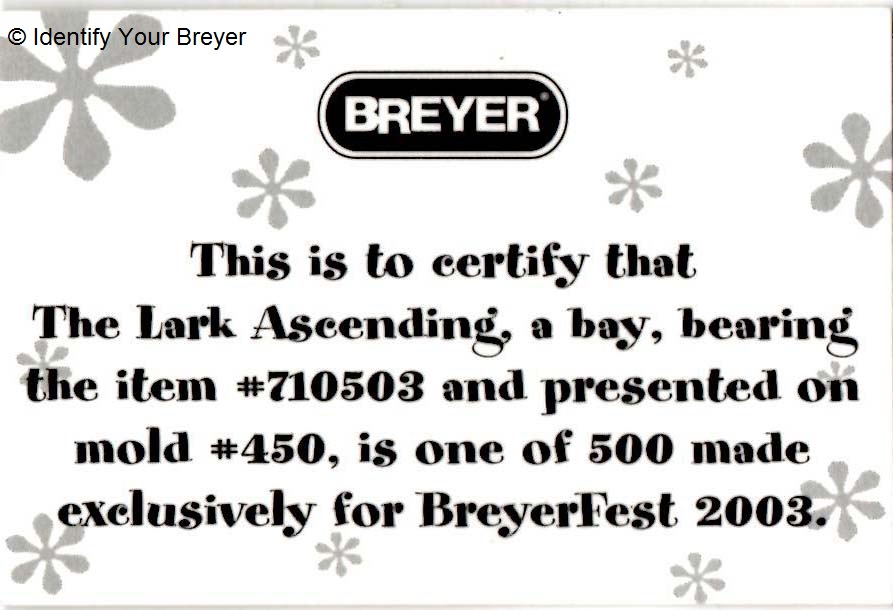
So here’s a picture of one of my BreyerFest finds, a nice example of the 2003 BreyerFest Rugged Lark Special Run of The Lark Ascending. He was cheap, he was in mint condition, and he was signed. He didn’t come with his teeny-tiny “Certificate of Authenticity”, however.


The last year they handed out certificates for the larger run BreyerFest Specials was 2006. The practice is now reserved primarily for prize models; as much as the hobby loves and lives for its paper documentation, it was stunningly impractical to hand out certificates for models with piece runs in the hundreds or thousands.

I kind of wanted The Lark Ascending that year, but when I managed to get a really good place in the line for a change, the two porcelains – the Othello Galway Warrior, and the Stablemate Seabiscuit – took priority instead.

The Lark Ascending has been a backburner want since then. They did a nice job on his color, with extra shading and metallic undertones to add a bit of sparkle to what could have been another ho-hum Bay paint job. The more I saw him, the more I thought Yeah, I think I need that guy.

The release exists in that strange state of being both relatively rare (only 500 pieces) and somewhat undesirable (being on the Rugged Lark mold). While it wasn’t hard to find one for sale, finding one at a price I was comfortable paying was the real trick. Physical rarity alone is not, and should not be, a guarantee of an elevated resale price.

And then this guy turned up during my late Saturday CHIN shopping marathon, at a price I literally could not walk away from. Sure, he didn’t have his little certificate, but I have gotten used to coming home from BreyerFest without them.

Monday, March 17, 2014

The Unsellables

I spent most of my waking hours over the weekend organizing the last of the tax paperwork: I sold more, it’s true, but I also bought more, and the difference between what I bought and what I sold is going to be almost identical to last year’s difference.

Funny how that works!

My downfall this year, again, was the retail end: too many store impulse buys. If my schedule continues the way it has been, though, that shouldn’t be much of an issue going forward. (Though I hear rumors of models reappearing at Tuesday Morning. Must. Stay. Away.)

A lot of what I sold was older, lower end items, and quite a bit from the dreaded period from the late 1980s through the mid-1990s: aka, The Age of the Unsellables.

Don’t let the online community fool you: now THAT was the true dark ages of Breyer quality control. Reeves had just taken over production and shipped it to New Jersey - with some, but not all of the Chicago crew. (Just the handful who were willing to move from Chicago to New Jersey.)

Coupled with the fact that Reeves had no idea what it had gotten into - well, it showed. Rough seams, undistinguished paint jobs with masking issues, questionable choices for sculptors, and problems with the plastic itself that later morphed into Shrinkies and Oozies.

Things didn’t seem so bad at the time, because there were some genuine bright spots. The first BreyerFest was in 1990. Models like Breezing Dixie and Precipitado Sin Par were early and moderately successful attempts at more complex paint jobs. Detailed, handpainted eyes and hooves reappeared on certain releases, as did Vintage colors, like Gloss Charcoal on the 1992 release of Memphis Storm.

The darkest parts were the new molds that they gave us: headshakers like Khemosabi and Rugged Lark, and pieces like Roemer and Misty’s Twilight that were more conceptual and "artistic" than realistic. While I didn’t have any problem with more artsy-fartsy molds, the increasingly complex and realistic paint jobs Reeves was putting on them did feel incongruous.

There is room for both approaches, but it’s rather hard to pull off on the same model.

By the end of the decade, however, we had molds like the Silver and the Huckleberry Bey, both of whom are still popular - almost too much so, in Silver’s case. While they may not be up to the almost too rigorous standards of today, consider that only ten years separates them from the likes of Khemo or Rugged Lark. They hardly seem like products of the same company, in retrospect.

Anyway, back to the selling aspect. I haven’t had too much trouble selling "Unsellable" Era models: at the right price, in the right marketplace, you can sell almost anything. I’ve found that New in Box items from that era sell moderately well at low - but not unreasonably so - prices.

For out of box items, it all depends on condition and relative quality - is it a good piece compared to others of the same kind? Is it something that at least has moderate value as a body (Adios, Lady Phase, G1 Stablemates, Love Classics)?

Fortunately for me, most of the items I resell from this era I pick up from my usual haunts, so my emotional and financial investment is not very substantial to start. For what they are and for what I invest in them, I do fine.

There is no model so homely that it cannot be loved by anyone.

Saturday, November 2, 2013

The Marks of Larks

After pontificating about my disinterest in minor color or finish variations, I will now show you the kind of minor variations I do see fit to have in my collection:

 
No, it’s not the color that piqued my interest in these Rugged Larks - though the difference is a nice little bonus. What I find significant between the two: one has a mold mark, and the other does not. (BTW, yes, I did discuss the unmarked one before, here briefly.)

The mold mark is so small and slight that most hobbyists would consider it just as inconsequential - if not moreso - than the color. It’s a small, flat area with a copyright symbol and the words "BREYER REEVES" next to it. If you weren’t looking for it, you wouldn’t see it. (I’m not even going to try and photograph it!)

The model without the mold mark is, naturally, the earlier one; there’s even a third #450 Rugged Lark with yet another mold mark - the number 97, added to the mold when Lark was reissued in 1997. (That one I do not have. Yet.)

I consider minor mold variations to be far more significant - and interesting - than minor paint variations, because unlike paint jobs, the changes are intrinsic to the mold itself.

All models painted on a given day may look different, but all models molded on that same day are going to be structurally the same - unless there was a repair or tweak made to the mold that very day, mid-production. If you’re familiar with the injection molding process, you know that this is very unlikely.

Because they are not so easily or quickly modified, mold changes are traceable through time in a way that paint jobs are not. Even if the changes only involve the subsequent removal of an added mold mark, it can still leave evidence behind. Such as in the case of the early Sea Stars, which I’ve discussed in greater detail in an earlier post, here.

By tracking minor mold variations, we are able to more precisely date models of questionable origins, and discover "hidden" Special Runs and Reissues otherwise indistinguishable from Regular Runs, like my Bloodhound with the USA mold mark.


(The #325 Bloodhound was discontinued in 1968 - well before the addition of the USA mold mark ca. 1970!)

The fact that Reeves apparently has - or had - several skids worth of older bodies with earlier mold marks does complicate things, though I hope that our current standards of documentation will render the issue moot.

What’s scary here is not my obsession over mold marks, but the fact that I have four different Rugged Larks in my collection, even after the culling. I only culled a fifth because the BreyerFest SR The Lark Ascending has become something of a minor grail, and I wanted to make room, just in case.

Thursday, May 26, 2011

Rare but Worthless

It was kind of warm and humid a couple of nights ago, so I started up my window fan, and then I noticed that The Toad - who resides on the same shelf as the fan - looked especially … shiny. It hadn’t been raining (for a change) so the only obvious source of moisture was from within.

Darn it! Looks like someone’s gonna hafta spend some quality time in the fridge between now and July, because I don’t want to change his name to "Horse Parts."

I was on a roll yesterday; I think I found the body I needed for the Happy Endings Contest, and possibly a component of my Costume Ball entry. (Note: it is not footwear.) My coworkers think it’s a fabulous idea, but I’m worried that their affirmations caused some sort of ripple effect in the Universe, meaning I will get picked to volunteer this year.

The one year that I did, I had to sit out on both the NPOD, and a raffle. (Missing that raffle wasn’t too bad, but missing the Pit? Hated it!) Finally coming up with a faboo costume idea, only to have to sit it out? Oh well, best not to think about it unless I have to.

I’m still working my way through the massive pileup on bodies here in the Cave. I’m waffling on a couple of "keepers" here; a couple of obscure variations that are tickling my fancy. Both are technically rare - as in, not made in large quantities, or for an extended period of time - but both are also considered worthless. One of them being this Rugged Lark, here:


He’s one of the early ones without any mold marks. In pretty good shape, too, just a couple of slight nose rubs. I had been thinking about adding one to my collection for the past few years, if for no other reason that I think rare and unwanted things need to be collected, too.

I never got around to him before now, because mold marks aren't the easiest feature to detect in an online auction. Even when a seller says it isn’t there, it usually is, because the mark is different from the typical Breyer mold marks: instead of the familiar copyright horseshoe, it’s a small flat area with a bit of type, often fainted molded. Easy to miss? Yes, very.

Finding one in a less-virtual venue wasn’t any easier. Nothing marks you for more of an amateur at BreyerFest than flipping a horse over to inspect the mold marks. Telling a seller I’m looking for something else, really, often gets me the rolled eyes and the what-an-idiot look. And if the seller knows who I am, sometimes I’ll get the what-did-I-miss look and the dreadful feeling that price negotiations aren’t going to go very far.

The "rare, but worthless" phenomenon occurs in just about every arena of collecting. When I was still active in comic book collecting, I used to obsess over the minutiae in the Overstreet Guide. (It’s mostly a price guide for vintage comics, but there’s a lot of history in it too, once you learn how to "read" it.)

Anyway, as I’d be plowing through my Overstreet, I’d see the notation of "Very Rare - Less than 10 copies known to exist" from time to time. I’d look at the estimated values, and often as not, there’d be no correlation. There were some genuinely rare, virtually extinct comic books out there that nobody wanted. That would always blow my mind.

The reason for that was simple: the content of those comics was undistinguished. The inherent value of most comics is not a function of rarity, but of significance: the first appearance of a major character or team, the first work of a well-known creator, the first printing of an important or award-winning story. A generic, random issue of Action Comics from the mid-1940s with a low print run is worth a lot in Pristine Mint condition, but nowhere near the same amount of money as even the lowest grades of a copy of Action Comics #1 - the first appearance of Superman.

For a while there, I thought about starting an archive of "rare and worthless" comic books, but before that idea ever got off the ground, the horses dragged me back into their world. But the notion of collecting the rare, but worthless still lingers.

Saturday, September 11, 2010

On a Lark

Lots of good stuff in the JAH this week (including me!), but I’d rather talk about a recent addition to the herd today:


Yeah, a Rugged Lark cull! The money situation being what it is, I shouldn’t have laid out the cash, but I felt sorry for him. He’s about as low on the totem pole of desirability as you can get. And weirdo me, I just had to have him.

I’m pretty sure he’s a cull: his forelock is unpainted, his lower legs were unfinished, and he lacks shading in the usual areas. The paint on his mane is rather sloppy, so that’s how he ended up in the cull bin in the first place. It looks like someone touched up his hooves and face a bit to make him more presentable.

Well, as presentable as a Rugged Lark can be.

His head and neck are pretty tragic, but I don’t completely dislike the mold. It’s the pose that he’s been sculpted in: I find his inherent awkwardness appealing. Too many model horses - OF, customized, resin, whatever - are a little too conventionally or artfully posed, and in the process come off as a little less realistic, at least to me.

I can remember being in my life drawing class, years ago, and the instructor imploring us to not shy away from the awkward poses. (These were people we were dealing with, by the way, not horses. Naked, and rarely the most attractive, either.) Our bodies can get into all sorts of awkward positions, and those positions can be beautiful, too, if done well.

Rugged Lark’s problem is that sculpturally, he’s not done well. I’m not a stickler for anatomical accuracy, but even I have my limits. (Unrealistic and unattractive are two different concepts: unfortunately for Rugged Lark, these concepts collide.) I’ve been tempted to get a Rugged Lark body and clean him up - while retaining his basic body pose and attitude - just to prove my point about the awkwardness. Customizing is something of a low priority in these parts, alas, so the point going to remain unproven for now.

The Rugged Lark mold hasn’t come in a very wide range of colors. Two bays, two chestnuts, a gray, and very briefly in a rather nice dark bay pinto. The only piece anyone even remotely wants is the BreyerFest SR of The Lark Ascending back in 2003, and that’s only because he had a very limited piece run (500) and a pretty nice paint job. I missed him back then, and had hoped to add him to my collection by now but so far, no luck. He's an expensive little bugger, especially on my budget!

For the time being, I’ll just have to settle for my cheaper, funkier, not-quite-bay boy.