Showing posts with label Chalky. Show all posts

Tuesday, November 7, 2023

Another Lucky Find

I know a lot of people are not fans of the concept in general, but if the time change manages to reset my internal clock, I am all for it. I am very tired of being very tired. 

It’d be fine with the not-sleeping, if I was actually getting anything done. But all the projects I am currently working on are, to put it kindly, long slogs. At what point did I think handpiecing a bed-sized quilt top that includes 684 bias-cut one-inch high equilateral triangles was a good idea?

Anyway, another “lucky” find arrived late last week: a Chalky #23 Bay Shetland Pony! 

I’ve had a lot of Bay Shetland Ponies over the years, and none of them really stuck around. The paint jobs were uninspiring, the seams were bad, they had condition issues, you name it. I really wanted a Chalky variation, but all the ones I found either (also) had condition issues, or were overpriced, or sold before I got to them.

Then I found this one for a super-affordable Buy It Now on eBay. I wasn’t 100 percent certain she was a Chalky, but the price was good, even for an ordinary Bay. I would have been happy even if she wasn’t what I thought she was.

But luckily, she was!

In terms of rarity, I’d put her somewhere in the middle of the pack. I think there are more out there than we imagine, because the color did debut in 1973, at the start of the “Chalky Era” (ca. 1973-1975), and new molds and new colors tend to sell really well at the beginning of their runs.

For example: the #99 Appaloosa Performance Horse and #61 El Pastor both debuted in 1974, and are among the “easier” vintage Chalkies to find.

The problem with this release – like the Chalky variation of the Midnight Sun – is that it’s a solid color with minimal markings. Even though she does have a bald face, it can still be difficult to determine if she’s a Chalky, because the overspray that was common on models from that era sometimes mimics chalkiness, especially in the overexposed photographs commonly seen over the Internet. 

She was never really a “Grail” model for me: I didn’t go out of my way to find one, or target one, and her absence from my rather abundant collection of Shetland Ponies never really nagged at me the way the Dapple Belgian sometimes did. But I did want one some day. 

So when the right model at the right price came at the right moment, I took it. 

And she is so lovely: nice dark coloring, and just a couple of itty-bitty marks and dings!

Tuesday, July 19, 2022

The Two Dollar Test

I still feel very much like a coagulated puddle of sweat and Gatorade, so you’ll have to forgive me for continuing to be a little antisocial until the end of the week or so. 

It’s nothing personal guys, I just think I underestimated how emotionally overwhelmed I’d be at being at the first in-person BreyerFest in three years. I thought I’d be prepared because I’d been to two live shows and Motor City Comic Con in the months previous, but I guess not!

Everything is out of the car, but I probably won’t be finished unpacking and sorting until the weekend. In the meantime, I also have to deal with some work-related stuff and getting the garden back in shape, too. (Wax beans are imminent!)

I wasn’t able to bring home the Dapple Gray Belgian or any of the Five-Gaiters I was looking for (there was a dearth of vintage stuff at the hotel this year), but I did find a few neat things I’ll be sharing over the next couple of weeks. 

But there is one little thing I do want to share with the group right now. I was actually getting a little obnoxious about it by the end of the weekend, but I think you’ll understand why when you see it.

I didn’t get a chance to go to the NPOD Friday morning, because I had actual stuff to do both at the hotel and at the KHP. I did hear about – and see! – some of the goodies pulled out of the “Body Bins” later in the day, though, including a Matte Dappled Black Five-Gaiter. 

(Yes, I whimpered a bit. But it went to someone who is almost as obsessed with vintage stuff as I am, so I know he will be well-loved.)

Since I didn’t have anything to do first thing Saturday morning, I decided to be brave and go for it.

The only complication I ran into was the fact that Reeves didn’t handle the numbered tickets very well: they had two sets of tickets for the two stores, and instead of handing them out more or less in order, (i.e. either one-one, two-two or in alternating groups of five or ten) they handed out the first 200 sequentially, and then the second set of 200 sequentially. 

That meant that many people would be getting into – and out of! – one of the stores before people who had gotten there several hours earlier. Not cool, guys! They also claimed that both stores had the same merchandise, but I knew that was not the case, which is why I fought to get into the main store in the Covered Arena. 

(This had apparently happened the day before, so that was something I was prepared for. And it was also remedied the next day. And forever, hopefully. This is not rocket science, guys!)

Anyway, after all that nonsense, I found this fabled body bin. It was almost all Classics that day, with some Traditional Foals also in the mix. I’m not as familiar with Classic oddities – in spite of owning an awful lot of them! – but I dug through the bin and pulled a few things out that I thought were worth my time. 

(Technically they were all “worth the time”: everything in the bin was Two Dollars!)

Then I grabbed this Ginger and said to myself: well, she’s peculiar:

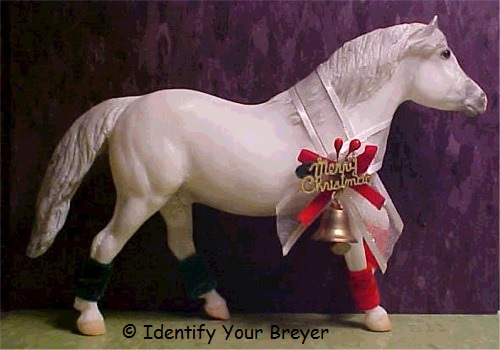
She’s Chalky, with natural-colored hooves, tons of pinking, and handpainted eyes. Yes, dear readers, I found myself a two-dollar Test Color! 

A friend of mine pointed out that she might be a Test for the First Christmas Horse Snowball, on the Haflinger mold, and I think she might be right, or at least in the neighborhood.

She’s not in the best condition, and I doubt she’d show well anywhere, but I love her all the same. Especially since I found her at a BreyerFest with a $65,000 Auction Test Color in it! 

I know that the prices at the Auction this year discouraged a lot of people from imagining that they could ever afford a Test Color, but as my little “Snow Baby” shows, it’s not always about the money. Do your research, do the legwork, and treasures will eventually find you.

(I’ll take her out of her bag, eventually.)

Sunday, June 19, 2022

Chalky Western Prancing Horse

In addition to all the other things I have going on right now, I was also “gently” reminded that I needed to finish dusting, so I had to spent a good portion of my weekend doing just that. That set my self-imposed deadline for the latest writing project back a day, but at least I won’t have to hear complaints about the dust for another six months or so…

I’d also like to know how I ended up with three Test Color Shetland Ponies. I don’t dislike her, but she’s also not someone anywhere near my “Top Ten”, so me ending up with that many Tests on her is kinda weird. 

In my defense, I didn’t spend all that much on all three of them combined, and I do not pass by cheap Test Colors, no matter the mold or color. (Dear Universe: A Test Color Trakehner would be a very nice change of pace. I will also accept a Morganglanz.)

It occurred to me that while you know may quite a bit about the fact that a Chalky Man o’ War was my first Breyer model, you don’t know much about the second and third models.

I didn’t get them until the Christmas of that same year: they were a #46 Pacer and a #110 Smoke Western Prancing Horse. The Pacer himself is unremarkable: he’s just the standard release in Liver Chestnut, with a few minor marks because Pacers are notoriously tipsy.  

The Smoke Western Prancing Horse, on the other hand, is also a Chalky:

Since I never had to search for another, it took me a while to realize just how scarce Chalky Smoke Western Prancers were. I’ve tried getting the Palomino, and even scored a few, but the ones I found were not in the best condition, even for Chalkies, and then the market went boom and I’ve pretty much had to give up finding inexpensive, misidentified Chalkies since then. 

The scarcity of the Smoke is probably related to the fact that the Western Prancer was not a high-volume seller at the time, generally. While the Palomino did remain in production through 1985, the Smoke was gone by the end of 1976. 

This also explains why some Chalkies are easier to find than others. Newer molds and colors introduced during the Chalky Era (1973-1975) – like Brighty, El Pastor, and the Appaloosa Performance Horse – were better sellers than models like the Smoke Western Prancing Horse, something that had been around for over a decade and was near the end of its production run.

Friday, April 16, 2021

Big Money Chalkies

I now have a pretty decent picture of a Black Dapple Belgian (thanks Jeri!) but I am still in search of a Rainbow Weather Girl pic. I think I’ll be good otherwise, but I’m making my last edits this weekend, and if it’s anything like my editing process with any of my other creative endeavors, I’m sure something will come up. 

By the way, if it’s one thing this video project has reminded me of, it’s that I do not like taking photographs, not one bit.

That’s also why I’m deciding to forego the BreyerFest Photo Show this year – one of the reasons, anyway. There’s apparently a limit on photos this year also, and I simply don’t have the time to curate my photos that well. 

I definitely took a “throw everything against the wall and see what sticks” approach last year, out of necessity. 

And as far as I could tell, any extra effort I put into making my photos “pretty” didn’t really help that much either: I know they said as much in the rules that it didn’t matter, and it showed in some of the placings. 

You’d think that would fall under the banner of “showmanship”, but whatever.

I have too much to do between now and BreyerFest as it is; I’d rather spend that time doing other things, like pulling the 3000 or so dandelions that have mysterious popped up in my garden (darn you, milder than average Winter!), finishing some of the quilts I promised to finish last year, and catching up on about a year’s worth of TV shows and movies. 

(Just about the only non-model-horse-related content I’ve been able to partake in over the past six months was a 4-hour long magnum opus about the end of the world, and it shows. I mean, I enjoyed it, but not the lightest of entertainments.)

To give you guys a little bit of model horse related content, here’s one of the photographs I’ve taken over the past couple of days: my Chalky Bay Appaloosa Indian Pony!

While she’s one of the scarcer Chalkies out there and I knew it when I bought her, I still winced a little when I paid the rather steep (for me) price of $45 for this beauty at BreyerFest several years back. I think that is the most I had paid for a Chalky up to that point, and even since then. (Cheapskate, etc.)

I shudder to think just how much she’d go for now. Car payment territory, maybe? 

Doesn’t matter, she’s not going anywhere.

I also discovered that I have way more Chalkies than I thought I did. Not a lot of the “big money” ones like the Shire, Misty or the Proud Arabian Mares, but at least a couple dozen. I’m so glad I was ahead of that curve before it took its huge exponential turn.

Most of the ones I now have were acquired the old-fashioned way: flea markets and cheap box lots on eBay with blurry pictures. Crossing my fingers that I find the rest of the ones I “need” the same way.

(For some reason I have never owned a Chalky Yellow Mount. I think I need one. Eventually.)

Sunday, March 28, 2021

Glossy Chalky Buckskin

The first thought that came to mind when I saw in-hand pictures of Goldfinch was: holy cats, this is My Girl all over again.

The 2016 Vintage Club release My Girl, on the Cantering Welsh Pony, came in three colors: Gloss Bay, Gloss Palomino, and Gloss Alabaster. When I opened the shipping box and discovered that I had received the Alabaster – my third choice – I was slightly crestfallen. 

I think Gloss Palomino is a highly underrated vintage color, and who doesn’t love a lovely Gloss Honey Bay? But Gloss Alabaster can be hit or miss, depending on its shading, or lack thereof. And as far as shading goes, the initial pictures of the Alabaster My Girls showed a definite lack.

Then I opened up her actual box-box, and fell in love with Glossy Chalky Alabaster. 

I think I kind of love Glossy Chalky Buckskin, too.

If I don’t get picked from what’s going to be a very small waitlist – because people are definitely willing to put themselves in short-term debt if they know they can make an almost-immediate profit – I’ll just have to let it go. 

I have a little too much stuff anyway. 

That’s what I keep telling myself, but there I was at the toy store after I got my first COVID shot Saturday, trying to persuade myself that I really didn’t need Obsidian.

I did manage to walk out of the store horse-free. This time.

(In all seriousness, though, if I do start buying seriously again, I think I’ll start with the homely little Standing Stock Horse Foal. Not a lot of demand, not a lot of rarities, not a lot of Test Colors, Oddities or Whatever.) 


Wednesday, November 25, 2020

Half Measures

The weather finally turned gray and dreary, so I went out to the local Salvation Army Store and bought several cuts of vintage Hawaiian fabric from the 1970s. About 15 yards total?

They are colorful and vibrant and full of possibilities, but at the moment I have no idea what I am going to do with any of it, other than reserving at least one piece of it as a future live show tablecover.

(And if they ever have a Hawaiian or South Seas-inspired BreyerFest, I am all set!)

It was also a bit of a consolation prize, since I missed some fabulous high-end Mid-Century Modern furniture in the same store literally by minutes. There’s actually quite a bit to be found in the Metro Detroit area, but this was (a) an entire matched suite and (b) at Salvation Army prices.

Sigh. Anyway. Back to horse stuff.

Here’s another item from the collection I recently purchased that included that fabulous Buckskin Indian Pony: a partially Chalky #62 Saddlebred Weanling!

It’s difficult to capture in the photograph, but in person you can definitely see that the plastic is only Chalky in spots, with no rhyme or reason for the location of said spots. Her blaze, for instance, is half-Chalky, half-not!

Because high-quality translucent white Cellulose Acetate was in short supply in the early- to mid-1970s, it wouldn’t surprise me if Breyer initially tried to salvage some of their culls contaminated with bits of colored regrind with this technique. 

Tried, and then quickly abandoned, because I could imagine how much of a pain in the butt that would be for painters to do these random touch-ups. It’s much easier to just give them all a thick, solid basecoat – whether it was molded out of solid green plastic, or just flecked with regrind – and call it a day. 

When I bought this collection, I didn’t think of it as anything more than a really nice lot of models in really nice condition, and I was happy with that. But the more I look into it, the more I wonder.  

One thing I do know for certain is that I am definitely not going to go down the rabbit hole of Saddlebred Weanling variations. Different socks, different blazes, different shades of Chestnut – been there, done that! I’ll stick to Traditional Man o’ Wars and #48 Black Morgans, thanks.

Saturday, October 10, 2020

White Shade of White

This year’s Christmas Model Yuletide Greetings is another model whose popularity I am moderately confused by. 

I get that the Shannondell model – independent of anything attached to it – is popular in and of itself. But all the Christmassy gewgaws dripping off of him aren’t doing much for me. As I’ve said before, some of these Breyer Christmas horses kind of remind me of the way Mom decorates for Christmas, and I am not so much unimpressed as I’m kind of over it. And Yuletide Greetings falls into that category. 

A giant, six-foot tall tree made out of pinecones? Completely covering a tree in pink poinsettias? Handmade grapevine wreaths decorated with flowers made out of hand-dyed cornhusks? Seen it. Done it. Yawn.

I do have a pretty nice, saddle-free White Western Pony in my body box right now that I might decorate as my interpretation of a Candy Packer for the holidays. All the supplies have been purchased (they were on sale!), but time? Time is the problem…

Speaking of all-white horses, here’s a pic of an old favorite of mine who didn’t do much at the BreyerFest Photo Show, but her photograph turned out pretty great so I’ll share it with you all:

This is an unpainted Chalky Plastic G1 Saddlebred, purchased from The Bentley Sales Company at Model Horse Congress back in 1985. For 25 cents? Or a dollar? Something ridiculously low, because Stablemates were cheap and collecting unpainted models back then wasn’t that big of a thing yet.

The swirls in the plastic are mold flow lines, caused by the leading edge of the melted plastic already beginning to harden, forming a slight skin. They are fairly common in vintage models, particularly those from the 1970s and 1980s. 

It’s not very apparent in the photograph, but she’s also somewhat yellowed: just because the plastic was opaque white doesn’t mean it doesn’t also yellow. Basecoated Chalkies are less likely to do so, though I’ve seen a few that have mellowed to a very pale ivory with age.

Unpainted Breyers in other colors also exist – most notably, the Pink Proud Arabian Foals – but a lot of the ones I see are actually just stripped Chalkies. The fact that some live shows allow them to show as Original Finish models, alas, only muddies the line between Customs and Original Finish and (to a degree) devalues those truly unpainted rarities that do occasionally resurface. 

Saturday, February 29, 2020

Ashes

At last, a release that doesn’t do a whole lot for me:


And that’s fine. I’m sure he’ll be lovelier in person, as most Breyer releases are. I remember not being particularly in love with the Vintage Club Chalky Alabaster Cantering Welsh Pony when I initially saw him, and then when my Gambler’s Choice arrived, I found myself smitten.

What will be nice about the Chalky finish is that it’ll emphasize all of the sculpting details that tend to get overlooked in discussions about Kathleen Moody’s sculpting style; hobbyists tend to get derailed by her manes and tails.

(For the record, I am pro-hair. If my love of Emma does not make that obvious!)

But again, Ash doesn’t float my boat. There have been a lot of Othello releases, and a lot of Othello releases in some variation of Dapple Gray, like the 2001 Volunteer Model The Poet. If it had been in another color that the mold hadn’t come in as often (Bay Roan?) I might have considered him.

One positive outcome: no more silly talk about the Othello being the Surprise release! With the reveal yesterday at BreyerWest that Brishen is being used for a Store Special, though, that means I either have to recalibrate my guess there, or hope my second choice (Croi Damsha) is still in the running.

Another positive spin I am putting on him is that it might make my life easier if I – as is usually the case – am stuck in the middle or the back of the line during my ticket times. As others use their slots to snap up Ash, I’ll have a better shot at getting items I am more interested in.

The only release (so far) that I absolutely positively need is the Angus Bull/Hamish, with the Georg/Oak definitely being a contender. I’m pretty sure that’s going to change once we get the Drafter section out of the way and get a pony mold or two in the lineup.

Aside from the (obvious to me) Croi, who else? Will it be something more modern like the Bouncer or Emma, or more Vintage like the Shetland Pony or Cantering Welsh?

I am good either way.

Monday, October 7, 2019

Chalky Brighty

Another quiet weekend mostly spent cleaning my office and my car, sorting out the consequences of my last two shopping excursions (Stablemates, Stablemates everywhere.)

A few days ago I did end up at one of my local Salvation Army stores – ostensibly to see if they still had a fabric remnant I saw a week earlier, one I realized (several days later) would be ideal for another long-unfinished quilt project – and found a Chalky Brighty chilling in the toy bins:


One does not, of course, leave a vintage Chalky behind. Even if it is relatively common and not exactly in pristine condition.

Brighty is “common” because like the Appaloosa Performance Horse and El Pastor – all introduced in 1974 – she began her Breyer career as a Chalky. This is smack dab in the middle of Breyer’s so-called “Chalky Era”, which ran from roughly 1973 through 1975/6, an era when many (but not all!) Breyer releases came in the now-insanely-popular Chalky variation.

No vintage Chalky is truly “common”, but unlike other Chalky releases of the time, those three molds – being new – were probably produced in greater quantities, and possibly over a longer period of time. Hence, they tend to be among the easiest of vintage Chalkies to find.

Brighty was originally issued in the #2075 Brighty Gift Set, which was discontinued in 1981; the model was reissued the following year as release #375, without the special carrying case and book. So technically whenever a Chalky Brighty is advertised for sale as the #375 release, it’s misidentified: all Chalky Brighties would have been from the #2075 Gift Set release.

Well okay, the vast majority: there are always some exceptions to the rule floating out there somewhere. Though I do not personally know of any in the case of Brighty.

And yes, I also know that Brighty’s mold number is #375, but mold numbers are rarely used as a reference point in sales listing. Except by us history nerds trying to gussy up a sales post, perhaps...

But anyway, I already have a mint and lovely Chalky Brighty in my herd, so she’ll be up for sale whenever I finally find the time to start doing so again.

(Soon, I hope.)

Sunday, December 10, 2017

An Early Chalky Western Horse

Since my back has been really bothering me the past several days (it’s nothing serious, just a chronic condition that periodically flares up) I’ll have to kick my commentary about that announcement Reeves made last week down the road a couple of days:

https://www.breyerhorses.com/index.php?pageId=13261

I want to add a bit of historical context to discussion, but my mobility issues have been putting a serious damper on my research abilities. (Note to self: buy smaller, lighter binders.)

But today I’ll spotlight what I hope is going to be one of my last eBay purchases for the year: a ca. 1951/52 Chalky Palomino Western Horse with black hooves, o-link reins and a high-grommet saddle!


Yeah, he’s not in the best of shape. That I attribute to his age: he was among the earliest Breyer models manufactured for sale independent of the clock, and Breyer probably still hadn’t realized that items sold as playthings will take more of a beating than a clock that sits on a mantel!

I had the opportunity to purchase a beautiful and near-mint Chalky White Western Horse at a very early BreyerFest and passed, and have regretted it ever since. This guy was cheap, and y’all know I’m not a huge stickler for condition.

But I know what some of you are thinking: What’s up with the Gray saddle?

Guys, it’s probably the least interesting part of him: it’s just a Brown saddle, faded to Gray. The only thing truly unusual about it is how nice and even the fading is, which suggests to me that it’s more than simply the result of sun-fading:


Again, it’s something I’d attribute to the earliness of his manufacturing. They were still in the earliest stages of figuring out this toy horse thing. Maybe this particular batch of brown plastic was not particularly color-fast?

We would not get true Gray/Graywashed plastic saddles until ca.1961/2, with the debut of the Western Prancing Horse, and it would not be until 1966/67 that we would see something similar on the Western Horse and Pony.

Monday, November 6, 2017

Funky Dappling: A Love Story

By the way, that hunch I had didn’t quite play out – there were no softly dappled Hwins at the store I went to last Wednesday night. Then I made the mistake of going to the Tractor Supply down the road, and guess what I found?

Not one, but two Chalky Hwins!


Normally I’d just buy the one and leave the other for someone else to discover, but as you can see, they are completely different. It was getting late and I have to get up unbelievably early for work, so I bought the both of them in hopes of making the decision later on.

The weekend has come and gone, and I’m still not sure which one I want to keep. Do I go with the darker one with the nicely executed polka-dot dapples, or the lighter and more Matte-finished one with the seriously askew dappling?

You’d think it would be a relatively easy decision, but it’s not. Well, not for me!

Unlike the rest of the hobby, I do not have a reflexive dislike of the newer, hand-airbrushed dappling technique. The ratio of good to bad to meh isn’t really all that different from the random resist dappling technique that was the norm prior.

You had beautiful ones. Terrible ones. Weird ones. You had lacy dapples, cornflake dapples, dapples in the mane and tail. Some were beautiful, some were awful, and some were just weird. But most of them were simply unmemorable.

A few years ago when they had some leftover Aintrees – the Dappled Rose Gray Cigar – in the Ninja Pit at BreyerFest, I almost purchased one that had to have been one of the worst hand-dappling jobs ever.

It was so bad it almost touched the philosophical definition of sublime. I am terrible at doing dapples and not all that handy with an airbrush, and even I could have done a better job. In the dark. Wearing oven mitts. It almost looked like a piece that was done to show the painters what not to do.

Terrible, yet still memorable: every now and again I’ll walk past the Aintree I did buy in the NPOD that year – a gorgeous Sample with subtle dappling and handpainted gray hooves – and lament that I didn’t rescue his terrifying yet strangely compelling brother.

Hence, my hesitation at leaving the second Hwin behind. She’s not quite as terrible as that Aintree was, but the combination of being a scarce Chalky variation with bad dappling is giving me serious pause.

I don’t think I can afford to keep both, though. I planned on listing a bunch of stuff in various places over the next few weeks, so I’ll see if it’s possible to make room for them both.

Monday, September 25, 2017

Lovesick

I was doing so good this weekend: there wasn’t much at the flea market, I decided to pass on the darker Hwin and the Halloween Horse Goblin and its adorably cartoony germ-monsters (though that one was tough!), and so far no Chalky Hwins appear to have shown up at any of the local TSCs I’ve visited, yet. (More on that a little later).

But it was a long, rough day at work today, so on the way home I caved and bought that softly and lightly dappled Hwin at the local Family Farm and Home. I love how sassy she looks here: she’s obviously not giving lovesick Java the time of day!


Her other side is a little more dappled, but definitely less-so than the average Hwin. Just a couple of teeny touch ups and I’d definitely put her on my live show string, if I had one. (I am still thinking about that possibility, yes.)

It’s still too early to tell how scarce this variation – or the Chalkies – will be. Judging from the number of ones I’ve looked at so far, I’m thinking/hoping fairly scarce?

I would have bought her regardless, but it’ll be interesting to see how it plays out.

Incidentally, Family Farm and Home is a Michigan-based farm store chain that tends to carry a pretty decent selection of Breyers for the holidays – more than the average TSC. Remember when the first run of the Zenyatta release sold out at the Reeves warehouse just before the holidays, and everyone was scrambling to find her?

The then-local FFH in Richmond – not far out of my way, but not a direction I usually go to shop – had at least four cases of them sitting on the floor, still leftover after Christmas.

Then a few years back, the store up in Almont had at least a couple dozen S Justadreams on the shelf. I remember looking at them thinking to myself “Is this another Zenyatta situation? Should I buy one just in case?”

(Yes it was, and no I didn’t. D’oh!)

Anyway, that’s why I’m moderately excited about having one of these stores in town now: while they don’t tend to get exclusive Special Runs, their buyer obviously knows what they are doing! I’ll be checking out other FFHs for more as time and travel permits, mostly to determine if this Hwin is an aberration, or an indication of something else going on there, again.

All the Chalky Hwins that I have heard of or seen so far have been found at Tractor Supply stores, and there’s some talk that this is perhaps related to Chalky/Nonchalky situation that occurred with the 2015 Tractor Supply Special Run Jesse.

I think…maybe there’s a correlation? It could just be coincidental one: I am assuming that Tractor Supply’s purchases/factory shipments occur at the same time every year, and maybe it happens to be the same time the factory in China “chalks up” slightly flawed bodies to repurpose from production runs earlier in the year.

So, in other words, the Chalky Hwins might be a de facto Special Run for TSC, in the same way the Black 75th Anniversary AQHA Horses became a de facto Tuesday Morning SR. One of circumstance, not intent.

While I’d love to find one, I’m not going to go out of my way to find it. One Hwin is enough for now!

Wednesday, August 9, 2017

At Long Last...

Here’s a sampling of the goodies I recovered from the flea market on Sunday:


Yes, the Man o’ War is Chalky!

He came with his original box as well, but I’ll spare you the sight of it: let’s just say it did its job, and leave it at that. The model, on the other hand – well, other than a couple of minor mildew marks and pinpoint rubs, I couldn’t ask for a better example!

As you may know, my very first model was a Chalky Man o’ War, but I’ve been wanting to add another to my MOW family for a while. With the market being the way that it is for Chalkies, I had to bide my time until something showed up at the flea market. And finally, one did!

(Ah, if only he had shown up before BreyerFest, instead of after. I really could have used him in the Man o’ War display at the Horse Park.)

Honestly, I was actually very lucky to get him at all.

Just a few moments after I spotted him and his cohorts (the dealer had about a dozen pieces, of various vintages and conditions) and made my way not-too-leisurely to the booth, an old guy literally ran up behind me and started grabbing horses as well. I had to shoo him away from my “pile” – including the Smoke Western Prancer, above – a couple of times, actually.

And then he proceeded to badger the vendor about the price, rather aggressively and persistently. The dealer and I both knew that his story about buying them for his granddaughter was probably bunkum, but she eventually relented, if only to get him to go away.

I did a bit of negotiating as well, but (I hope!) not quite as obnoxiously. I was pretty excited to get the Man o’ War, and I did not try to hide it. So paying a bit more than I normally would have seemed fair.

Guys like that are one of the reasons why hobbyists get a bad rap at flea markets: it’s one thing to haggle, but it’s quite another to badger. And never assume the person you are dealing with, on either end of the deal, is an idiot.

Yet it is a behavior so ingrained in some of us that it plays out with distressing frequency, even at BreyerFest. (And I am not immune to attempts!)

The Western Prancing Horse I am on the fence about; his shading is magnificent, but I really don’t need another Smoke variation. He was the fellow covered in a gravy-like substance I mentioned before. He’s still a bit yellow, but considerably better looking than he was on Sunday.

The Beswick puppies also exist in a similar fugitive state; until I decide their fate, they’ll be chilling on my desk with the little Britains Donkey that came in the Hagen-Renaker box. (I don’t normally collect Britains, but he’s so cute and little!)

Friday, July 21, 2017

To The Dogs

I am about 98 percent unpacked (just a bit of unboxing and unwrapping, really) and I can confirm that my Kaalee is definitely AWOL.

Sigh. Every year there’s some sort of BreyerFest-associated loss, and I suppose $65 worth is getting off cheap, but still not any fun, no way…

I’ll call Breyer on Monday to see if there was a Kaalee that ended up in the Lost & Found – maybe she fell out of the bag before I even left the Horse Park? – but I’m not holding out much hope.

Anyway, as promised, here’s the two interesting doggies I found, one of them a grail. First up, a Basset Hound in that early 1970s “weird white” plastic. It’s a little hard to see in photo, but he’s definitely different in person:


I’ve struggled with what to call this particular class of models – Semi-Chalky? Off Whites? Weird Whites? I like the term “Milky White”, but Milky is sometimes used to refer to Woodgrains and other early Matte-finished models where the clear topcoat has started to turn opaque.

I was rage-shopping at the CHIN on Saturday when I found him, so anything that was that odd and that cheap was coming home with me, regardless.

It’s generally accepted wisdom among the hobby pros that one does not find worthy things to buy at the Horse Park, outside of the NPOD and the Pop-Up Store. For the second time in three years, though, I have managed to find a treasure. This year, it was a hand-airbrushed Saint Bernard:


(Standing next to his more conservatively painted cousin, of course. Who is also an earlier piece, just not as early…)

I found out about the hand-airbrushed Saint Bernards a couple of years ago, while doing a completed auction search on eBay. I suspect that these dogs are a lot like the early Jasper the Market Hogs, which were also hand-airbrushed until the painting masks were complete.

The airbrushed Jaspers are more common because he was just more popular mold in general: the original Jasper ran from 1974 through 2000, with multiple small Special Runs in the 1980s sold directly to breeders (more or less).

The Saint Bernard had a more modest but still respectable ten-year run, from 1972 through 1981. But in spite of a couple newer releases – Brandy in 1995-1996, and the BreyerFest Special Run Beethoven – the mold still isn’t setting collector hearts aflutter. So while I wasn’t too worried that I’d have to pay through the nose when I found this obscurity, I’m glad I found one this year, when everything else didn’t quite go my way.

And he wasn’t the only grail I achieved, but we’ll get to that one next time.

Tuesday, April 11, 2017

Another Unexpected Thing

And here comes another unexpected thing, in the form of Diwali:


We’ve had years with more than one Nonhorse Special Run: 2002 comes to mind, which gave us the Glossy Buffalo Choc, and the Cougar and Wolf set Kohana and Bandit.

Since we already had one announced as a Pop-Up Store Special (Holi the Elephant) and one as a part of a Store Special (Dally the Jack Russell Terrier, in the Dally and Spanky set), having a third Nonhorse as a Ticket Special seemed unlikely to me.

There have been numerous small Special Runs on the Cow, but most of them have been variations of the original five releases – Holstein, Jersey, Brown Swiss, Guernsey and Ayrshire. The one deviation was the 2008 BreyerFest Special Run Simmental Cow and Calf Heidi and Edelweiss.

Aside from being in a new (for her) color, Diwali is an entirely different finish from all other Breyer Cow releases too: she is both Glossy and Chalky. No other official production release of the Cow has ever been Glossy, and although there are a handful of Chalky Holstein Cows floating around the hobby, she’s so rare that chances are good that you have never even seen one.

As someone who makes her extra hobby cash reselling flea market finds, I’ve found that the Cow (even the common Holstein) is also one of the quickest and easiest of Breyer molds to resell. Whenever I’m lucky enough to bring one to sell at BreyerFest, it’s usually one of the first things to leave my room.

So even though the past few Nonhorse Special Runs didn’t sell out in Kentucky, I have a feeling that Diwali might. That adorable red and gold blanket doesn’t hurt, either!

Reeves is making it very hard for me this year, and extending the deadline for Early Bird tickets by a couple of days is not helping.

Wednesday, March 29, 2017

Man o' War: The Centennial

It’s the centennial of Man o’ War’s birthday, today.

I think most of you are aware that the original #47 Man o’ War was my very first model horse, purchased with my birthday money. It was at a toy store called Circus World, across the street from the Kmart where Mom worked. Here he is, just a little worse for wear:


In case you cannot tell from the photo, he is also a Chalky. The blaze was not original: it was an attempted repair at a seam split, gone wrong.

(Yes, a store-bought Chalky. I am old!)

 “Has a nice head on him.” Dad said, nodding in approval of my selection. He had been a horseracing fan, too, as a kid, listening to the races on his radio. (His favorite racehorse was Native Dancer.)

I have since acquired many Breyer Man o’ Wars, of both the Classic and the Traditional variety. One of my most recent and treasured acquisitions being the 1991 Gold Charm Raffle Horse, at last year’s BreyerFest:


For as many as I have, there are still more I would love to own: a Presentation Series one, one in the Showcase packaging, a MIB Chalky one, one with a Large Blue Ribbon Sticker, one in the original corrugated shipper…

…and any other Test Colors or Oddities, if I can find them. I have a few of the later, and one of the former – depicting another famous racehorse, Phar Lap:


The Kentucky Horse Park will be hosting a Man o’ War Celebration from now through November 1 – the 70th Anniversary of his death, in 1947. (The likely origin of his original issue number, in case you hadn’t made the connection before.) Here’s a link:

https://www.kyhorsepark.com/featured-events/man-o-war-celebration-presented-windstream

And gosh, look at what’s on the list of events:
JULY 14TH, 15TH & 16TH
COLLECTOR’S EDITION MAN O’ WAR AT BREYERFEST
As part of the annual Breyerfest event at KHP, a collector’s edition Man o’ War horse has been commissioned. This replica of the greatest Thoroughbred of all time will prove to be a popular addition to the heavily attended model horse festival for fans from around the country.
That’s all there is to say, really. I’ll be spending the rest of my afternoon doing a Snoopy Dance of Joy.

Happy Man o’ War Day!

Sunday, December 18, 2016

Highlander Haflinger

I’m feeling so sorry for the Highland Pony release on the old Haflinger mold:


She really does have a lovely paintjob, but as I feared, it wasn’t enough to rescue her from being discontinued for next year – along with fellow “Best of British” series alums the Welsh Cob (on the Llanarth True Briton), the Shetland Pony and the Connemara Pony Newsworthy.

It wasn’t a surprise, though; in spite of the fact that there have been quite a few “collectible” Haflingers issued over the years, it has generated very little love for the mold among hobbyists in general.

The original 156 Haflinger comes in multiple – though minor – variations, mostly involving the shade of Chestnut it comes in, and markings. (This release can, on very rare occasions, be found with airbrushed stockings.)

Of the rarities, there’s the Gloss variation of the #1483 Highland Pony, made for the 2012 BreyerFest Youth/Child Shows, the Gloss Apricot Dun prize model for the 2005 BreyerFest Sceptre Contest, and the slightly modified reissue of the RDA Strikey (sans “brand”) made for the 2010 WEG in Kentucky.

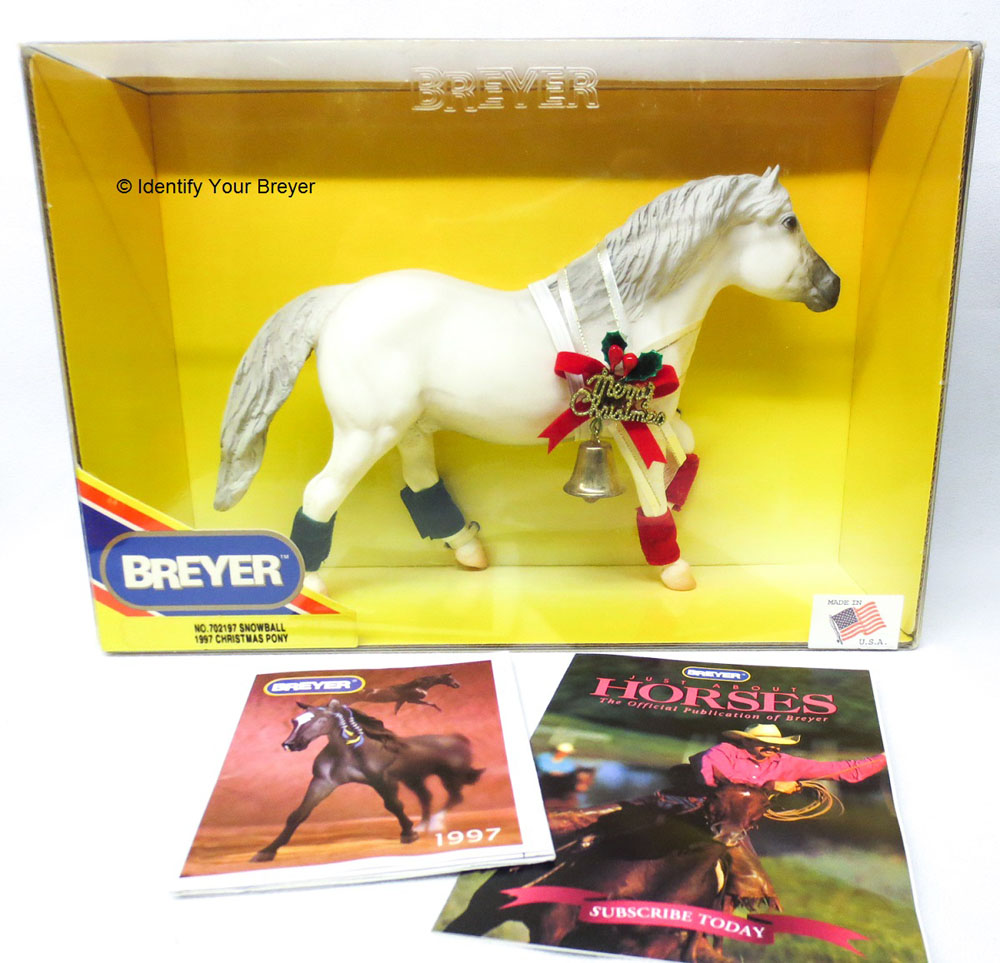
Even though all of those releases were under 50 pieces – and there were only 18 made of the WEG Haflinger! – the most desirable Haflinger of them all is still the 1997 Christmas release of Snowball:

http://www.identifyyourbreyer.com/images/702197box.jpg

Snowball is popular because outside of being the first in the ongoing series of Holiday Horses, the release was cut short due to production issues with the tack. They disappeared rather quickly in stores, which cause a bit of a run on them right from the get-go; judging from the recent sales on eBay, demand still seems pretty solid nearly 20 years on.

Like the Highland Pony, Snowball came a Chalky finish, albeit without the extensive shading or dappling. Snowball wasn’t unique: many Alabasters from that time period came in a Chalky or semi-Chalky finish, like the Black Stallion release Equus.

In Snowball’s case, that bright white finish wasn’t merely an aesthetic choice, but a practical one. The matte and opaque Chalky finish would help keep them from turning into… yellow(ed) Snowballs.

I haven’t made a decision yet on keeping this pony; I’m already keeping several pieces from that Grab Bag, and I don’t really want to add more. Even if I did decide to let it go now, busy season is coming up at work, and I won’t have much time to do much selling.

Tuesday, November 22, 2016

Another Mustang Oddity

From another grungy box lot arises yet another weird Buckskin Mustang I feel compelled to keep….


He’s another one of those plastic oddities from the early 1970s – the surface physically feels like chalk, the plastic looks bright white in places, and he has some paint flaking characteristic of an Opaque White Plastic Chalky.

But he isn’t a White Plastic Chalky – he’s not opaque enough. And he’s not simply an exceptionally white model that hasn’t yellowed one iota from the day it was pulled from the mold, because he doesn’t have the translucency of standard, garden-variety Tenite, either.

(Most exceptionally white vintage models, I believe, were molded from fresh Tenite that was completely unadulterated by any regrind. The more regrind there is in the mix, the faster and more deeply a model will yellow.)

No, this fellow is something in between.

He was found in a collection with a couple of genuine Basecoat Chalkies and at least one other piece that might be of the same “stuff” (that one’s still grungy, so I can’t tell yet).

So he fits in with my earlier hypothesis, which is that at some point during the Chalky era, Breyer started mixing the Opaque White Chalky plastic with the standard Semi-Translucent White plastic to get this – kind of plastic I still struggle to find a proper name for. (Milky White? Bright White? Partial Chalky?)

So now I find myself in the possession of not one, but two oddball Buckskin Mustangs from the 1970s. Of all the crazy things you can find in box lots....

Monday, May 2, 2016

Runs and Drips

I’m not going to elaborate any further than this, but I’m going to pretend that this weekend didn’t happen. Nothing particularly awful, just extremely unproductive and frustrating.

For the next week or two, as I get some long overdue paperwork and spring cleaning over and done with, the posts will be a bit on the short side, length-wise.

For example, today’s topic is about drips. Drips like this one, on an otherwise very nice Chalky Pacer:


While the general consensus seems to be that runs and drips are a clear indicator that a finish has either been tampered with, or falsified entirely, that’s simply not the case.

Although they are not common, they do show up from time to time usually – as is the case here – on Basecoated Chalkies.

Every once and a while you will also see runs and drips on early Glosses, too – particularly items from the 1950s and early 1960s. I’ve owned at least one Gloss Family Arabian Stallion with factory dripping, and I’ve seen a handful of Western Horses and Ponies suffering from similar painting malfunctions.

These are a little more controversial, because Glosses are pretty easy to fake, but identifying a genuine Gloss drip or run is like identifying a genuine Chalky finish: once you see one in person, it tends to become very obvious.

For the record, I don’t try to “fix” these kinds of factory flaws if I come across them, especially if the model is otherwise presentable. It’s part of the history of the model, and gentle reminder that those “Good Old Days” weren’t uniformly so.

Here’s a picture of the whole horse, if you’re curious:


A few marks and rubs, and a bit unstable (hence the crutch) but definitely a keeper.

Friday, April 29, 2016

Different Shades of White

For your consideration and discussion today, an early and attractive Classic Arabian Family set:


These were a part of the same lot that brought me my “Famous Race Horses” set. Even though I knew they were in nicer-than-average condition when I bought them, I didn’t have any hesitation about their ultimate destination: the sales list. I have several examples of the Classic Arabian Family, and I really didn’t need another.

Until they arrived and I was able to inspect them in person, and darn it, they’re Chalky Plastic!

Well, the Stallion and the Mare are, but not the Foal. I found that a little amusing since it’s been my experience that the Foal is usually the easiest of the three to find as a Chalky.

It’s not unusual for Family sets to have “mixed” finishes: we tend to forget that each of these molds is a separate entity unto itself. One shot of plastic into a mold does not make an entire family, just the pieces of a single family member (usually two, but occasionally more if it has interchangeable ears, manes, tails or horns).

This is not a universal truth: I know some of the G1 Stablemates molds (at least) are “doubled up” and one shot can get you two different horses. But that’s a different subject for a different day.

Most of the Chalky Classic Arabians I’ve had over the years have been the basecoated type; Chalky Plastic ones are a little less common.

These were from that time period, however, when Cellulose Acetate was hard to come by, and Breyer was buying whatever they could get their hands on. That included a lot of batches of varying shades of whiteness and translucency, ranging from very bright white to housepaint-opaque.

These different shades of white might not have been as noticeable then, but they’ve become moreso over time, yellowing in different ways (if at all) from the standard semi-translucent stuff.

I’ll give myself a little more time to consider whether or not the set gets to stay, or have to go. That mare is so nice…