Showing posts with label colored plastic. Show all posts

Saturday, October 22, 2016

More on the Swirly Keychains

My work schedule is still not compatible with a social life, so the trip report will have to wait a little bit longer. In the meantime, though, I’d like to clarify a little bit of misinformation that seems to be making the rounds regarding this guy, and others like him:


He’s a piece from the 2003 BreyerFest Mod Squad set – and yes, by some strange coincidence (you know, the kind that only seems to happen to me) he’s the very same swirly Stablemates Keychain whose picture I linked to in my recent discussion on swirly- and solid-colored plastic Stablemates. He was one of the trivia prizes on the Blue Bus, and I won him.

I didn’t know he was the specific prize for that question, they just reached into the bag of goodies and randomly handed him to me.

As far as I know, most of the Stablemates given away as trivia prizes for this year’s Exclusive Event were leftovers of previous Keychain Special Runs and giveaways, with the best of them being the Glossy 2013 Toy Fair Highland Pony.

I am not aware of any of them being the Test Swirlies that had been given away at previous Events. Those were somewhat different than regular Keychains in that they either had no actual keychain parts attached, or just the hook.

I didn’t see every single one out of the forty or so that were distributed over the four buses, so there might have been something especially special, but I think – with the current crazy prices for Diesel – that they would have revealed themselves by now.

That being said, it is true that the Mod Squad Keychains are a little harder to find than other Special Run keychains made in similar quantities. I know some were sold in the NPOD later, but I wasn’t sure that was the entire remainder.

That was back when the BreyerFest Keychains were finally fading out as a thing, and they were beginning to get left behind for physically and metaphorically bigger Special Runs. I skipped out on that set that year because I didn’t think it’d be difficult to get them later on. (Ha!)

Makes me wonder just how many of these leftover Keychains they still have knocking around the warehouse. Now that might make for a fun giveaway or warehouse sale for Stablemates Club members….

Friday, April 29, 2016

Different Shades of White

For your consideration and discussion today, an early and attractive Classic Arabian Family set:


These were a part of the same lot that brought me my “Famous Race Horses” set. Even though I knew they were in nicer-than-average condition when I bought them, I didn’t have any hesitation about their ultimate destination: the sales list. I have several examples of the Classic Arabian Family, and I really didn’t need another.

Until they arrived and I was able to inspect them in person, and darn it, they’re Chalky Plastic!

Well, the Stallion and the Mare are, but not the Foal. I found that a little amusing since it’s been my experience that the Foal is usually the easiest of the three to find as a Chalky.

It’s not unusual for Family sets to have “mixed” finishes: we tend to forget that each of these molds is a separate entity unto itself. One shot of plastic into a mold does not make an entire family, just the pieces of a single family member (usually two, but occasionally more if it has interchangeable ears, manes, tails or horns).

This is not a universal truth: I know some of the G1 Stablemates molds (at least) are “doubled up” and one shot can get you two different horses. But that’s a different subject for a different day.

Most of the Chalky Classic Arabians I’ve had over the years have been the basecoated type; Chalky Plastic ones are a little less common.

These were from that time period, however, when Cellulose Acetate was hard to come by, and Breyer was buying whatever they could get their hands on. That included a lot of batches of varying shades of whiteness and translucency, ranging from very bright white to housepaint-opaque.

These different shades of white might not have been as noticeable then, but they’ve become moreso over time, yellowing in different ways (if at all) from the standard semi-translucent stuff.

I’ll give myself a little more time to consider whether or not the set gets to stay, or have to go. That mare is so nice…

Sunday, April 12, 2015

Prune Brown

Head’s up: I’ll be starting to sell stuff again within the next week or so. The outdoor flea market season opens soon here, and I will need some walking-around-money for that.

The Special Run we thought would be a vintage model turned out to be the Croi Damsha in Dappled Sooty Palomino: it’s the very antithesis of a Vintage Model. Huh. I wasn’t expecting another release on that mold until the Fall.

You know, from a distance, in passing, and if I wasn’t wearing my glasses, a Palomino Croi Damsha could pass for a Palomino Family Arabian Stallion. There’s that, at least.

(Hmm. A Reissue Palomino FAS in Dappled Sooty Palomino. I had not considered that a possibility until now.)

The final model in the Ticket Special Lineup will be a Gloss Dappled Rose Gray Wixom, if the rotating banners on the Breyer web site are to be believed. (A Percheron, finally!) Unless it turns out to be a different kind of something, like a Store or Souvenir Special.

Regardless of what she is, I doubt her inclusion there is an accident. It feels more like a way to drum up interest for the last weekend of Early Bird Ticket sales: Let’s drop a previously unknown/unseen Gloss Special Run on the front page!

Back on topic. Here are a couple of actual Vintage Models: a pair of Western Ponies in Dark Brown and Black Beauty:


The Dark Brown variation is comparatively rare; it appears that it was only issued ca. 1956, or shortly after the discontinuation of the Davy Crockett Horse and Rider set. It really was listed as "Dark Brown" on at least one piece of ephemera from the era, so it was a genuine release, and not a variation.


My theory for its existence - and relative rarity - is that the #40 Dark Brown release was created to help use up the "Plum Brown" acetate that was purchased for the manufacture of the Davy Crockett Horse and Rider set. The Davy Crockett fad faded almost as quickly as it rose, and Breyer may have been stuck with a load or two of Plum Brown plastic.

But not too much: the Brown Western Ponies aren’t easy to find today, and (as far as I know) there aren’t any other Plum Brown models floating around, other than the Fury/Prancers. The "Brown and Gold" Western Horses that occasionally cause a stir on eBay are just early (and not very good) knockoffs.

The color of the Brown Western Pony is dark enough that in the right setting and the right lighting, it’s almost indistinguishable from the Star-faced Black Beauty, so it might be slightly more common than we actually think. And the Star-faced Black Beauty slightly more rare.

Through the 1950s and early 1960s, Breyer seemed to have an "as above, so below" policy when it came to the Western Horses and Ponies. Except for the Dark Brown - and the Star-faced Black Beauty Ponies, who share the same item number. That, and their decorative similarities lead us to the conclusion that the Star-faced Black Beauty Western Ponies were the variation - of the Dark Brown, created when the Plum Brown plastic finally ran out.  

Due to the ephemera gaps of the 1950s, we can’t be sure when the transition happened. It was somewhere between 1956 and 1958, since the No. 40 Western Pony is listed on a 1958 dated price list - and is shown in a ca. 1958 Dealer Catalog - as "Black Beauty". I tend to believe it was earlier rather than later, hence my "ca. 1956" dating.

On a final note, I have to admit that I snicker a little bit every time I see or hear the term "Plum Brown" used to describe this brown plastic we’ve been discussing today. "Plum Brown" has always struck me as a very pleasant euphemism for the word "Prune".

We’re very fond of describing horse colors using food words: Olive Bay, Mulberry Gray, and Peach Dun. But Prune Brown? It doesn't sound quite so yummy.

Tuesday, July 24, 2012

The Chalky Nobody Heard About

Feeling a little bit better, now that I’ve gotten a little more sleep under my eyes. (On the other hand, I had to break some horrible news to a friend today. Nothing anyone here needs to know about, though.)

Still in the process of unpacking; I just realized about an hour ago that I somehow ended up with two Bay Esprit "Steppin’ Outs"; seeing as I only "need" one, I’ll probably have the other either up for sale or trade by the end of the week. I’d love to trade it for an Appaloosa Stoneleigh Surprise, but seeing as how it’s the "rarest" one of the set (per Breyer’s Facebook page) it’s probably not likely.

Eh, maybe I can throw in my sample/no VIN CH Sprinkles in to sweeten the pot. (S/he is actually quite nice, but I already have a good number of "no VINs" already, and I haven’t grown attached to him/her just yet, the way I have to the others.)

Anyway, as I’m still unpacking and subject to a rather disagreeable work schedule, this is going to be short and quick. My first "big" find at BreyerFest this year:


A Chalky Black Bucking Bronco! (Yeah, I know, I got all artsy-fartsy on the photo. He does look good at this angle, though, don’t he?) I had never seen one before - and judging from the reaction I got from everyone I showed him to, nobody else has, either. The fact that I found him at all - in this white-hot Chalky market - is absolutely astounding. (And so was the price!)

He’s pretty darn close to mint, for a Chalky. He’s a "White Plastic" Chalky, too, which means that there have to be more than just a handful out there. They might have just run the one batch of that plastic, but I’m not sure quite how many Bucking Broncos a drum of Tenite translates into. (A hundred? Maybe two?)

I knew he was theoretically possible - he was in production during the classic "Chalky Era" - but even moi, the ginormous Bucking Bronco fangirl, had discounted the possibility after all these years.

If I had not found anything else at the hotel, I would have considered my shopping run a success, but we’ll get to my other big find next time.

Wednesday, April 25, 2012

Not Your Average Bear

My first reaction when I read the e-mail about the new Web Special Sucesion and Le Fire was: Only $135? What a deal! Seriously, that’s about 40 to 50 bucks cheaper than what boxed Regular Run sets of considerably greater piece runs are going for now. I thought with it being a two-piece set that they’d be charging a little bit more than that.

I’m not going to fuss over the affordability of the latest Web Special, though, since the flea market season is now officially underway.

It was another cold and quiet "opening day" on Sunday. There were quite a few horse-related objects lying about - used tack, potmetal carnival horses, tiles and other doodads - but I didn’t buy anything other than a couple of cute, Classics-scale ceramic Zebras of unknown origin for Mom. (They look vaguely Robert Simmons-ish.)

The big find of the week came the next day, when I stopped at the local Salvation Army on the way home from work. I needed a new wallet, and the only one I’d seen lately that I even remotely liked was a better-than-average knockoff I saw there last week. After picking it up, I took a quick cruise of the knick-knack aisle, and look who was nestled next to the Christmas decorations:


A pretty darn nice dark-faced variation of the Breyer Black Bear! When I picked her up, it appeared that she had some white housepaint speckled on her - something I see on a not-infrequent basis. A quick bath in hot soapy water and a gentle rubdown with a washcloth usually takes care of the problem.

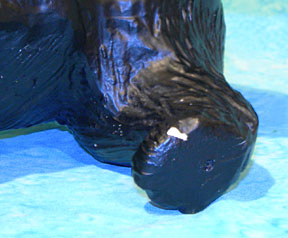
After her bath, however, I discovered that some of those opaque white "paint flecks" weren’t paint flecks. They were rubs and chips down to the opaque white plastic. Such as this small gouge on the bottom of a rear paw:


She’s a White Plastic Chalky! Awesome!

I hadn’t heard of any Chalky Bears before; seeing as they have a dark, full-body paint job, they wouldn’t be immediately obvious to most hobbyists unless some damage - such as rubs or chips - happens to reveal it. They were within the realm of possibility, though, since the Black Bears were in production throughout the entire "Chalky Era", not being discontinued until the end of 1976.

That she’s a White Plastic Chalky is also somewhat typical of Nonhorse Chalkies - not all are, but a bigger-than-average percentage of them seem to be. I don’t know if it was a conscious decision on Breyer’s part, but it makes sense if it does. Getting good paint coverage for a basecoat on roughly textured molds like the Buffalo or the Bear would have been a major pain in the behind. 

Just a few weeks ago I was griping to myself that good quality, harder-to-find Chalkies were rapidly shooting out of my price range. And now The Universe practically delivers one to my front door.

Friday, January 1, 2010

The Original Black Beauty

I have a small confession to make: I don’t like Anna Sewell’s Black Beauty. Most of my attempts to read it ended with me throwing my copy against the nearest wall. It’s not something I normally do with any book that displeases me, so I’ll just chalk it up to my low tolerance for Victorian sentimentality.

When you grow up in an environment encrusted with Victoriana, you either learn to love that particular aesthetic, or ignore it … and I don’t love it. I’m more of a gee-whiz, streamlined, hope-for-a-better-future Art Deco gal. (A bit of a contradiction for someone who researches history, I know.)

On the other hand, I do like Breyer’s early Black Beauties: not the seemingly endless reissues and reinterpretations of the horse from the book, but the color itself.

The color "Black Beauty" first appeared in the ca. 1953 catalog sheets, in reference to the Western Horse and Pony: the Western Horse is #58, and the Western Pony is #44. By 1958, the number on the Western Pony changes to #40, the Western Horse disappears completely, and the Fury/Prancer is now listed as being available in this color. From the 1958 price list:


The term is not used as a color descriptor, but as a proper name. Here’s another part of that 1958 price list that clarifies this point: the model doesn’t come in "Black Beauty," it is Black Beauty:


The Black Beauty terminology is dropped in the 1960 Dealer’s Catalog, and the color simply becomes "Black." The Western Horse reappears in this color, too, as #50. A Mission Supply House mailer from ca. 1961 still refers to all three as "Black Beauty," but Red Bird Sales pages from roughly the same time period call them "Black."

Confused yet? It gets worse: there are at least three different variations of this color!

The earliest "Black Beauties" - the #44 Pony, and the #58 Horse - were solid, glossy black plastic, with metallic gold hooves and trim. The Prancer never came in this variation, as far as I know. It may have been discontinued by 1955, but it’s difficult to tell precisely due to the lack of paper evidence.


The second version of "Black Beauty" was the version I discussed in my last post, with four white stockings, gray hooves, and a masked star or blaze. Only the Western Pony and the Fury/Prancer came in this color. Since the #27 Fury has nearly the same paint job as the #P40 Black Beauty Prancer, it can be hard to distinguish between the two. Black Fury/Prancers are usually only identified as #P40 Prancers if they still have their original chain reins and western saddles.

Both the Western Pony and the Fury/Prancer were used in Horse and Rider sets in this color, adding to the confusion. Some of the Horse and Rider set Fury/Prancers had the wider, Davy Crockett Horse blazes, but not all. This variation appears in the 1958 Dealer’s Catalog.

Dating this color variation is very difficult, especially since they share the same issue number - and markings - as the Plum Browns. The Plum Browns predate the Blacks, and probably "evolved" into the Black Beauties once they ran out of the colored acetate: all they had to do was change the name on the pricelist, and carry on.

All three models came in the third and final version of "Black Beauty." This color is quite distinctive, and in my opinion is the most attractive of the three: bald face, 4 stockings, a white tail tip, and silver trim on the saddle and molded on tack:


This color also varies the most of the three: the markings can be white plastic, or overpainted, or some combination of the two; handpainted eyewhites are also sometimes seen.

A Western Horse in this variation appears in the 1960 Montgomery Wards catalog; it’s possible that they may have started manufacturing it up to a year earlier, but until more evidence shows up, we can never really know for sure.

The same can be said for their discontinuation dates: all we have are rough boundaries here. They all appear in the ca. 1960 Dealer’s Catalog, and are all gone from the 1963 Dealer’s Catalog. I’m pretty sure the Fury/Prancer mold, with the exception of Fury himself, was discontinued in 1961. But according to the Red Bird Sales pages, the Western Horse was still available in 1962.

All three variations are fairly rare; I’ve been told that the solid blacks are the rarest of the three, but it’s hard for me to judge. I purchased a primo pair back in 1980 (one of my earliest "hobby" purchases) and consequently haven’t paid too much attention to their market prices.

I’ve had the most trouble finding the silver-tipped third version, but I think that’s mostly an issue of condition, not availability. Since most third version models were molded in white plastic, and not black, rubs are just more prevalent - or noticeable.

Wednesday, December 30, 2009

Plum Brown

I’m still suffering from a motivational deficit. I tried to brush it off with a marathon of paper shredding yesterday, but the enthusiam didn’t stick. I think it’s the weather: not the lack of sun, but the lack of heat. I don’t get a lot of projects done in the wintertime, because it’s incredibly difficult to get anything done when your swaddled in a half dozen blankets and quilts (unless what you're working on is actually a quilt!)

Laugh if you must, but I was secretly hoping I’d get a zebra-print Snuggie from Santa this year. Nope, just a peachy keen new laptop and some fancy chocolates. And speaking of chocolate…

Here are two different pre-1960 Western Ponies. Notice anything different between the two?


It's a little hard to tell, but the one with darker hooves is dark brown. It’s a color hobbyists call "Plum Brown" because it often comes with purplish undertones, though mine is more dark chocolate-colored. The base color is colored plastic that, as we’ve discussed before, was not an uncommon Breyer painting shortcut in the 1950s.

There are only two models known that came in this brown color: Davy Crockett’s Fury/Prancer horse from the Horse and Rider set, and the Western Pony. Both are painted with masked facial markings, 4 stockings and dark gray hooves.

For the longest time, we didn’t know anything at all about these Plum Brown models, and just assumed that they were a color variation of the Black. We didn’t learn that they were separate and distinct releases until copies of an undated catalog page/flier started circulating among collectors. From the reverse:


It was widely presumed that Breyer also made a Brown Western Horse. It was a logical presumption to make: they did make a brown Fury/Prancer and Western Pony, and our fragmentary documentation from the 1950s didn't rule out the possibility. Why not a Western Horse? Some collectors even claimed that they had one in their herds.

Then I saw one of those alleged Western Horses in person and realized it was just a copy, and not a very good one at that. The plastic was wrong, the color was wrong, the hooves were poorly sculpted - even the reins were wrong! They also have metallic gold shading that’s not seen on either the Plum Brown Fury/Prancer or Western Pony. It’s as if they were actually trying to imitate a bronze finish; I believe the manufacturer of these odd and early knock-offs was probably taking its design cues more from pot metal carnival horses than the plastic Breyer versions.

The Fury/Prancer is far more common than the Western Pony in this color, possibly because the Plum Brown Fury/Prancer was not only used with another Horse and Rider set - the Canadian Mountie - it was also sold separately. The Western Pony mold was used on a few Horse and Rider sets, such as the Indian, the Cowboy, and Kit Carson, but I can’t recall ever seeing an original set with the Plum Brown Pony.

Not much is known about the Plum Brown Western Pony, other than its appearance on that single, undated (ca. 1956) catalog page and his hasty retreat: he was gone from the 1958 catalog and price list. Maybe, as I hypothesized with the Pink and Blue Elephants, he was designed to use up the colored acetate they had lying around the factory.

It may be that the Plum Brown Western Pony’s rarity isn’t as profound as we perceive it: in low light, and at first glance, they can be indistinguishable from the somewhat more common Black Beauty version. None of the Black Beauties are really "common" either, but I’ll discuss that in my next post.

Thursday, December 24, 2009

2010 Previews and Stuff

It looks like I'll start the year with a truly clean slate: there was honest-to-goodness dusting performed in the office yesterday! I have no idea what got into me; I'll chalk it up to work avoidance and the absence of a cat to vacuum.

The work avoidance issue: dealing with the big black hole that is my research data entry slush pile. I'm always incorporating new data into my files, but not at the same rate that I research it. Then I find some unexpected lead, and off I am again on some other crazy topic. I think I'll probably spend most of my free time in the beginning of the new year dealing with the consequences of that foolishness. (In addition to working on the nascent hobby advocacy movement that seems to be coming into being – finally!)

The new year is almost here, and photos of the 2010 releases are already being floated about, and analyzed to death. I'm not going to be one of those people today: we should all know by now that it's not a good idea to judge a Breyer horse by its stock photo. Especially the new G4 Stablemates; it's pretty clear that a number of those photos are of prototypes, and not to be trusted. The two resin prototypes we had a sneak peek at BreyerFest this year looked just fine and dandy in person, and I suspect that most of the rest will be, too. There might be a clunker or two, but it's nothing worth fretting over until we have them in hand.

I'm glad to see a new Nokota and a new Peruvian, though – now there's a couple of favorite molds that might make me break my vows of model horse austerity. The Treasure Hunt Othellos are very nice – I like the mold a lot, but I'm not sure I like him enough to participate. I may reconsider, depending on the color and quality of the redemption horse. (Gloss Charcoal = YES! Another shade of gray = meh, not so much.)

I have a lot of reservations about the Breast Cancer Benefit horse. Normally I'd be attempting cartwheels at the thought of a mass-market transparent Traditional-scale horse; one of my few, true model horse grails is to track down and possess the Transparent Belgian I once saw in Marney Walerius's basement. I have all of the other transparent, or mostly transparent Breyer releases, except for the unaffordable Connoisseur Tortuga.

Benefit horses of any kind are good; I just wish it could have been targeted towards an orphan cancer that doesn't quite get the same level of funding or media attention.

You know, like pancreatic cancer.

Hell yeah, it's personal. Some of you may know, but others do not: I lost my Dad to pancreatic cancer almost two years ago. PC has a 5% survival rate after five years; we had 28 days, which is not untypical. There hasn't been much research done, because there's no money in it: there are virtually no survivors to campaign for it.

Now that they have the painting template for it, we can hope that maybe the idea will carry through to other causes, in other colors. (PC's color is purple.) And at least with PC, there would be a logical connection of the horse to the cause: Patrick Swayze was an Arabian horse breeder and enthusiast. I think there's even some footage of him competing at the Kentucky Horse Park on YouTube somewhere.

(And intriguingly, the Tempur-Pedic company is also doing a PC fundraising effort with a limited-edition teddy bear: their headquarters just happens to be in Lexington, Kentucky. BreyerFest attendees would much appreciate some comfy mattresses in a nap station in the Covered Arena, dontcha think?)

Thursday, November 26, 2009

Gray Plastic Chalkies

My next big project will take me to the end of the year, and probably a little bit beyond: I need to inspect the one-third of my collection now currently in storage. There are approximately 40 (40!) boxes to unpack, examine and repack, and each box has anywhere from 10 to 20 models apiece, so my end-of-the-year projection is not an exaggeration.

I pack pretty well, and the storage conditions – while not ideal – are more than adequate, so damage isn't the primary issue here. I did a thorough inventory a couple of years ago and I've managed to keep that up-to-date, so that's not the reason why, either.

Nope, the primary reason for the excavation is research. I'm trying to collect physical data on the models themselves. I'm taking notes on things like color, markings, mold marks, mold changes and other unique or distinct characteristics that help distinguish one release from another. It's tedious, boring but necessary work, especially when you have some models that came in a multitude of “Bay” paint jobs, some of which are worth significantly more than another – and some of which aren't technically Bay!

A secondary benefit of this excavation is that I can unearth and photograph some of my buried treasures for future blog posts. Today's subject is was one of the things I found in my first day back on the project: my Gray Plastic El Pastor!

Gray Plastic Chalkies are just one of the many different subcategories of Chalkies. Gray Plastic Chalkies are models that were molded in a light to medium gray-colored Tenite, and not basecoated with white prior to painting. I sometimes call them Semi-Chalkies because they were nonwhite plastic models made during the Chalky Era (ca. 1973-1976): Breyer just skipped the basecoating step. The most common Gray Plastic Chalkies are Elephants and Donkeys; here's a particularly lovely near-black variation of the Donkey:

The Gray Plastic Chalky Elephant and Donkey are easy to distinguish from the earlier Donkey and Elephant (ca. Late 1950s – early 1960s) that were also molded out of gray plastic. One, the color is different: the earlier ones were a glossier and more battleship gray color, while the Chalky Era ones are more of a mop-water gray. Second, the paint jobs were completely different. The earlier versions only had their eyes painted; on the later ones, additional gray paint is used to enhance the color.

Breyer also used the gray plastic on the Spanish Fighting Bull and the Walking Polled Black Angus Bull to good effect. I actually prefer the Fighting Bull in its gray plastic version: I think the gray plastic horns are less stark-looking than the white ones he usually comes with.

Breyer attempted to go with the unpainted gray plastic on some of their horses, but with less success. With solid colors, or black-painted horses, it wasn't too much of a problem: I have a gray plastic Black Stretch Morgan who's quite handsome. (Haven't unearthed him yet, sorry.) With models like El Pastor, where having a white surface is essential to the proper execution of the design, the gray plastic just makes them look dingy and oversprayed.

Maybe Breyer thought they could get away with it for a batch or two. This was the era of the fuzzy overspray: clean, sharp markings were the exception, not the rule. (Whenever I see someone carping nowadays about a miniscule amount of overspray on an otherwise flawless horse, I'm not sure if I want to laugh at them or call them out on it. Back in the day, we bought Stablemates with untrimmed flashing on them, and we were okay with that! Well, not entirely okay with it, but certainly a lot less whiney.)

The Gray Plastic Chalky horses are less common than the nonhorses, probably because while our standards were lower than they are today, they weren't nonexistent. Did they really think we'd buy a #97 Chestnut Appaloosa Gelding with a gray hip blanket?

(Yeah, really, they made Gray Plastic Appaloosa Geldings. I don't have one – yet.)

Wednesday, May 6, 2009

Old Yeller

At a BreyerFest several years ago, I remember getting into a mildly heated argument with a hobbyist who insisted that her heavily yellowed Palomino Rearing Stallion was, in fact, a special run. Or a variation, at the very least - there was no doubt in her mind that this model was special. It was issued in yellow plastic, had always been that yellow, and how dare I even suggest that it could merely be yellowed!

(He was also sprayed with an aftermarket gloss finish that was not only uneven, but flaking off in places, too. And probably contributing to his yellowness. Pointing all of this out did not dissuade her opinion one bit. At that point I did what a normal person would: I walked away.)

That story came to mind while observing the kerfuffle last week about the heavily yellowed Old Timer on eBay. Of course it’s heavily, and quite obviously yellowed - the fact that it was yellowed to the point of looking like a chestnut did not change the fact that it was, and still is, an Alabaster.

It’s also another case where a little knowledge leads to a lot of trouble: in this case, it’s the existence of at least one genuine chestnut Old Timer. A picture of one was published in the July/August 1985 issue of Model Horse Gazette, in an article about test colors and special runs by Jill Rademacher (now Guitterez). Even though the pic is in black and white, it does seem to bear some similarity to the heavily yellowed fellow in the eBay auction:


At first glance, a black and white picture in a defunct, 24 year-old hobby magazine may seem like a rather obscure reference to cite. But it’s not: many hobbyists are packrats of the highest order, especially when it comes to old magazines, newsletters and other reference materials. (And woe to you being the one trying to buy that old ephemera from them: been there, done that.)

I’ve seen hobbyists use more obscure, and much less reliable sources to base their buying decisions on. So while the $75 final selling price was disappointing, it was not unexpected. It just takes two hobbyists to bid something up, and there were certainly more than two hobbyists watching that auction.

What complicated the argument over the Rearing Stallion is the fact that Breyer did - and still does - use colored plastic as a deliberate decorative technique. For a brief time in the 1970s, Breyer used unpainted light gray plastic as a base for some of its gray and black painted models, such as the Donkey, Elephant, and the Spanish Fighting Bull (and less successfully on a few non-gray, non-black models, too!)

As far as I can tell, yellow plastic was not one of those deliberate techniques. Not in the 1970s and 1980s, anyway.

What causes yellowing in Breyer horses is actually quite a complex subject - worthy of it’s own post, easily. To keep it short and simple for today, I’ll just state that it is not unusual for a model to yellow out evenly over its entire exposed surface. It’d be far more unusual, and suspicious, to have a model that was unevenly yellowed.