Showing posts with label Running Mare. Show all posts

Saturday, October 22, 2022

The Red Roan Mares

Why is everything so hard right now and taking three times as long as it should? Argh!

Oh yeah, I forget: it’s October. Me and October don’t mix. People who say their favorite season is Fall can politely stuff it. Keep your Pumpkin Spice nonsense, I prefer seasons with green growing things!

Anyway, here’s the story of the Red Roan Running Mares I promised.

When I first got into the hobby, I was obsessed with acquiring a Breyer Red Roan. I had just missed seeing them in stores – they were pretty much discontinued by the time I started collecting – so when I saw one pop up on a Bentley Sales Company “Discontinued” Sales List in the early 1980s, I rode my bike to the Post Office and sent that money order by the end of the day I received it.

I had no idea at the time she was the Special Run that debuted at Model Horse Congress in 1982. I was lucky enough to get the Red Roan Running Foal secondhand not long after it was released, but I was either unaware or unconcerned about the matching Running Mare. 

(Maybe because it seemed silly to me at the time to buy a Special Run of something that had already been released as a Regular Run item?)

I loved and adored her, but I was young and dumb and newly cognizant of the power of nail polish remover, and I… slightly customized her, as I did many of my model back then. 

I still have a few of those retouched models, but the Running Mare was sold some years later, I think during my first big collecting purge in the late 1980s. I was slightly embarrassed that I had done such a thing to what was in reality a rather scarce Special Run, and didn’t want to be reminded of my youthful experimentations with acetone.

I did acquire all of the original Red Roans eventually, three of them in one fell swoop at my local flea market. And all with Blue Ribbon Stickers, of course! I contemplated reacquiring a more minty version of the Special Run, but most of the ones I found were a little out of my price comfort zone. But you know me, I am fine with waiting…

At BreyerFest this year I wanted to focus on getting a few choice Vintage pieces, but high quality older items were hard to find. And every time I asked around, I ended up getting directed to rooms that had lots of Vintage Club items, which was definitely not what I was looking for. 

I walked into a room that was still setting up, and came across a couple of Red Roan Running Mares, one of whom was quite obviously the Special Run. They were still unpriced, and when I inquired I was informed that neither one was the Special Run, and the price for either was… less than a current Regular Run Traditional. 

All righty, then.

So I bought her. It was the logical thing to do.

The next day I was shopping in another part of the hotel, hoping to score something else that was higher up on my want list (scarce early Five-Gaiters, a Woodgrain, or a decent Dark Smoke or Gloss Dapple Gray Belgian). As I walked into one promising room, I glanced to my left to quickly scan a chorus line of assorted Running Mares, and I saw her.

My original Red Roan Running Mare.

I immediately vocalized my thoughts: “Oh my God, I can’t believe I’ve found you.”

I did not care who heard me; I doubt anyone was paying attention.

Did I start crying? I can’t remember. My hands shook as I picked her up and I went to the seller to tell her the mare’s origin story. In turn, I found out what my old gal (her name was Peppermint Twist, by the way) had been up to: she had been residing in California in a collection with several other Red Roan Running Mares. 

I managed to get her price down a bit – I think the seller saw how verklempt I was – and thanked her for allowing me to return her to her family, and give her a happy retirement from her travels.

Tuesday, May 3, 2022

The Charcoal Running Mare

Today definitely a “crawl into my Batcave and hide” day: lots of issues at work, the national news was terrible, it rained all day so my garden was a swampy mess, and I’m still out of sorts to find out that Neal Adams died on my birthday. 

And yes, I am very familiar with that auction lot on eBay with the three probable Chicago-era Test Colors in it. In fact, I saw it a few minutes after it got listed and momentarily panicked as I searched (in vain) for a Buy It Now button!

Heck, I’d be happy buying everything in the lot except the Fighters and the Black Yellow Mount, but that’s not going to happen, so I’m just going to watch it like everyone else and wonder just how high it’s going to go. (Those Black Pinto Western Horses are Matte – kind of a rare variation, and one I’ve been looking for.)

I hadn’t expected it to hit $3000 this early in the game, but the market is insane right now. I wish it wasn’t so, but this is where we are. Lucky for the seller, though! 

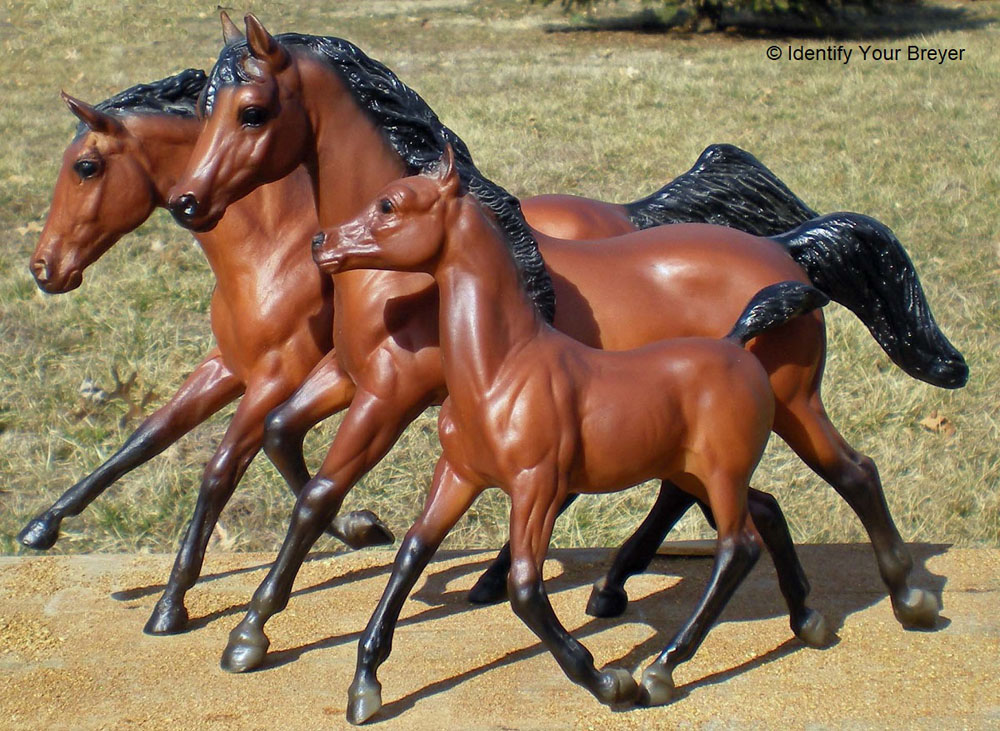
Because you asked for it, here’s the Charcoal Running Mare with her now-matching foal:

The Mare is slightly semi-gloss/satin, and the Foal is very matte, but I am quite pleased how well they otherwise match!

Of the Mare, she’s nice but nothing remarkable by today’s standards. She’s also something that I probably overpaid for: I think you can get a comparably nice one today for about the same amount of money.

In my defense, I was a junior high school horse girl and history dork who was very excited at the prospect of getting an old and rare variation of a Breyer that was discontinued years before I even knew Breyers existed. 

Our choices of molds and colors were also significantly more limited than they are now. At that point, the only color I had ever seen the Running Mare in was the #124 Bay. A Charcoal variation of Smoke seemed so exotic!

I also bought her sight unseen. That’s just how we rolled back then. Most of the time things turned out… fine. Or at least not terrible. Live showing wasn’t as big a deal back then, and even models with obvious flaws – and sometimes, broken limbs! – could compete. 

A model in better condition was always better, yes, but finding old models of any sort was difficult enough. You made do with what you could find, and what you could afford. A couple of small rubs and rough seams? Still LSQ!

I can’t recall if I ever did live show her back in the 1980s. Collectability wasn’t its own separate category in the 1980s outside of Collector’s Classes. They were pretty similar to the Collector’s Classes at BreyerFest Open Show now, except that most collectors back in the 1980s worked on presenting a well-rounded collection, rather than organizing it around a theme or concept.  

Monday, March 14, 2022

Robin and Nestling

I’ll just say it was a rough weekend, and leave it at that! On the plus side, there was homemade chocolate cake that was freaking amazing…

You probably won’t believe me (something I’m used to, but let’s not dwell) but I’ve been a little obsessed with the Running Mare and Foal lately. I’ve been shopping around for the 1984 Sears Wishbook Running Horse Family Set to replace the set I had and sold years ago, and for a 2009 Fun Foals Collector’s Event Running Mare in Dappled Liver Chestnut that’s technically/allegedly an unmarked Appaloosa, but so beautifully painted I give that bit of weirdness a pass. 

And the Just About Horses Anniversary Appaloosa, mostly because the JAH included in the set has an article I wrote in it, and I kinda-sorta need it for the archives. (The Mare herself isn’t too shabby either!)

So I was kind of delighted at the reveal of the latest Birds of a Feather release Robin and Nestling, on the Running Mare and Foal. They look very similar to the 2014 Web Special Run Mare and Foal Set Vixen and Blitzen, except that they’re Glossy, and possibly Chalky? 

Even though they’ve bumped up the runs on these Web Specials to 500 pieces, and they’re Vintage molds, I’m still not expecting to get picked for them. To be honest, I’m not expecting to get picked for anything anymore. That’s just how the market is right now: if that goofy Christmas Bighorn Ram didn’t happen for me, nothing will.

It’s not entirely a bad thing: I’m still pretty behind with the paperwork for all of last year’s new (non Web Special) arrivals, so getting caught up on all that, and sorting out some of my more questionable purchases (and getting a few of them sold) is a bigger priority. As is getting ready for a live show, getting the garden ready for Spring, finishing two applique projects, cleaning the basement, and finishing my taxes. 

(That’s just this week’s plans, except for the selling part. That probably won’t happen until April, at the earliest. Sigh.)

Saturday, April 3, 2021

Swing And A Miss

Sigh. Weren't we just talking about bad information?

This picture – from the latest Collector’s Club online newsletter, celebrating mold birthdays from 1961 – is mostly wrong:

The first and most obvious: the Grazing Mare didn’t come out until 1965. This is not a matter of a lack of documentation. She’s not in the 1961 Dealer’s Catalog inserts, she’s not in the 1963 Dealer’s Manual, and she’s not in the 1964 Dealer’s Catalog inserts. The first time we see her in any official Breyer ephemera is on the official pricelist from 1965, with the Grazing Foal.

The Running Mare and Western Prancing Horse are probably 1962 releases; I don’t have any official Breyer ephemera that says so, but I have multiple copies of Red Bird Sales Company fliers from the early 1960s, and the Running Mare and Foal and Western Prancing Horse don’t appear on the earliest of version of them. The earliest version of these fliers does include the Semi-Rearing Mustang and the Five-Gaiter, who we’re pretty sure are genuine 1961 releases.

The Fighting Stallion is the most questionable one here: although he does appear in the 1961 Dealer’s Catalog insert sheets, I think he might have been released as early as 1960, but I only have circumstantial evidence of that. 

So, at best, Reeves got only two out of five right? 

I could kinda-sorta understand why they didn’t get the Running Mare and Western Prancing Horse right; that ephemera is pretty scarce and not widely circulated, and despite my best efforts to the contrary, bad information has an annoying habit of persisting long after it has been corrected. 

To the point where I wonder if I should even bother sometimes.

But the Grazing Mare? A pretty big swing and a miss here, guys.

Friday, August 28, 2020

Garage Sale Finds, Yay!

Earlier in the week I was going through my paperwork for the year thus far, and lamented that the “Nonretail” portion of my purchases – made at flea markets, yard sales, auctions and such – was pretty skimpy, and would probably remain so for the rest of it.

Then I did one of my intermittent searches on Craigslist and found a potentially interesting local garage sale that led to… these lovely finds!

Believe it or not, this is my first light, Nonchalky version of the #110 Smoke Western Prancing Horse. My first Smoke – my second model horse ever – was a Chalky variation I received for Christmas back in 1974. I’ve also gone through several Charcoal variations before settling (I think!) on the one I have now.

But a standard, actually “Smoke” Smoke Western Prancing Horse, or one I considered worth adding to my collection, had eluded me until now. I was kind of hoping to find a minty, New-in-White-Picture-Box one, or even an example with a Blue Ribbon Sticker, but this fellow with awesome pinking and original saddle and reins will more than do.

He needs a little bit of touch up work, but I’ll worry about that another day.

And well, you also know my fondness for vintage Red Roans. It’s kind of interesting that in spite of the Red Roan Running Mare’s relative rarity (produced only from 1971-1973) that’s she’s not considered more desirable.  

I think it’s a combination of two factors.

First, while she certain has her share of fans, the Running Mare is simply a less-collected mold than her 1960s contemporaries, like the Semi-Rearing Mustang and Fighting Stallion.  

Second, she’s come in so many Variations, Special Runs and even scarce Regular Run items over the years that the #119 Red Roan doesn’t even break the top ten in terms of rarity or desirability. Even vintage Test Colors of her are not especially difficult to find. (Still not cheap, though!)

Just about the only time you see the price of a Red Roan Running Mare hit the stratosphere is if it’s found in Showcase Collection packaging, or features an exceptionally beautiful or distinctive paint job.

Speaking of that, vintage Red Roans vary, a lot; I’m justifying keeping this pretty girl because aside from her original shipper box, she has finer freckling than my other Red Roan Running Mare, who also happens to have corn spotting. And a sticker that’s not really her sticker, but that’s another story.

All of the other goodies came along for the ride; they’re not things I normally collect, but I have a hard time resisting cute, little things.

Sunday, March 15, 2020

Bittersweet Complexity

The past few days have been bittersweet. Not only did the money I was anticipating finally arrive, but I finished my taxes and found (as I hoped) that I’d be getting a refund for the first time in many years. And both amounts were significantly larger than I expected.

Combined, they would have more than covered the trip to Seattle.

But alas, luck was not on my side, and no amount of money can turn me into one of those people who gets picked for everything they hope for.

My luck (lately) has been running more towards finding random rarities on eBay, and I am mostly okay with that.

The money won’t go to waste: there are plenty of purchases I’ve put off for months (and years!) that I can finally catch up on. And BreyerFest will definitely be more stress free, without the pressure of having to make as many sales to pay for it all.

(Assuming the world is closer to normal by then. Which – for the sake of my sanity – I am assuming is going to be the case, unless evidence or circumstance change.)

I can also go ahead with my plan of buying “a few glorious things” – at retail! I’ve decided to wait until BreyerFest to buy the Gloss Dapple Gray Belgian of my dreams, and one or two others if the opportunities present themselves like an earlier/homelier Auction Test Color, or a scarcer-than-average Woodgrain like a freestanding (never mounted on a lamp) Running Mare or Foal.

The latter may seem surprising because hobbyists tend to forget that the actual Regular Run #920 Woodgrain Running Mare and #930 Foal were only in production from ca. 1962 through 1965. A significant percentage of loose Woodgrain Mares and Foals on the market are actually ones set free from Ranchcraft Lamps.

Which are, themselves, likely later – or as I sometime call them – Post-Production Special Runs. In other words, separate releases entirely.

Sometimes it even feels like the Woodgrain Lamps Mares and Foals are more common than the freestanding pieces, but I think that’s more of a consequence of their manufacture. Many of the freestanding pieces ended up as toys, with a higher attrition rate than lamps, which as furniture don’t get manhandled quite as much or discarded quite as easily.

We genuinely don’t know much about production quantities of Regular Run models from the 1950 through the mid-1980s – and what the average attrition rate was for those models as they traveled through time to today.

To make a long story short: rarity is complicated, and more relative than you might imagine. So buy what you like at the price you are comfortable with.

Wednesday, June 27, 2018

Just a Few

A Few Spot Appaloosa on the True North mold? You’re killing me!


Aside from the fact I just think Few Spot Appaloosa are kinda neat, I’m also of the opinion that the Appaloosa as a breed has been done no favors by the aggressive quest for color.

Once I get around to customizing again, one of the projects I’m very eager to get to work on is an Appaloosa Performance Horse in a Few Spot Appaloosa, since it’s unlikely that they’ll ever get around to giving us a Regular Run one anytime soon.

As much as we carp about virtually every release nowadays being spotted, the fact of the matter is that’s what sells. Unless the model is exceptional in some other way – glossy, with extra or extra-special detailing, or is a Portrait Model of someone historical/noteworthy – it’s been in Reeves best financial interest to make it as fancy as possible.

And fancy means spots.

Though it is true that many BreyerFest Auction pieces in the past few years have actually been previews of future releases (in other words, truly Tests!) I’m still skeptical of more Few Spot releases in the near future.

They are, by definition, not fancy enough.

There haven’t been many Breyer Few Spot Appaloosas in the past, either. There are the occasional extreme variations of the #115 Appaloosa Western Prancing Horse, and I’ve seen a few older Gloss Gray Appaloosa with spots sparse enough to possibly pass as one (later examples of the Fighting Stallion, for instance.)

But the only intentional Few Spot that immediately comes to mind is the San Domingo Oxydol, who was from about 20 years ago.

(I have one, he just happens to be in storage right now.)

I think they tried to pass off the Dappled Liver Chestnut Running Mare from the 2009 Fun Foals Treasure Hunt as a “solid Appaloosa” too. Which I thought kind of muddled the color genetics lesson the Fun Foals promotion was supposed to be about. (Would it really have been that big a deal to toss a couple of stray spots on her? Mottle her nose a bit? Add a couple of hoof stripes? )
 
Back to BreyerFest prep…

Sunday, April 9, 2017

Bollywood Surprise

I’m up to my elbows in tax paperwork and Spring Cleaning here. (The latter somewhat ahead of schedule and against my will.) So it seems like a good day to engage in a little BreyerFest speculating, it being the last week before the Early Bird Deadline and all.

(In spite of my insistence that I wouldn’t, I know.)


Things the Bollywood Surprise won’t be: Othello, Silver, Lady Phase, a Mare and Foal set, or a random assortment of molds. It probably won’t be a Nonhorse mold or the Marwari, either. The former because most people attending BreyerFest want horses, and the latter because I just can’t see them doing that.

They kinda-sorta promised us a Polo Pony of some sort in a blog post back in January – in fact, it was one of the first “hints” they gave us – but I think that’s what makes it unlikely to be the Surprise, in whatever form it takes. There are still a few more Special Runs to go, and Reeves has a habit of saving the most obvious ones for last – like they did with the Gloss Dapple Gray Percheron Versailles, for the French-themed year.

The “Bet you'll never guess which model this is!” clue makes me think it’s a Vintage mold we don’t see very much or very often anymore.

The theory wouldn’t necessarily exclude Legionario (introduced in late 1978), who is the current popular choice for the Surprise.

But wasn’t one of the Chinese factory escapees a while back a Translucent Running Mare? That’s where I’ll put my imaginary betting money, then, since (a) last year’s Surprise assortment included a Translucent Deco, and (b) a Running Mare would be plenty surprising.

Nobody ever expects the Running Mare!

Other than a few Auction pieces, she’s never made an appearance as a BreyerFest Special Run. The majority of her production releases have being either Matte or Solids (and usually both) so in spite of the fact that she has come in over 30 distinct colors over the past 50+ years, there is still a lot of room for experimentation.

Thursday, December 1, 2016

In a Name

Calm down, everyone: Tuesday’s special offer on Breyer’s web site was just overstock of last year’s Tractor Supply Special Jesse, given the more generic name “Palomino Quarter Horse”. Everything else appears to be exactly the same, even the issue number:


They did the same thing with the 2012 Mid-States Special Run Bay Roan Roxy Constellations, too, if you recall.

I briefly thought of ordering one – the handful of Jesses that I found around here were underwhelming – considering the possibility that there might be some of the Chalky variation ones in the overstock.

But then they sold out, and that temptation went away. More money for the potential surprises of December, I guess!

These re-releases are a nice offer for people who don’t have these participating retailers near them, or who wouldn’t dare brave the Breyer Sales Tent/NPOD for one either (where these kinds of overstocks often go).

I don’t have any Mid-States retailers within a reasonable driving distance, for instance; if I hadn’t already acquired a Constellation, I might have taken up the offer on the web site.

(Ironically, mine is a Sample from the NPOD!)

But historically speaking, this is little more than an interesting footnote, kind of like this one:


Yes, in some – but not all – early Breyer ephemera, the Running Mare and Foal were also known as the Running Arabian Mare and Foal. (This particular snippet is from the 1964 Price List.)

Saturday, October 15, 2016

A Short History of Alabaster: Part II

For some reason this did not drop as scheduled on Saturday. So here is the conclusion, four days late....

I don’t think it was a popularity issue that doomed the “new” White paint job, but a manufacturing one: it was hard color to maintain consistency from model to model and the gray paint, applied over (not under) the Matte topcoat, rubbed off easily.

Confusing? Yes, very.

Honestly, this color confusion shouldn’t really be too surprising: we are talking about a company that had a hard time distinguishing between Bay and Chestnut. Having all these different names for a color as allegedly uncomplicated as White? Just par for the course.

Some argument could be made that Alabaster was in itself just another one of Breyer’s “Decorator” colors, albeit its simplest and most subtle. Like Smoke and Charcoal, Alabaster is not a term that was used in the real horse world to any significant degree, and bears only a coincidental resemblance to colors horses actually come in.

Matte finishes were still relatively uncommon at the time and used then primarily as a sealing topcoat for Woodgrains. The term might have been invented to help call out what was then something unusual and distinctive. Or as I’ve speculated with the color Charcoal, the term may have come from an offhand reference in a book or magazine.

Another point in favor of labeling Alabaster a Decorator color is that the term Smoke – another quasi-realistic color – debuted on the Running Mare and Foal at exactly the same time as Alabaster, and was even paired and marketed with it in deliberately mismatched Mare and Foal sets.


Then there is the matter of Gloss Alabaster: believe it or not, this term never comes up in early Breyer ephemera. It appears to be a hobbyist creation: through the 1960s and until Gloss finishes were phased out, Breyer always referred to Gloss Alabasters as White.

There were a number of reasons why white-colored horses, in all their names and forms, became a staple in the Breyer line through the 1960s and 1970s.

First and foremost: yes, they were a little cheaper to manufacture. They required fewer painting steps, and less paint. There was also less production waste. In an era where multiple simultaneous releases of a mold were the norm, it was common practice to set aside lighter-colored culls to repaint with a darker color later, rather than discarding or regrinding them.

But white was one of the most popular horse colors with the general public too, partly fueled by pop culture figures like The Lone Ranger’s Silver and Hopalong Cassidy’s Topper.

Although derided in recent years as a cheap, plain, and (at times) a downright lazy color to paint, careful examination reveals that too is not as simple as it seems. The simplicity of the color itself is a deceit: unlike other paint jobs, there’s no place for a minor decorating or molding flaw to hide.

In effect, we see the mold as the moldmaker sees it: no more, no less. That so many molds still succeed and delight is a testament to the craftsmen who helped bring them to life in the first place.

Wednesday, October 12, 2016

A Short History of Alabaster: Part I

Since I am going to either be away, or occupied with other things through the weekend, I will be queuing up the article I wrote about the history of Alabaster for this year’s Sampler.

Even though Breyer’s history began with a white Western Horse, the term “Alabaster” – the word hobbyists most commonly use to describe white-colored Breyer horses – did not appear in any official Breyer ephemera until ca. 1962.

My recent research has determined the reason why: “Alabaster” was created as a descriptor not just of a color, but a finish. In short, Matte White = Alabaster.

The history of Breyer’s plainest and most basic color, however, is far more complicated than that.

The earliest white-colored Breyer horses of the 1950s were literally White, in both form and name. Models like the Western Horse, Western Pony and Fury Prancer were uniformly described in the ephemera of the time as White: and they were, save for a few touches of gray shading on the hooves and head.

It wasn’t until 1958 that models with more extensive gray shading arrived, in the form of the Old Mold Mare and Foal (and a year later, on the Stallion). While the paint job on the Old Mold Family was very similar to the color we think of as Alabaster (gray manes, tails and body shading) they still weren’t labeled that way. The early ephemera still referred to them as White.


Other white-colored models began to show up shortly after but they were not labeled Alabaster, either. The Shetland Pony, with her gray mane and tail and pink hooves and muzzle, was still White. The Mustang and Five-Gaiter were described as Albino, presumably because the earliest pieces were issued with dark pink eyes, not black ones.

It wasn’t until ca. 1962 that the term “Alabaster” finally appeared in print, to describe the brand new Running Mare and Foal, and a revamped White Fighting Stallion.


What did these three releases have in common? The Running Mare and Foal and the re-released Fighting Stallion all came in a Matte finish. They were followed shortly afterwards by the Rearing Stallion (1965) and Running Stallion (1968), both Matte, and “Alabaster”.

It wasn’t until 1969 that the Family Arabians and the Shetland Pony – among the last remaining glossy White pieces in the Breyer line – were officially labeled Alabasters in existing ephemera. This is almost exactly the same time that Breyer officially began phasing out gloss.

1968 Pricelist:


1969 Pricelist:


I do not think this was a coincidence. Especially since the third white release in the line at the time – the Western Pony – remained glossy. And was still labeled as White.

There seems to be quite a bit of evidence that Breyer was being careful and nuanced when it came to their color terminology in the late 1960s and early 1970s, especially with their expanding repertoire of gray-based colors. One that expanded further with the release of the matte Dapple Gray paint job on the Proud Arabian Stallion in 1971.

To complicate matters even more, the term White was still being used. In spite of the fact that neither the Old Timer (released in 1966) nor the Indian Pony (released in 1970) ever came in a Gloss Finish, they were both consistently described in catalogs and other price lists as White well into the 1970s.


What I think was going on there was that a decision was made to turn that particular descriptor into a term for a matte white finish with heavy, almost Smoke-like body shading.

This “new” White didn’t last long: all subsequent “white” releases in the 1970s and 1980s were labeled Alabaster, regardless of the amount of gray shading they came with.

Wednesday, November 25, 2015

Anomalous Chalky Alabaster Running Mare

Since the minor research projects I’ve been working on this week aren’t yet ready for prime time, here’s a picture of an oddity I picked up a little while back in a box lot. A strange chalky Alabaster Running Mare:


Believe it or not, she was in significantly worse condition when I found her; there’s still plenty of room for improvement, but I haven’t had the time to do much else than add her to the herd whitening in the window. She’s presentable enough for our purposes today, though.

Chalky Alabaster Running Mares are part of the “Anomalous” group of Chalkies, ones either not made during the Chalky Era (1973-1975) or of more recent (Reeves) origins. The Alabaster Running Mare was discontinued in 1970, and the mold mark on this old lady is absent her USA mark, which means that my example is not an early 1970s Reissue (aka Post Production Special Run) either.

What’s even weirder about her is that her Chalkiness is uneven; where she’s yellowish in the picture is where the Chalkiness is thinnest – or in the case of the lower part of the left hind leg, nonexistent. It’s not a matter of wear and tear, since the gray shading on the mane, tail, head and hooves is not equally “worn away”. It’s most noticeable in her tail, in fact, which appears to be half Chalky and half not-Chalky underneath the gray paint!

Weird, very weird.

At first I thought maybe the opaque white areas were an unusually smooth and even form of precipitate – typically a crusty layer of powdery residue that can form on the surface over time, usually in areas that were aggressively cleaned (buffed and smoothed down with acetone) at the factory, but I don’t think that’s the case.

Is it milkiness, maybe? The thing about milkiness though, is that it’s translucent, not opaque. And usually sits on top of any other paint, not underneath it.

What it looks like to me is that Breyer might have taken a model that was inconsistently white for whatever reason (due to contaminated regrind or differently-colored acetate batches?) and lightly sprayed it with white paint to smooth the color out. It’s only with the passage of time that the unevenness becomes obvious.

The Alabaster Running Mare is a relatively rare Chalky, and I haven’t seen any others in person to judge if mine falls within the norm, or is even more anomalous than I thought.

(FYI: Yes, her mouth was sawed open by a previous owner.)

Wednesday, October 28, 2015

Sugarloaf and the Gray Areas

When I heard that the Christmas Silver Filigree might have been leaked on eBay, and that its name was Sugarloaf, this is the first thing that came to my mind:

http://www.heyquilty.com/blogs/?p=789

A nineteenth century quilt block pattern! (You know, I do have a bit of leftover “Silver Filigree” fabric I made for my BreyerFest hat last year, hmmm.)

Anyway, it was getting to that time of year where we speculate about the year-end special runs Reeves dumps on us, including the Silver Filigree. Although there’s a possibility that this “Sugarloaf” might be a rejected concept, it fits all of the usual parameters: it’s a relatively popular and very new mold with big hair.

(The Icelandic is a possibility, too, but with mold’s release as the Flagship Special Elska, it seems a little less likely.)

There’s been some discussion about the ethics of buying models like these (the vendor also has a translucent lavender Traditional Running Mare) that appear to be prototypes/samples of models yet to be.

It’s one thing to buy prototypes/samples of models that already exist or have (at least) been announced; models that clearly appear to be of things yet to be … are out of my personal comfort zone.

I’ve bought things of questionable provenance – both intentionally, and unintentionally. I bought several models from the notorious “newtoymens” dealer on eBay (though none of the super-pricey ones: out of my league entirely there) and I also purchased the Sample of the Pottery Barn Kennebec Count.

One of my rationales for buying them was that at least they were being sold after-the-fact: they weren’t revealing any special secrets or upcoming releases. While there were rumors of where these models were coming from, there had been no official confirmation, either.

The Kennebec Count was a liminal case: rumors had been going around that the Special had been planned, but canceled; a short time after the Sample appeared on eBay, it was officially released.

Everyone’s comfort zones in these ethical gray areas are different – and not necessarily wrong. We’re not really sure what the situation is at the factories in China that are allowing these pieces to come to market. They could have been gifts or compensation of some sort. And what constitutes ethical behavior in China – especially regarding knockoffs and antiquities – is another issue entirely.

There’s also the possibility that Reeves has already given the security issue some thought, and determined that either the positives (publicity) outweigh the negatives (element of surprise). Since it’s also something that happens with other toys and collectibles manufacturers there, they might have considered this risk a part of doing business in that part of the world.

That’s all speculation: I don’t know.

All I do know is that I’m more excited at the possibility of Traditional scale Horse Crazy release (which is what I’m assuming the Running Mare thingie is/might be) than the Sugarloaf, oddly enough.

I'm all for more Silver Filigrees, but how long has it been since we’ve had a Traditional Translucent production run, anyway? It feels like forever. The entire Running “family” would be wonderful candidates for that kind of treatment.

Tuesday, March 3, 2015

Murphy

Whew. Glad those Grab Bags are gone; the one with the Night Mare (Glow-in-the-Dark Goffert) and the Woodgrain Clock Saddlebred was becoming unbearably tempting, as was the miniscule potential of a Silver Charm Sherman Morgan. But now that the offer is off the table, I have the Vintage Club Murphy to contend with:


There are a couple of minor mistakes in the offer e-mail, though both are obscure enough to give Reeves a pass on them. Can my fellow history mavens spot them in the opening sentence?
The Cleveland Bay mold, sculpted by Karen Gerhardt, debuted in 2006 while the beautiful vintage glossy dapple grey color was inspired by the Running Mare and Foal released in 1963.
The second mistake first: we don’t actually know if the Running Mare and Foal were released in 1963. Undated Red Bird Sales pages that feature the Buckskin Running Mare and Foal - and a subsequent notice of their discontinuation - suggest that they may have been released earlier, since the Buckskins do not appear on any dated ephemera from 1963.

It’s possible that they might have been late 1962 releases - released in time for holiday shopping - and discontinued prior to their formal release in 1963. This theory would explain their incredible rarity. The scarcity of ephemera from 1959-1962 prevents us (again) from knowing for sure.

It is been becoming clear that in the pre-Modern Era, Breyer released models when the mold was ready, and didn’t stick to strictly defined release dates. If the mold was ready for production, it was put into production, and subsequently issued an updated sales list, letter or PR about it. Such was the case with the Davy Crockett Horse and Rider Set, which was announced in the August 1955 issue of Toys & Novelties magazine.

In fact, Breyer frequently got themselves in trouble in the 1970s and 1980s when they did promise models by a certain date and didn’t deliver. The Classic USET horses were a prime example of this: they were supposed to be an early or mid-1980 release that didn’t actually materialize until September of that year. Because the molds weren’t ready in time, Test Colors stood in for the actual models in the Christmas catalogs, and much confusion and pouting ensued.

(I still want a Dapple Gray Classics Ruffian, dagnabit!)

The first mistake is a little more obvious: Murphy’s color isn’t merely "Glossy Dapple Gray", it’s "Dark Dapple Gray".

It was very rarely truly "dark"; the primary distinguishing feature of Dark Dapple Gray is that the dapples are exclusively situated on the hindquarters. It’s a fairly rare vintage color; other than the Special Run releases of the Running Mare and Foal in the early 1980s, I’m having a hard time recalling any other releases. There are a few variations - like the "Gray Appaloosa" version #85 Foundation Stallion/Azteca, and some of the Black-pointed Dapple Gray Proud Arabian Foals - that come close, but aren’t quite.

Hobbyists and nonhobbyists unfamiliar with the nomenclature often refer to it as "Gray Appaloosa", which drives me crazy, because that term refers to something else entirely.

Though both the Running Mare and Foal and the Cleveland Bay would look good in that color, as well.

Saturday, November 15, 2014

If It’s Not One SR Set, It’s Another

In the meantime, Reeves released another Special Run Mare and Foal set to go with the other Special Run set released earlier in the week.

While I do appreciate the effort they are putting into trying to appeal to every taste and budget (Classics, or Traditionals? Realistic, or Fantastic?) it sure makes it harder for those of us hoping to make a little extra cash this time of year. Who has time to shop the secondary market when they’re bombarding us with so many new and pretty things?

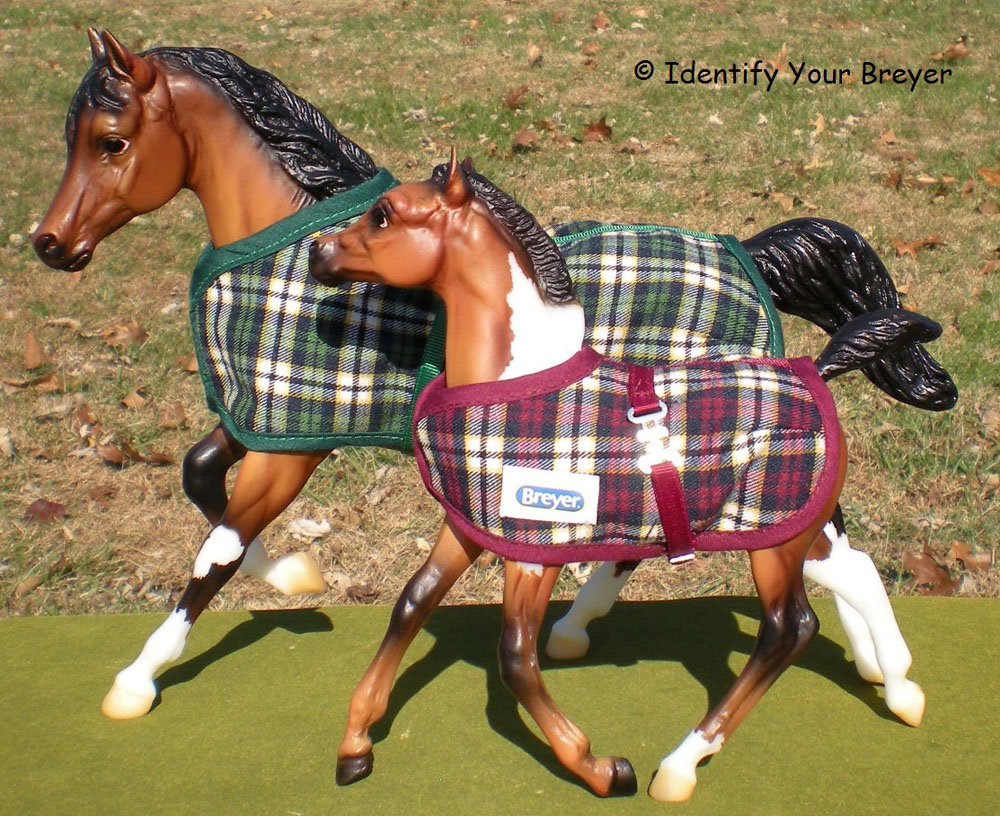
Of the two sets - the Classic Palomino Unicorns Glitter and Gem, or the Traditional Running Mare and Foal Vixen and Blitzen - I slightly prefer the Traditional set. It’s not a matter of color or scale preference here, it’s the homespun blankets that do it for me. How adorable are they? 


I have a big bag of homespun scraps I’ve been just itching to make into blankets. Time hasn’t been in good supply this year, so that project has been put on hold indefinitely; I’m hoping I might be able to whip up some itty-bitty Stablemates scale ones by BreyerFest next year, at least. Either as fun giveaway items, or as something cute and inexpensive for those of us on a tight budget.

But anyway, yeah, if I had the money right now, I’d be buying the Running Mare and Foal set. I don’t, so I can’t. The spare cash is tied up in a couple of small collections I just purchased, and until I sort and piece them out, buying stuff strictly to please myself isn’t on the agenda.

(Items from those collections are being listed in all the usual places, as they are cleaned and prepped.)

The 75 dollar price tag - a sticking point with many hobbyists on this set - doesn’t seem out of line with me. You’re getting two models and two blankets, plus a free 2015 calendar if you haven’t already redeemed that offer. (Then again, I don’t have a Chamonix burning a hole in my bank account, either!)

They’re making 1000 sets, and the Running Mare and Foal isn’t all that "in" with the in crowd, so I can afford to wait on them. There doesn’t appear to be a specified amount on the Unicorns, but most of the Classics SRs seem to be in that piece range, too (except maybe Mischief Night?) so again, not too much of a worry.

The Running Mare and Foal have come in a ton of releases in their 50+ year history, but Vixen and Blitzen are only the third release in a pinto - the first being the Liver Chestnut Pintos #848 and #849 back in 1991-1993, and the second being the Vintage Club Black Pinto Salt and Pepper.

There have been a couple of Appaloosas on each mold, some funky and unique "solid" colors like the Dark Dapple Gray, and they were among the five molds used in the original Decorator Series in the 1960s, too. So it's not like the releases have lacked for variety or imagination.

Just pintos, for some reason.

Friday, May 9, 2014

Gray Vs. Gray

Today’s pet peeve. This is Gray Appaloosa:


This is Dark Dapple Gray:


Whatever you want to call the color in your live show documentation, pedigree assignments or the privacy of your own home is your own business; model horses have no genotypes.  (Note: the pic skews a bit yellow - scanning references photos here, because the basement is still being painted.)

However, the term "Gray Appaloosa" has a very specific meaning in the model horse world, especially the subsection of it that we are all obsessed with here: Vintage Breyer models.

It’s Gray, with black or dark gray points, and a splash-spotted blanket, usually (but not always) located over the hindquarters. For a period of time in the 1960s, they painted the white blanket around the belly instead of the butt, but still kept the spots there. When they made the switch to Matte Finishes, the spots and the blanket matched up again.

We’re not entirely sure why they started painting them that way; some speculation is that it was originally a mistake, but then it became intentional, or something like that. It’s a separate topic I’ll get around to someday.

But anyway. If you are ever in the possession of a Dark Dapple Gray model - the only two true Vintage ones being the Running Mare and Foal - refer to them as such. If you call them Gray Appaloosa, collectors of a certain stripe (like me) are going to think Gray Appaloosa, not Dark Dapple Gray.

Yes, they have spots on the butt too - sort of. But for whatever crazy reason Breyer decided to call that color "Dark Dapple Gray" - to distinguish it from all of the other versions of Dapple Gray. Some of which are just as distinct and identifiable variations of Dapple Gray too, but never merited a special name. It's another one of those (probably) unsolvable Breyer mysteries.

If any true vintage Gray Appaloosa Running Mares and Foals do show up - Matte or Gloss - it would not be pretty. (Except to the seller, maybe.) 

There’s plenty enough confusion in the model horse world over color as it is, and we don’t need to add to it, even if we don't really mean to. Just do a little research, and call it what it was called when it was issued.

If there’s any potential for accidental misidentification (like a words-only saleslist, or verbally) just add a few qualifiers to your description. The #36 Racehorse is a good example: it was referred to as a "Bay" in the original Breyer documentation, even though it’s really Chestnut. Use air quotes, or call it Chestnut/Bay, or Bay/Chestnut. (Or perennial eBay favorite: Brown!)

(Hmm. A true Honey Bay Racehorse would be nice.)

First antique show of the season tomorrow, yay! It's an outdoor one, so I hope it doesn't rain. Time for bed!

Saturday, June 30, 2012

What’s the Fuss?

Is it the heat? I don’t normally expect a high level of discourse on the Internet, but dang it, it’s like everyone’s jacked up the crazy over the past few days. (The comments on Breyer’s web site forum and Facebook page … ‘nuff said, right?)

My theory: all the people who’d normally be outside shouting at random strangers on street corners decided to stay indoors and shout on the Internet instead.

I know I’m feeling a little more agitated than average today, but I’ve been chalking that up to a lack of sleep, due to the idiot neighbor who is abusing the recent changes in the fireworks laws around here.

(Vita don’t like it, either. Which contributes to the problem.)


My Salt and Pepper have arrived, and they are quite lovely. The packaging was a huge improvement - double boxed, individually bagged, and with a little extra packing paper, too. (See? Again, they really are listening.) I think mine have a touch more of the "fake overspray" than most, but I’m digging it all the same.

I also noticed that they might have done a little bit of tweaking on both the Mare and Foal molds; I can’t quite pinpoint the differences yet, other than the mold marks being switched out for the newer one, which might have happened earlier but I haven’t noticed since I haven’t bought a new Running Mare or Foal in a while.

(Note to self: I need to track these mold mark switches better. Also, work on my run-on sentence problem.)

And Reeves was most definitely trying to reproduce the Western Prancing Horse color on them; it even says so right on the Certificate of Authenticity:
"Our exclusive Club mare and foal feature limited edition glossy black and white pinto markings reminiscent of the retro Western Prancing Horse."
The gloss is a little bit thicker than the finish on the old Western Prancers, and there’s a little bit of body shading reminiscent of Charcoals in the black areas, but both of those changes were made, I think, to add a little bit of richness to the finish.

Besides, an exact reproduction of this finish would be pretty darn difficult, for all sorts of reasons. For instance, creating an old-fashioned painting mask, like they used to use (prior to the laser-cut stickers) would have been cost-prohibitive. There aren’t a lot people who can - or will - do that sort of detail work anymore.

(I wonder what happened to all those old painting masks/stencils? Another thing I haven’t given much thought to.)

I also consider the fact that they went with such an offbeat vintage color quite encouraging: I can only hope that one of my favorite vintage colors - the Black Splash Spot Leopard, also seen on the Western Prancing Horse - is somewhere on the horizon.

Wednesday, June 27, 2012

Salt and Pepper, Cream and Sugar

Today’s prayer: that some of those beautiful American Cream Draft centerpieces from the American Horse Publications awards dinner (as seen on Breyer’s Facebook page today) end up in the NPOD, and if I should miss them in the melee, that someone should hand one to me.

Oh, I’m not asking for it as a gift: I’m perfectly willing to pay for it. I don’t want anyone to get hurt, should someone else other than me happens to lay hands on mine, you know.

(Another long story, one that will be told only if and when one of those beautiful boys should join my herd. Yes, I am fully aware of - and own - the #906 Goliath, the 1995 Commemorative Edition. In fact, it’s part of that danged story.)

The Salt and Peppers are starting to show up, but mine’s not due here until tomorrow, I think; very nice of Reeves to send us UPS shipping notifications without prompting. (See, they’re learning!) The pattern on the mare is pretty much just like Western Prancing Horse’s, not the Shetland Pony; the composition of the original photograph did obscure it, though.

I’ve been trying to skim through the various online discussions about them because, well, I don’t need the additional grief, and I’m really not in the mood for more whining and whinging today.  Besides, y’all are amateurs in comparison to the Vita Monster: we cut back a bit on her snacks recently, and she’s not having it.

(Her tantrums are way cuter, too. Though the knocking of stuff off the tables, not so much. Terriers, man.)

I think I’m liking this year’s BreyerFest auction pieces better than most hobbyists; all these odd patterns and mold "mash-ups" give me the feeling that a greater percentage of them are actual test pieces, and not just whimsies done to please the hobby hoi polloi.

Like the red dun brindle Smart Chic Olena: there have been a couple other attempts at brindling in previous years’ auctions, and this SCO may be representative of where they are from a production standpoint. Still not there, but getting warmer.

I certainly wouldn’t turn it down if it were offered to me as a gift. (Not asking, just saying.)

Though, like everyone else, my favorite is the "Blackpool" Brighty in an adorbs mahogany bay pinto - with tack! We really do need a few more production run Brighties; the last two Specials were the BreyerFest 2005 Ticket Special Oliver, and the 2010 Contest prize Cameo, both of whom are just about impossible to acquire.

Another Brighty might make a nice Special Run for the Collector’s Club, don’t you think? Wouldn’t need to be spotted; I’d be happy with a Dark Bay or Black.

Thursday, June 21, 2012

Egg on my Face

Well, in my defense, I was only mostly wrong about the third Vintage Club release: I did get the "Reeves wouldn’t release the Running Mare without the matching Foal" part right.

And it’s nice to see that Reeves is now acknowledging that the Running Mare and Foal were released prior to 1963, which makes up (slightly) for the time that they misidentified (and misdated!) the Proud Arabian Stallion as the Family Arabian Stallion on their Facebook page.

There was an offhand comment by someone on Blab a few weeks ago about a Reeves employee/rep mentioning that the next Vintage Club release was "black and white", but I had discounted that because a similar rumor about a "buff" (Palomino?) Silver a few years ago never amounted to anything.

Oh well, I guess that just means I’m merely an expert, not a prophet. Major league baseball players only need to get one hit out of every three at bats to be considered "All-Star" material, right? I’ll comfort myself with that thought.

I am getting annoyed that it’s being referred to as a "Charcoal" Pinto, since the colorway that "Salt and Pepper" sport was never formally identified as Charcoal Pinto in any of the contemporary ephemera. (Just as the Smoke Belgian was never actually called "Smoke"!) It’s a nitpick, I know, but hey, I’m the queen of nitpicking. (And their hooves aren’t pink, either, so there.) The Foal’s pattern is based on the Western Prancing Horse’s, but the Mare is a little harder to tell (Shetland Pony-ish?)

My only other concern with the release is that it’s going to make the Breyer web site forums even more insufferable than they already are. (Are they a textbook argument for firm moderation, or what? Sheesh.)

Let’s see, in the next week we should see: a half dozen threads harassing/demanding Reeves release a matching Stallion; several more complaining about the overspray (it’s intentional folks - check out the Regular Run Bay Pinto Fury Prancers); and at least one griping about it not being solid Charcoal instead.

(I love Charcoal, but the obsession the Breyer web site forum-dwellers have with it is making me reconsider.)

Oh, and three or four threads of people crowing/chest thumping about how Reeves listened and responded specifically to their demands. That line of argument especially gets my dander up.

Other than a few extra-limited Special Runs and Glosses, Reeves does not have the ability to execute "quick" responses to collector demand: the factory is in China, for Pete’s sake. The rest of the releases for the Vintage Club - the fourth release, and any other special offers - are probably already either in production, or in the advanced planning stages (subject to minor, last-minute tweaking). 

We all like to entertain the notion that we’re more influential than we actually are. I’m not any different - and I get reminded of it all the time.

Tuesday, June 19, 2012

Maybe It's the Weather

My days continue to be nonawesome. Aside from my ongoing troubles, it looks like I might have to return my Vintage Club Stablemate Eagle, because of smudged spots.

Even the flea market left me feeling discomforted. The weather was not optimal, so a lot of the regulars didn’t show up. And those that did …weren’t the kind of people I like dealing with. (As I told my brother, it felt like "an insane asylum with a slightly better gift shop. And more guns".)

In more positive news, I did get my BreyerFest paperwork mostly done; all that’s needed is proofreading and printing, which I’ll put off until the last possible minute just in case of last minute rewrites. (You wouldn’t think that writing about vintage models would require that sort of thing, but almost every year...)

The third clue for the next Vintage Club release "Not standing" is not helpful, since all it does is eliminate the Shetland Pony and Morgan from the list, and they were already pretty much eliminated by the previous clue.

Not sure why everyone is so fired up about the possibility of the Running Mare: I just can’t see her being released without a matching Foal. Vintage Running Mares and Foals - with the exception of the Red Roan Mare - almost always came in matching colors.

I believe Reeves is thinking along those same lines. The clue is in the photograph in the Vintage Club Newsletter: it has a matching Glossy Alabaster Thoroughbred Mare and Suckling Foal in the background.

A matching Foal would either necessitate a higher price, or another Made-to-Order like Gus. I’m having a hard time seeing either event happening this year. (Especially since I think there’s at least a couple other unrelated "special offers" in the pipeline already.)

In other news, the BreyerFest Youth Show prizes were announced:
Grand Champ: Glossy Padre (4)
Reserve Grand Champ: Glossy Rocky Mountain Horse (4)
Sectional Champion: Glossy Highland Pony (18)
Reserve Sectional Champion: Glossy Shetland Pony (18)
1st place in Misc. Classes: Regular Run Little Texas
I think the Padres will look beautiful in Gloss - and the Rocky Mountain Horse? I wish. Not sure if I’m liking the fact that Sectional/Reserve piece counts are now reduced. Making the Youth Show prizes even more scarce doesn’t really help correct the issues the prizes bring in the first place.

The Saturday Raffle Horse was announced today, too: Carlisle, a Dappled Buckskin Tobiano Smarty Jones, as a Polo Pony. Here’s a link to his swoonilicious photo:   

http://www.breyerhorses.com/files/imagesBreyer/Community/Breyerfest_2012_Images/SR_Folder/BF12_SaturdayRaffle.jpg

I wasn’t expecting that. I was beginning to think that they’d maybe sneak in the upcoming Totilas mold as the Raffle piece, or a new pony mold. (Well, I guess he’s kinda new, and technically a "pony".) I’ll buy my usual allotment of tickets, and hope for the best.

As for the price that In-Between Mare brought, well, what can be said? That’s not the kind of crowd I run with.

Off to go spackle something…