Showing posts with label Adios. Show all posts

Friday, May 19, 2023

Metallic Bay Adios

That was an unwelcome surprise: I found a giant black spider on the envelope of my BreyerFest tickets as I pulled them out of the mailbox yesterday! I freaked out and immediately dropped all my mail on the ground, because spiders

The last time I had that close of an encounter with a spider, I got bit and thought I’d have to go to the ER. So my reaction was not entirely unjustified.

I am happy to report that both me and the spider survived the incident unscathed, as did the tickets. (No footprints!) The rest of the mail was also fine, including a lot of vintage Wyoming travel brochures I bought off eBay.

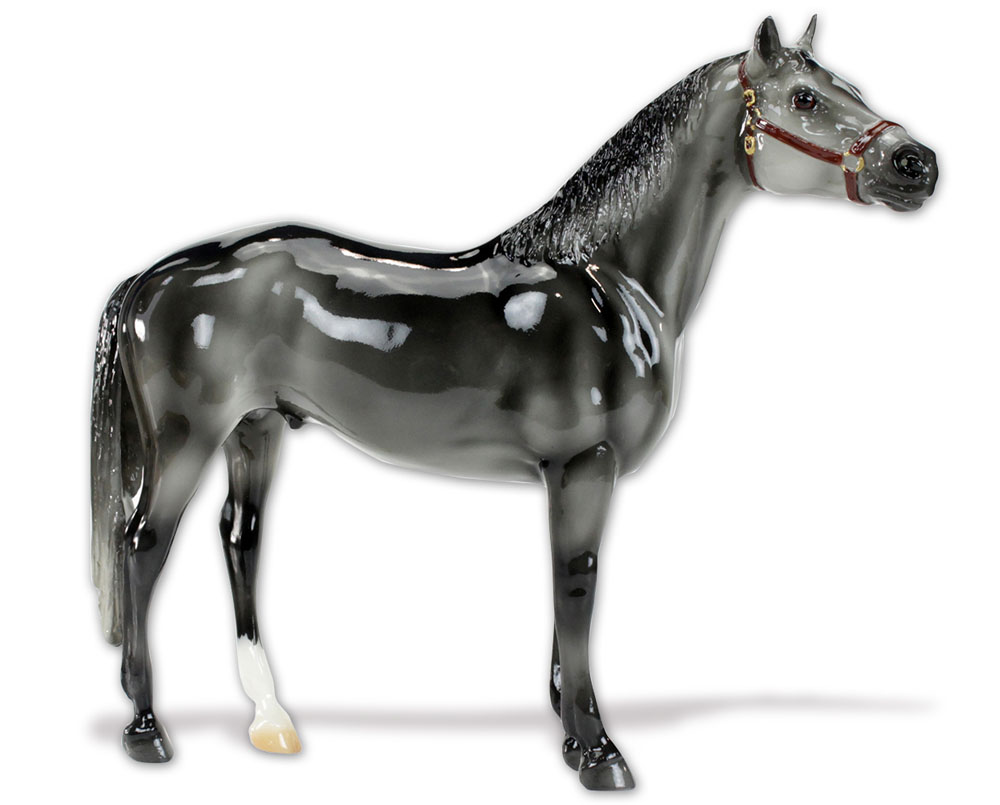
In less traumatic news, I was not draw for a Sparrow, but that’s neither a surprise nor a heartbreak. If I want to speak of heartbreak, there’s another Test Color Drawing, for a Metallic Bay Adios:

I wasn’t expecting this, because he’s not particularly flashy or groundbreaking (another Bay Adios, of all things?) but gosh, he is so pretty. I think I need him. 

Adios was a pretty popular guy in the 1970s and 1980s with both the general public and hobbyists: not only was he a portrait model twice over (Adios and Yellow Mount), he was also one of the more anatomically correct models of the era, and tended to show pretty well. Everyone had at least one Adios mold in their showstring!

Consequently, bodies were plentiful at the factory, which resulted a number of Test Colors and Oddities. You experiment with what’s available to you, after all…. 

The most desirable of these Oddball Adioses at the time, of course, were the Black ones. 

Contrary to hobby belief, the Black Adios was never formally considered a Special Run of any sort: they existed in a fuzzy gray area somewhere in between Test Color, Factory Custom and Gift/Prize Model. 

Some of them were painted by Marney as gifts to hobbyists who were lucky enough to get a factory tour: Black was the easiest color of all to paint, and since it covered a multitude of decorative sins, it was also a good way to use up some of the Culls in the regrind bin.

But she also painted up (or rescued?) some for resale. I remember seeing at least a couple in the Test Color boxes she casually placed on some empty show tables at Model Horse Congress in 1985, the ones that made everyone in attendance go into full meltdown mode.   

I was never lucky enough to get a Black Adios, though I came pretty close: our local hobbyist group was planning a trip to visit the Chicago factory in mid to late 1984, but the tour got canceled at the last minute, probably due to the pending sale to Reeves International. 

Considering how much of a legend the Black Adios has become nowadays, I think I have a better shot at getting the Metallic Bay one. 

Technically, I do have a Test Color Adios, or at least I think he is (yeah, it is one of those things) but I’ll cover him another time, when I actually have a little more to spare.

Saturday, December 19, 2020

The Nuisance

This Adios doesn’t look like much at first glance, but it was kind of a big deal for me – but more as a nuisance and a lingering bother at the back of my head than an actual grail:

He has no USA mold mark, which makes him a 1969 or early 1970 release. Although there are subtle differences from Adioses that came after – the color on the earlier examples seem a little redder and flatter than slightly later ones, with more noticeable shading in the face and the genitals – the absence of the mold mark is the only significant difference.

And for me, it was a variation that I could never manage to score, ever. I’ve owned a lot of Adioses over the years; the area I live in used to be home to several Standardbred farms, and there used to be harness racing just up the road at the Eastern Michigan State Fairgrounds. Seeing campers with sulkies strapped to their roofs or being pulled on trailers were a very common sight during my childhood.

In short, I find a lot of Adioses. I thought finding this variation would be easy. 

But most of them are either later examples or in, shall we say, unsuitable condition. My efforts to shortcut the process and buy an example with a Blue Ribbon Sticker didn’t pan out as expected, either: while I have excellent examples of both the Adios and Yellow Mount with stickers, both have the USA mold mark. 

This one came up on eBay a couple of weeks ago, with a very clear photo showing its obvious lack of said mark. So in spite of my spending moratorium, he had to come home to me to (finally) put that nagging nuisance to rest. 

While the Adios without the USA mark is not particularly rare variation overall – he was a pretty popular fellow upon his release ca. 1969, and sold briskly – his mold mark is something that only Breyer History nerds like me, and a not insignificant portion of you, care about. 

It’s not something that is usually noted upon in online listings. Exceptions are ironically made by sellers unfamiliar with Breyers in general, who tend to take pictures of the mold mark to prove to us what we already know (that it’s a Breyer!) not realizing it also tells us other, sometimes more important things (that he’s old!) 

Anyway, he’s neat and he’s sticking around, unless a mint condition one with a Blue Ribbon Sticker happens to show up at the right place, the right time, and at the right price.

Tuesday, November 19, 2019

Yellow Mount: The Grail

Originally I was going to pass this one more post down the road because of my scheduling issues (guys, I have two months worth of TV shows to catch up on: imma gonna binge watch my way through Black Friday) but I figure I’ve teased you enough. Here’s the first “grail” I purchased, a few weeks back:


At last: a mint, near-perfect Yellow Mount with Blue Ribbon Sticker. Isn’t he beautiful?

As you know, I rarely pay “market price” for vintage models: it’s just not in me to do it, even when I have the funds available. I also have the advantage of living in an area where I can find stuff real cheap; I’ve found that if I wait long enough, I’ll find almost anything, eventually.

(Except Decorators, Presentation Series models, and Liver Chestnut Quarter Horse Yearlings. The last one baffles me.)

Anyway, a “perfect” Yellow Mount’s been on my grail list for a while, and in the run-up to Mr. Perfect here I’ve acquired a couple of pretty decent fellows, including one that’s possibly a painting sample of some sort. But other models (and other things) took priority – and whenever a beautiful Yellow Mount did show up on my radar, I’d put in a token effort and let it go whenever my bid or offer was inevitably superseded.

I figured one would show up locally, eventually. It would probably take a while, since Yellow Mounts aren’t nearly as common around here as Adioses are.

In short: while I wanted it, it never felt like the time to fight for it, until this one came up. Since I had the funds, and a serious need to buy something special (I’ve been so good!) I bid my max… and got him.

Yellow Mount debuted in 1970, the last year that the Blue Ribbon Sticker was in use, making Yellow Mounts like this one among the earliest examples made in a pretty lengthy run (from 1970-1987).

He does have the USA mark; the USA mark started showing up on Breyer models at some point in 1970, since many new models and releases that debuted that year came without it – like my Liver Chestnut Quarter Horse Yearling, who I had to buy at BreyerFest one year because I could never find one in these parts, either…

(… though she didn’t cost me nearly as much as the Yellow Mount!)

I’m not sure if I’ve ever actually seen a Yellow Mount without the USA mark, but I wouldn’t rule out the possibility. If I did find one, it’d just be another addition to my Yellow Mount collection, and most definitely not a replacement for this guy.

Wednesday, January 16, 2019

Let The Guessing Games Begin!

Current speculation on what the next Special Run reveal for BreyerFest – based on the tiny sneak peek they provided us on the blog yesterday – is running towards either the Adios or the Clydesdale Mare:


Both have similar coat textures, and both debuted in 1969, more or less. Precise release dates for new mold releases from 1968 through 1970 are actually kind of hard to pin down, but that’s another topic entirely and not something I’m up to untangling today.

(I didn’t sleep well last night, so I’ve been fuzzy all day.)

But let’s nip this one particular nugget of misinformation in the discussion in the bud: the #47 Man o’ War was definitely a 1967 release, not a 1969 one. While I think it’d be awesome if they did offer a Traditional Man o’ War as one of the Special Runs this year (because I’m still a bit chafed about last year’s Early Bird Raffle Model Riddlethis particular model can’t be him.

Anyway, if it’s a choice between the two (I haven’t really done a muscle by muscle comparison, yet. Fuzzy: see above) I’m rooting for the Clydesdale Mare. Aside from being a favorite of mine, the mold has had a rather illustrious history of BreyerFest releases, including the coveted 1998 Special Run Shannon, the (much underrated) 2003 Celebration Horse Gladwin Lucky Lady, and the 2013 Volunteer Special Run Gloss Palomino Opry:


There’s also the 2007 Reserve Champ Show Prize Betsy Ross, but they only made nine of her. Unless I am bequeathed one in a will, or one mysteriously appears on my doorstep, that one will never grace my horseshelves.

It also helps that mold has been in production very recently, with the last of the well-received Tractor Supply Special Run release Alba still lingering in some remoter stores. (I am still trying my best to resist!)

We’ll all know by Friday, regardless.

Monday, February 6, 2017

Adios’s Little Star

Since I mentioned it in passing last time, here’s a close-up of the original Adios’s teeny-tiny star:


(The spot on his nose is just a rub, not some rare or obscure variation.)

You might notice that this example has extra black shading around his eyes, because he’s an early release of this model, ca. 1970, with a near-complete Blue Ribbon Sticker. Some examples even have fully blackened ears; mine has black ear tips, but I wasn’t quite able to pick them up in the light of my office.


The only thing that would make this guy any better – besides a sticker in slightly better condition – would be if he didn’t have the USA mold mark, but that’s a pretty rare trick to pull off for an Adios, sticker or no.

Early Adioses with Blue Ribbon Stickers seem to be a bit of a hot commodity lately, so I am not going to think about upgrading, unless one miraculously drops into my lap at my local Salvation Army or something.

Adios was not the first Breyer “portrait” model – as true Breyer aficionados know, Lassie and Rin Tin Tin can claim that title, both being released in 1956. (I think Lassie came out a couple months before Rinty, but that topic deserves a post in and of itself.) And then there is the Circus Boy set, which came out in late 1956 or early 1957: the actual “Circus Boy” is a fairly decent depiction of a young Mickey Dolenz in his pre-Monkee years. 

Adios isn’t even the first equine portrait model: that title would go to the Fury Prancer release of “TV’s Fury” ca. 1958. The second? That was the #47 Man o’ War in 1967.

But other than being “a black horse with white markings”, Fury looks little like the actual Fury; and as much as I adore the Traditional Man o’ War, it wasn’t until 2010 that the WEG Reissue accurately portrayed his actual star and stripe.

Adios is thus the first equine portrait model that made a real effort to look like the actual horse, both in form and in the paint masking.

Sunday, September 25, 2016

When Breyer Met Mego (no, the other Mego)

It was another weird and wonderful day at the flea market, the kind that makes me wish I had a booth at one of the local antique malls so I could justify buying stuff to stock it!

I passed by most of the horses – they were either overpriced, or simply not that interesting – but I did find one interesting bit of Breyer-related ephemera from the same vendor I purchased that photo album from:


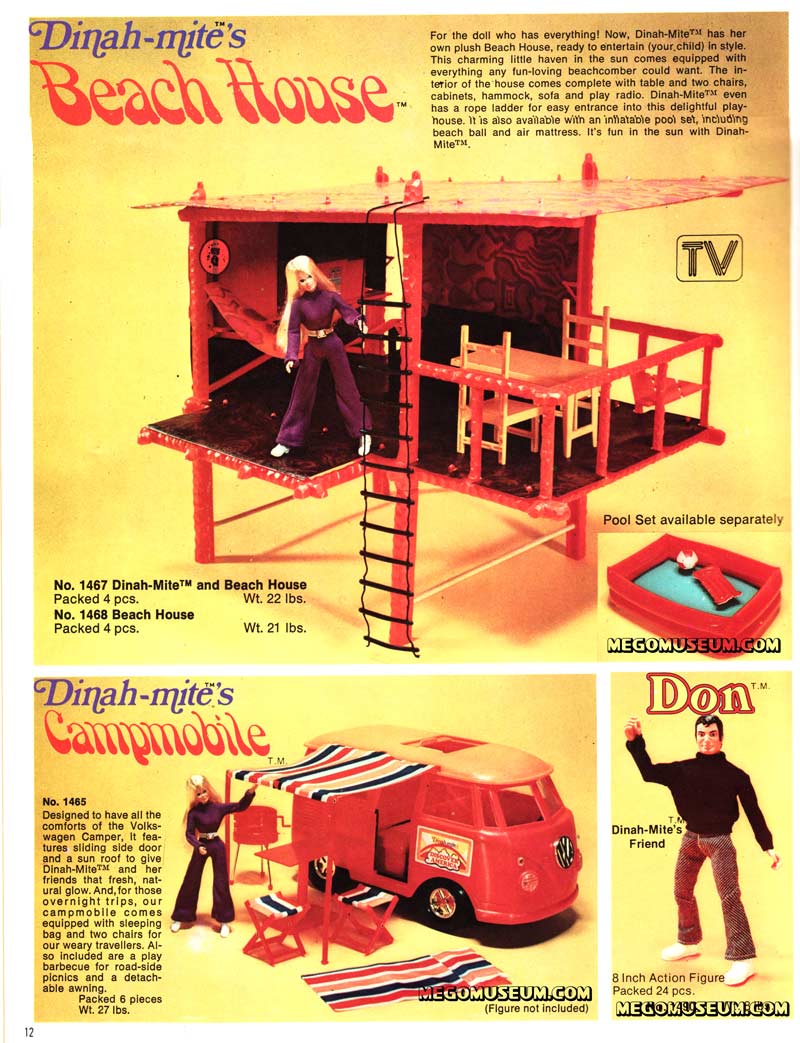
Dinah-Mite paper dolls!

Dinah-Mite was Mego’s version of Barbie, whose biggest selling feature was that she was – as you can see from the cover of the book – far more posable and versatile.

She didn’t last long – she was discontinued ca. 1975, in favor of Mego’s better-selling Star Trek, Superhero, and Planet of the Apes lines. But not before she acquired some interesting accessories, including a horse “Golden Pal”, who was a motorized knock-off of our friend the Palomino Family Arabian Stallion:

http://www.megomuseum.com/dinah/v_horse.shtml

And a boyfriend “Don”:

http://www.megomuseum.com/catalog/1974/images/dinahmite2.jpg

Both of these accessories were not originally her own; Golden Pal was originally the Planet of the Apes “Action Stallion” and Don was simply a Mego Superman in civilian clothes. Mego was thrifty (and/or creative) that way.

So why am I going on about this obscure doll from the early 1970s? It’s because the original, elusive, rarely-seen Breyer Rider Doll from the 1976 Breyer Rider Gift Set was… a repurposed Dinah-Mite:


Or at least, the prototypes were.

There are all sorts of stories floating around about why the original Breyer Rider Gift Set never materialized; the original one I heard was that there was a safety or manufacturing issue involved. But if the plan was to just repurpose/reissue Dinah-Mites – and not merely hijack a few for the prototypes – something else might have been going on.

There are enough Mego resources online to solve that riddle, but like so many other things, I haven’t had the time to find out.

Sunday, January 10, 2016

Mostly Black

Why yes, there are quite a few solid black Breyer releases on tap for 2016:
  • Dag Dia (BreyerFest SR Brishen) 
  • Carltonlima Emma (the new Fell Pony)
  • Cortes C (Carrick)
  • Cherry Creek Fonzie Merit (Adios)
  • Rhapsody in Black (Weather Girl)
Add the following earlier Traditionals, still current:
  • Magic (Miniature Horse from the Magic and Hamlet set)
  • Classic Shire (from the set)
  • Welsh Cob (Llanarth True Briton)
  • Totilas
Throw in several more recently discontinued items like the AQHA Horse, and models in other scales, and it makes you think: wow, Reeves must have gotten some deal on black paint recently, eh?

I think it’s more coincidence than planning. Mostly.

Black horses had a strong pull on the imagination of horse lovers long before the publication of Black Beauty in 1877. Black in and of itself is visually striking: in a herd of Bays and Chestnuts, the Blacks will stand out. It doesn’t hurt that it also has the cachet of being a relatively rare color too, genetically speaking.

It is an easy and inexpensive color to paint, and very flattering on molds with strong and pleasing contours, like the Adios.

With all other factors being equal, Black will tend to get the nod over something slightly more common, like Chestnut or Bay. Throw in a few popular or trendy breeds that either specify or favor Black (like the Friesian, and the Fell) and there you go: a Mostly Black lineup for 2016.

Speaking of Adios: not counting Roans, Grays or Tests, the Cherry Creek Fonzie Merit release represents the first true unmodified Solid Matte Black Adios Production Run. The closest we came previously was the striking Dark Mahogany Bay #853 Mesa, released in 1991-1992.

The “Special Run” Black Adioses of the 1980s that get spoken of with some frequency in hobby circles were more a collection of similar Samples, Tests, and Gifts than a true or formal Special Run, and as far as I can remember were never advertised as such, either.

I certainly wouldn’t argue its technical or legal status if one was offered to me, though!

Thursday, June 20, 2013

Body Box Adventures

Before I go on, I just wanted to point out that the next round of Munda auctions is up tomorrow. I actually bid on a couple this time, partly because eBay is annoying me this week. (There are a couple of very inexpensive items I am trying to acquire for a project, and I keep getting sniped. Sniped, on cheap stuff!)

We got out of work unexpectedly early yesterday, so I took that extra time to clean out my Stablemates body box. Aside from the fact that there was no way in heck I’d ever get around to working on them any time soon, my "Dollar Table" selection was looking a little skimpy. I like having a certain amount of inexpensive items for kids, cheapskates, and people who’ve already blown their budgets but still want to buy more stuff anyway.

None of them were specifically bought as bodies, but most were "comes with" box lot items. Some of I wouldn’t necessarily classify as body quality, but I decided to just sell them all that way anyway, just because I didn’t want to deal with the drama.

The most painful experiences I have had at BreyerFest - aside from the Roommate Issues, and the actual incidents of me injuring myself - have been when I’ve had to deal with people who put up big fights over condition, often over the most minor of flaws.

We’re not talking about honest pricing negotiations: these were the kinds of folks who wanted me to sell them a $40-50 Special Run for ten bucks, because of a single smudged dapple. It’s gotten to the point that if more common models with already low price points have even the tiniest of flaws, I sometimes relegate them to the body box, just so I don’t have to get into arguments with people over what constitutes a "body".

What pains me more though, are the models that aren’t so common - yet are technically classifiable as body quality.

My thinking is this: just because something is classified as body quality doesn’t necessarily mean that it should be used as a body. I have a small but significant assortment of models I’ve fished out of body boxes myself, and place on the shelf right next to LSQ Test Colors.

The problem is that the prices for pieces that are meant to be bodies - and pieces that are simply rare, but in poor condition - are indistinguishable. The price for a body-body is a reflection of its value as a "base" or armature for a new work, while the price of a body-rarity is because it still has some residual value even in spite of its condition. (A coverless, poor-quality copy of Action Comics #1 may not be worth much, for instance, but there’s certainly still a market for it.)

One particularly painful year I had a body quality Adios for sale. Normally this wouldn’t cause me much consternation, but this guy was a Chalky - a white plastic Chalky, to be precise. While Yellow Mounts are not too difficult to come by, Chalky Adioses definitely are - even in body condition.

I was reluctant to sell him, but my sales stash was quite skimpy that year, and he was a recent flea market pickup that I had not yet grown too attached to. Since he was technically quite rare, I put him on the shelves with all of my other stuff. I figured he’d be a fairly easy sell, right?

Nope. He lingered on my shelves straight up until Saturday. I’d happily chirp to anyone who looked his way about his Chalky status, and his exceeding cheapness, but no dice. This was a bit before the current Chalky craze, and it was true he wasn’t in the best shape, but I kept thinking what the heck?

When I pointed out his Chalky nature to someone who appeared to be genuinely interested in him, the expression on the (eventual) buyer’s face was clearly one of "And I should care why?" She needed it as a body, nothing more.

My first reaction was "No, you do not deserve him! Begone!" But I needed the money, and I needed the space. Who was I to deem her money unworthy? I swallowed my pride, bit my tongue, and took the money, because she was willing to at least pay the asking price.

So the way I deal with this situation now is by tossing quality models of dubious condition status into the body box. That way, if someone happens to find it and recognize it for what it is, it cheers my heart a little.

Honestly, I think I have an easier time selling models like that in the body box because, well, I am not the only one who specifically goes hunting for buried treasure there. Other hobbyists are all too eager to show me Chalkies, Pearlies, and vintage customs from famous customizers pulled out of other people’s body boxes - things that I would have been proud to add to my collection.

It happened last year, with an early Lady Phase. Some of the earliest Lady Phases, for some odd reason, come in a very white - but not truly Chalky - plastic. I don’t know if they decided to go with virgin Tenite (no regrind = minimal yellowing over time) or it was a last little remnant of Chalky white plastic mixed in with the standard semi-opaque stuff.

She was, unfortunately, very much a body: her condition much worse than the Adios, even. I’ve been running a bit of a surplus of models here, so keeping her wasn’t even remotely an option.

The person who fished her out of the box stared at her a good long while, turned her over in the lamp light several times, and then said something to the effect of "She’s something special. I think I can fix her up." 

I think I ended up selling her for the same price as the Adios. It wasn’t about the price, though.

Monday, May 13, 2013

Shades of White

Okay, so now the scuttlebutt is that the Shetland Ponies I mentioned last post might/will be a Vintage Club release, so the reference to last year’s e-mail photo was probably the correct one.

I am a little ambivalent about the concept only because, duh, there never were any Decorator Pintos. There were rumors of Decorator Pinto Test Colors floating around back in the day, but I found those rumors even less substantial than the Christmas Decorator ones.

(I swear Reeves does these sneaky reveals on the "Kid Tours" just to mess with us, knowing the kids are going to be fixated on the newer molds in more realistic colors.)

I found some charged batteries, so here’s the Calf I mentioned previously, with his Regular Run cohort:


So now you see why I am not so eager to send the little bugger back!

Yes, I know my Regular Run Calf is yellowed, but it looks worse than it actually is because the Oddball is very stark white - not Chalky or Opaque White Plastic, but I could see how some people could mistake it for such.

That sort of thing happens, from time to time: someone at the factory - possibly by accident - came up with the perfect mix of virgin (fresh) plastic, plasticizer, and colorant. I have an Alabaster Western Pony that’s so white it almost glows in the dark. (Discontinued in 1970, if you’re trying to do the math at home.)

It’s been recently reported on Blab that someone found an older Chestnut Belgian that was actually made of a mix of standard white and Chalky white plastic, which only really reveals itself when held up to a strong light. (Ooh, swirly!)

This does not surprise me at all. Breyer was experimenting with whatever plastic they could get their hands on in the early 1970s (the Chalky Era), and it undoubtedly included many different colors of white in addition to all those funky reds, browns, grays, purples and greens.

In the sometime questionable light of a factory, the mixing of these various whites would become an inevitability, if not an economic necessity. 

It’s even happened more recently, with some of the Stablemates molds: at some point, the Glow-in-the-Dark plastic that was used to make the Giveaway Andalusian Keychains was mixed in with the standard white stuff, giving some later releases a faint luminescence.

Other colors sometimes got swirled into the standard white plastic, especially in the Chalky Era, but they generally got painted over - either by a solid dark (or black) paint job, or with a Chalky basecoat first. Reeves does this even today, as many faux finishers have discovered first hand.

And…I just opened up my Yellow Mount that I bought from That Guy, and guess what? Aside from being one of the nicest Yellow Mounts I’ve ever seen, his plastic is also snowball-white.

Interesting.

(His variations are pretty subtle - tan instead of pink shading, more gray on his muzzle - but I bought him mostly because I wanted a nice Yellow Mount at a nice price. Done, and done.)

Saturday, February 2, 2013

When, Not If

My standard work procedures involve me pecking away at several small projects simultaneously, based on my levels of time, interest and energy, with the goal of finishing them all within a relatively narrow time frame. (That’s similar to how work works, too - we run multiple work flows with the intent of finishing them up around the same time.)

It doesn’t always work out, but it works out well enough most of the time that there’s little reason to change it.

Most of the time. Every once and a while I get into a fit and I just have to see a project through from start to finish, RIGHT NOW.

Anyway, that’s my excuse for not opening up my Commander, even though I got him late Thursday afternoon. If I opened him, I’d have to deal with him, and until a few hours ago, I couldn’t. I have to work tonight (a new account, too, I think) so I’ll probably have to put off his unveiling until tomorrow morning, when my mind has room to roam.

One minor distraction I did allow myself was the one-question Vintage Club survey asking members about our preferences: Do you want Vintage colors on Vintage molds, or Vintage colors on Newer molds?

Y’all should know by now what I picked. There was also room to comment, but I didn’t: trust me, Reeves already knows. 

I am not philosophically opposed to Vintage colors on Newer molds, I’d just rather see them released in a different context or program - either as a extra release, like Gus, or as a part of some other program. (A "Retro" Club?)

The molds they selected to show us as examples were quite interesting, especially the Vintage/Vintage pieces:


 For balance, here were the Vintage/New pieces:


No promises were made about the models depicted in the survey - they were being used merely as examples of the kinds of items they were discussing.

Judging from the reactions I’ve seen to the Charcoal Adios, though, I think it’s just a matter of when, not if, on that pretty boy. (Next year’s "Exclusive", maybe, if he ain’t the next release?)

I liked the Gloss Honey Bay Pinto Yellow Mount more than I thought, too. When I initially saw him in that group shot they sent out last year (the one with the Morgan now known as "Halo") I thought "Nice, nothing spectacular". He looked like a glossed regular run Yellow Mount with added black points. (Something they've done in the past, by the way - anyone remember the BHR Bay Running Stallion, made out of leftover 1988 JAH Special Run? And the Small World Trakehner?)

No, he’s an actual Honey Bay, complete with four stockings and black hooves, just like an honest-to-goodness vintage Honey Bay.

And just to let you know, I’d buy either of the Nokotas in a heartbeat, especially the one in the Splash Spot Black Leopard. I like the mold, but I’d dig that color on anything. (As long as they actually do the Splash Spots as Splash Spots, of course.)

Saturday, September 1, 2012

Not Dun Questing

The book sale was surprisingly low key this year. The overall selection was good, but there weren’t a lot of horse-themed books to be had. I might go back on Monday for the box sale anyway, because they did have lots of vintage astronomy books, another odd and unprofitable obsession of mine.

(I also really like old Botany textbooks, and Latin Grammars. Mostly for the really beautiful illustrations.)

Oh, and just to let you know, I’ve finally made a decision on who gets to be my next official one True Grail, now that I’ve found the Man o’ War of my dreams.

It’s Yellow Mount.

I’ve had many Yellow Mounts over the years, but none of them ever worked out for me. The color wouldn’t be quite right, or there would be condition issues, or the masking would be just a bit too fuzzy for my tastes.

The earliest variation, with the blue ribbon sticker, dorsal stripe, and pinkish hooves would be ideal, of course, but they’re way more difficult to come by than the early Man o’ Wars. It’s been years since I’ve seen one like that up for sale, and the price it went for was definitely not to my liking.

I’d settle for a Presentation Series piece, or a nice Chalky, or even a late example with no forearm spot and dark greyish hooves. I suspect I’ll end up with most of them, by the time the quest runs its course.

All it means in the short term is that I’ll be spending a little extra time ogling Yellow Mount-infested listings on eBay and MH$P. I did have him on my want list for BreyerFest this year, but I was tapped out - of enthusiasm, and money - fairly early.

As I noted above, the earliest Yellow Mounts had dorsal stripes - a subtle acknowledgement of the fact that the real Yellow Mount was actually Red Dun, not Chestnut. Breyer called him a "Chestnut Paint’ right from the get go, though. From the 1970 Collector’s Manual, the year he debuted:

I don’t know if this was a simple mistake, or if Breyer "simplified" the color for the general market. Yeah, the really horse-crazy kids would know what a Red Dun is, but an average consumer has a hard enough time telling a Bay from a Chestnut. It had only been a couple years earlier that Breyer itself had even figured out the difference!

It’s not that big a deal nowadays - in fact, trying to upsell an older mold with an exotic color is all the rage these days. (Remember the "Silver Dapple Dilute Dun" on a more recent release of the Adios, Frappe? Of course you do!)

The Yellow Mount lost his dorsal stripe early on - like so many other early decorating changes, a matter of cost. What’s interesting, though, is that while the Yellow Mounts eventually morphed into a somewhat standard Chestnut, a lot of Breyer Chestnut paint jobs of the 1970s looked more like Red Dun than Chestnut, particularly the Stablemates ones:

Go figure.

Friday, September 9, 2011

Presenting Itself

I just happened to be in That part of town where That farm store is, and what’s sitting on the shelf waiting for me? I swear, I was there just to see if they might have one of those Rocky Mountain Horses!


A glossy Valentine and Heartbreaker set. Sigh. I couldn’t just leave them there, either. Who knows whose hands they’d have fallen into? I had to rescue them! Such a quandary - keep, or sell to one of my regular customers, who’s still looking?

Argh! Time to futilely list more items on MHSP while I decide. (If any of you are interested in a cheap thrill or two, all my listings include postage, just to simplify things. Sometimes when you start dickering about postage, it slows the process down. Money’s great, but I want ‘em gone, too.)

(BTW, that store still had a couple of older Zenyattas from last year, if anyone’s still looking, and any deal needs sweetening.)

To clarify the book scanner thing: book dealers go to used book sales with handheld devices that can tell them how much a book’s current resale value is; if it’s greater than what the book sale is charging, they’ll buy it for their inventory.

I go to used book sales for (a) cheap/obscure reads, (b) to add to my collection, and (c) to stock my BreyerFest sales stash with fun little extras. I don’t make enough to justify buying a scanner, plus I think it’s tacky and a buzzkill. There are some sales that ban the use of scanners outright, though the local sale is not one of them, unfortunately.

I might be listing a few of my better sale books on MHSP too, once I run out of horses to list. Nothing expensive there, either. (Sorry, no Paul Browns - those are keepers!)

So yeah, I saw the Presentation Man o’ War on eBay; I didn’t even bother bookmarking it for later. It went for well over double what I could theoretically pay. Paying for my teeth and my tires take priority right now.

You know, it wasn’t that long ago that Presentation Series pieces were considered … well, not all that big a thing. A lot of collectors then (as now) weren’t too keen on the whole attached base thing. Why spend extra for one with a base, when you could get a freestanding one cheaper? It was nerdy-cool to have a few in your collection - especially if you were a completist - but they weren’t the high demand budget-busters they are now.

Some have been found in this area - mostly Adios, which is not a surprise: there used to be a number of Standardbred farms in the area. The Adios model itself is a fairly easy find around here. I’ve come close: I’ve found a few mounted trophy-like things, but no true Presentation pieces, yet.

I’d be happy with any of them. I’m not particular; I only "need" one for the collection. Aside from cost and rarity, those bases take up an ungodly amount of shelf space: it just wouldn't be practical. Now, I wouldn't turn down a nice-sized collection of them if they did happen to fall in my lap somehow, but what are the odds of that?

(Yeah, I know, it's me we're talking about. When, not if, etc.)

Friday, December 4, 2009

Stock Photos and Stock Horses

I did a quick box count last night and realized that I was one-third done with my big “descriptors” project – considerably further along than I had anticipated. It helps that I'm not working, I guess. I have lots of time to occupy, and I might as well do it constructively.

The not-working part is not by choice. And not something I want to talk about right now.

What I do want to talk about is the catalog photography problem. No, not the recent phenomenon of lackluster lighting and color correction, but Breyer's bad habit of reusing and recycling old stock photos.

It was a particularly bad problem in the 1960s and early 1970s, when the product line changed at what now seems like a glacial pace: models and colors were issued not for months or years, but for decades. It made sense for Breyer to get as much use out of the stock photographs they had on file, rather than retake photos of the same models from year to year.

The only problem was that these paint jobs didn't necessarily stay the same over time. Markings changed, or the color or shading may have been tweaked over the years. Sometimes only the prototype of the model was available for the initial photo shoot, and the production model was significantly different. The Yellow Mount was famous for this discrepancy. For years, Breyer used photos of the prototype, which looked little like the actual production model. Here he is again, in the 1975 Collector's Manual:

He was his actual normal self in other PR materials, including the picture box he came in – here illustrated in the 1975 Dealer's Catalog:

Many of us were quite disappointed back in the day when we realized that the model we received only bore a passing resemblance to the one we saw in the catalog – because it was the photo in the catalog that we had formed our hopes and dreams on!

It's a huge problem when it comes to documenting color and mold changes. Most of the photographs in the 1968 Collector's Manual weren't taken from models that were fresh off the line: they were stock photographs that had been sitting around, sometimes for years. They retook a lot of them for the 1969 Manual, but a lot of those same photos were still being used in the 1975 Collector's Manual, even though many paint jobs changed dramatically in that timespan. We have to rely on other sources – contemporary photographs and accounts, and non-catalog promotional materials – to date those changes.

Stock photos are still useful research tools; look at how far it got us with the mystery of the Sorrel Fighting Stallion. It helped establish an earliest possible date: that model in that color had to exist by 1963. Stock photos cannot be used to establish a latest possible date, because as long as the photos exists in some form, somewhere, it may get used. For example, I have a very amusing toy jobber catalog from 1977: some of the photos they use to illustrate then-current Breyer products date back to the 1950s! (And don't necessarily match up to the product advertised!)

I'll have to talk about that wonderful old toy catalog another day – it really is worth its own post.

The stock photo problem doesn't happen as much as it used to, because the turnover is so high that individual releases don't have the opportunity to change over time. The markings or masking might be a bit different, or they might switch the finish from matte to gloss, but the photographs they release are a lot closer to the final production pieces than they used to be. We still hear griping and moaning about the models don't EXACTLY match the photographs, but compared to what we had to deal with in the 1970s, those complaints seem almost comical.

Tuesday, October 27, 2009

Even More Adios

Frappe’s quick sellout was a bit of a surprise. I don’t mind being wrong in this case, if only to take pleasure in seeing some of the other know-it-alls being silenced as well. (A little schadenfreude every once and a while ain’t a bad thing.)

In my case, though, my reservations weren’t with the model, but the circumstances: the economy, the holidays, the rare-model-grabfest coming up at the end of the week, and the overall grumpiness of the hobby-at-large kinda had me feeling that it might take a little longer than a mere 24 hours.

(And now Reeves is throwing grab bags into the mix this week, too. So tempting…must resist!)

At first I thought maybe everyone had a same reaction to the color that I did, but now I’m thinking that an awful high percentage of buyers bought duplicates.

I understand this on one level: everyone wants to make a little extra cash any way they can nowadays.

On the flip side, speculating is just plain bad for the market. It’s not just the money issue (with a few winners, a lot of losers) but there’s also a perception issue: it distorts the perceived value of a model in the marketplace, and that can have a more lasting, and more damaging, effect on the market.

When the value of a model changes, it’s rarely because of a physical change in the number of models in the market. (That does happen, but not as often as you might think nor in the quantities generally imagined.) What changes is the perception: if it is perceived as rare, popular, or hard to get, more hobbyists will want it. If it’s perceived as less rare, less popular, and easier to get, less will.

The actual quantity is almost irrelevant: things change when you hit the sub-200 piece threshold, but I’ll talk a little bit more about that in my LSE discussion later this week. I’m not into a mood to go into a deep philosophical discussion about the nature of model horse market today anyway.

I do want to discuss something I did find at the flea market this past Sunday, that I briefly mentioned in the comments of the last post: a biography of Edward Marshall Boehm.

No joke. I seriously thought I was being punked at first. (The book in question is Edward Marshall Boehm: 1913 - 1969, by Frank J. Cosentino, published in 1970 by The Lakeside Press.) I picked it up, flipped through it, found the pics of Adios, and then started looking for cameras or familiar faces in the crowd to jump out at me and yell "Psych!" Nope, just my crazy flea market mojo at work again.

Here’s one of those pictures: the Boehms presenting the first Adios to the Millers on October 14, 1968 (sorry about the moire pattern - the scanner is being temperamental):


I will take the hint that the universe is giving me and finally cover the Boehm Adios issue.

Simply stated: there really isn’t one. I think Nancy Young rather conclusively proved that the Breyer Adios and the Boehm Adios were sculpted concurrently; and their similarities are mostly a result of the source materials both Boehm and Hess relied on. (Hess adapted the small bronze trophy Adios based on the original, life-sized sculpture by James Slick; Boehm probably used the same photographic references Slick used to create the original bronze.)

But here we go with the perception thing again: until Nancy did her research, the belief was that Breyer copied the Boehm. The fact that a large number of early releases were copies from other manufacturers - most notably Boehm - reinforced the notion. The notion has been dispelled largely through Nancy’s thorough research, but it still crops up from time to time (whenever someone runs across a Boehm Adios, basically.)

But the idea also tends to get a boost from the "Breyer can do nothing right" crowd. You know these folks - they’re usually the first folks to post their opinion of anything Breyer, and it’s always negative. There’s not actually a lot of them out there, but they’re persistent and omnipresent, and the sheer volume of their comments masks the fact that it’s actually a rather small pool of crankypusses repeating the same complaints over and over and over again.

(There's the perception issue, again!)

Canon among this crowd is that if Breyer did something right, well, they had nothing to do with it in the first place. They got lucky, it was an accident, other collectors have unsophisticated artistic tastes, etc.

So naturally, the assumption of the "Debbie Downer" crowd is that any success the Adios mold has had in the model horse marketplace is almost entirely because it’s a copy of something else. Something superior.

In a sense that’s true: the Breyer Adios is a copy of the Trophy-scale Adios, which in turn is an adaptation of a much larger work. But it wasn’t the Boehm. They just happen to look similar because they both ultimately came from the same source material.

Just because it’s more limited, and done in a more expensive medium doesn’t change that fact. I certainly wouldn’t reject a Boehm Adios out of hand if one were to show up at the flea market, but if I had to choose between it and a beautiful, minty Presentation Adios, I’m nabbing the Presentation Adios, hands down. Not just for sentimental reasons, but because I also think it’s a better sculpture.

More on the Boehm book later in the week. Aside from the LSE commentary, I have another flea market find to discuss. Stay tuned!

Saturday, October 24, 2009

Frappe

Words of advice: don't ever do a Double Wedding Ring Quilt. They will eat your brain, all of your spare time, and your fingertips.


There’s a long and interesting story behind it, but I’ll save it for when I finally get around to my Breyer History Quilt project.

I’ve been trying to work on a post about the LSE, but everything I write turns into a cranky rant, and you guys deserve better than my best Harlan Ellison imitation. There’s been WAY too much crankiness in the model horse world lately anyway, and there's no need to throw more into that toxic soup. It’ll just have to simmer on the back burner for another day or two and try to cook some of the unpleasant flavors out of it.

(Can you tell the weather turned wet and drizzly this week? I need a bowl of Corn Chowder, STAT!)

Dang, the color on that Web Special Frappe is sweet. I kinda hope he sells out before I inevitably change my mind and hit the BUY button. (Not sure that’ll even happen, but I’ll cover that in the LSE post.) I’ve pretty much put a moratorium on buying any horses through the end of the year: I could swing it financially, but I really, truly do not have the space for it.

(Unless someone wants to trade my extra Del Mar for one. Same price point, comparable run. No bag, two very faint lines under the gloss in the blaze. Real nice shading. Think about it.)

I like Adios; I can’t recall how many I have, but it’s definitely more than a couple. Let’s see, I have an original bay Adios with a Blue Ribbon Sticker, a beautiful Mesa, Hollywood Gold, that strangely appealing 1990 Black Roan, the highly underrated Like A Diamond … no Yellow Mount, yet, but that’s because I’m being inexplicably picky. I’ve had a lot of Yellow Mounts, but none of them have been the right Yellow Mount, y’know? I have the same problem with the Palomino Western Prancing Horse.

I will never own the original Palomino, and the Buckskin? You don’t want to know my history with the Buckskin Adios. It will lead to crankiness. And the possible throwing of sharp, pointy things.

Outside of his original release, most of his releases have been of the stock horse variety, in spite of the fact that he doesn’t look too particularly "stock horsy." He looks like what he was originally meant to be: a mature Standardbred stud. (As for who came first - the Breyer, or the Boehm - I’ll be deferring that topic, yet again, for another time.)

The mold manages to carry off just about any color really well, though, so I don’t have a problem with any of the more exotic colors they put on him. (Who doesn’t love that gorgeous Brandywine?) And that dappled dilute dun? Holy milkshakes, Batman! I think I have a new favorite color for my Collector’s Choice submissions.

In case you were wondering: why yes, I do have a picture of the real Adios in his salad (or would that be alfalfa?) days: here he is as a 2 year old, in an uncredited photo from the cover of the June 16, 1943 issue of The Harness Horse:


Yet another gift to my archive from the local flea market.

Friday, April 17, 2009

Breyer Urban Legend: Black Adios

This one has gotten me in trouble before, so I’ll have to tread lightly.

There is no such thing as a Black Adios Special Run. What you see here is also not a Black Adios: it’s a Mesa, in the extremely handsome and rarely used "Mahogany" paint job. (Few models would not be improved by it!) It’s probably the closest I’ll ever get to a Black Adios, and I’m okay with that:


I see the Black Adios on a lot of want lists as a valid item. Nancy Young listed it as such in her reference bible. And there are just enough of them out there that some folks may actually find one, lending credence to the idea of it being a special run. But what they’re buying isn’t really a special run.

A Special Run item has to have a few things going for it to qualify as a one. One characteristic is consistency: all of the models have to be the same, or nearly the same: one batch might have better shading than another, or slightly different markings, but the variability is relatively narrow.

The second characteristic is limitation: it is either available only for a limited time, in a limited quantity, or only through a specific dealer or venue.

The third characteristic is acknowledgment: it has to be advertised or distinguished from a regular run item.

Not every special run item shares every characteristic, but they do meet at least two of them. "Acknowledgement" probably the most controversial: a lot of early special runs - especially the XMAS catalog items, and the Woodgrain Ranchcraft Lamps - were never advertised as such, but that’s mostly because the term really didn’t exist back then.

"Acknowledgement" mainly applies to later items that are very similar or identical to regular run releases, but were specifically advertised as specials. The most obvious item would be the Toys R Us Bay Fighting Stallion - virtually identical to the regular run release, but sold a special run.

(There’s another subcategory of this kind of special I call Post-Production Specials, which are regular run items rereleased after their original discontinuation, but I’ll leave that esoteric concept for another time.)

The Black Adioses only really meet one of the criteria, and it’s only because of the person who was involved in their creation: Marney. The Adios model was a particular favorite of hers, and the black paint job was an extremely easy one to render. Any Adios cull with reasonably clean seams could quickly, and easily, be transformed into a Black Adios.

Markings on these Adioses varied widely - some had leg markings, facial markings, gray hooves, tan hooves, black hooves - whatever Marney’s mood and the condition of the body allowed.

They were made over a period of years; she didn’t have a stockpile of Black Adioses waiting for shipment or orders to come in. They were made whenever she had access, opportunity, and potential customers. Some were reputedly available as a gift at the end of factory tours (I almost had a chance to go, but it was canceled at the last minute. And when I did finally get a tour - well, another story, another time.)

So they were not limited by time or quantity. There was no real consistency in markings or finish. They were not really advertised as special runs, though Marney was never really consistent with that terminology one way or another either. They were available almost exclusively through Marney, but that’s because she was probably the one making them on an ad hoc basis.

So what do we call them? How do we classify them? It’s a good question I really have no answer for: he’s a unique case. The Black Adios is the Black Adios.