Showing posts with label Restoration. Show all posts

Sunday, April 16, 2023

More, or Less?

Enjoying a momentary respite here: the taxes are done, the seeds have been started, and (most) of the financial paperwork I wanted to wrap up has been… wrapped up. Nothing I need to get done can get done until tomorrow, other than some stray e-mails that I am procrastinating about.

I was going to write up a more full-bodied explanation of my reasoning surrounding the likelihood of the early Family Arabian Special Runs, but the initial dive into my research materials left my head spinning. So instead, let’s focus on something that is both less – and more – of a mystery:

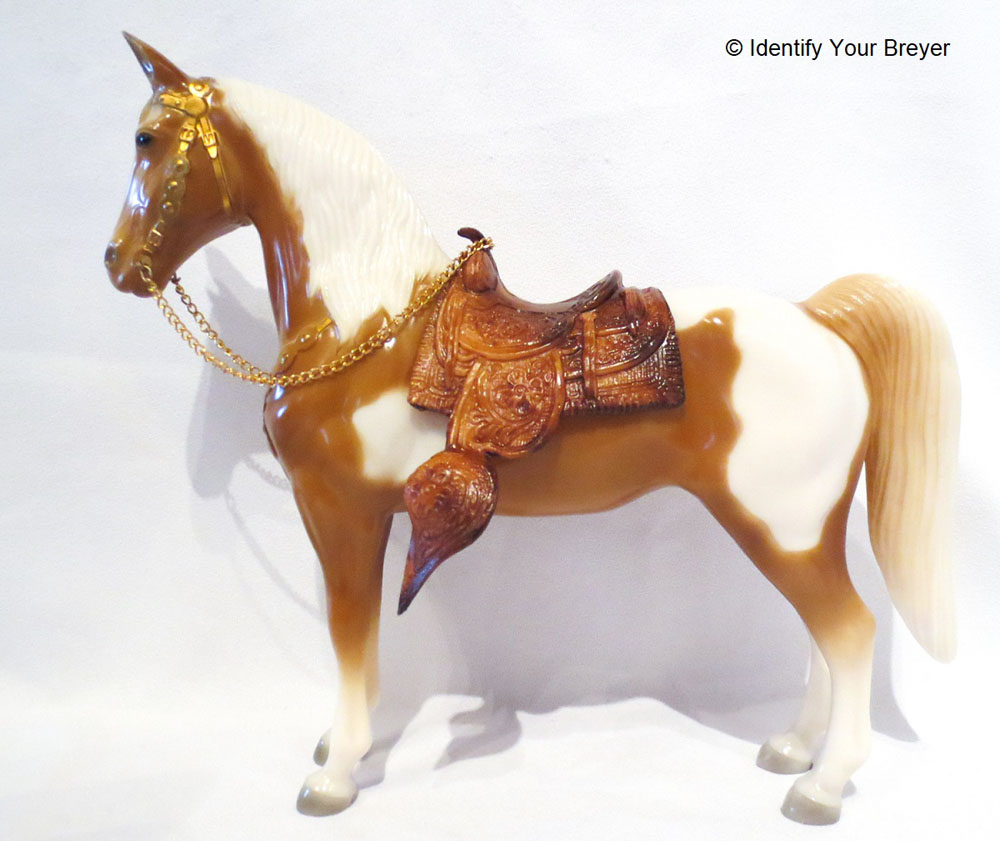
As I mentioned many, many years ago, I picked up this Western Horse at Model Horse Congress back in 1985 or 1986, which was both significantly before the Just About Horses Special Run Palomino Pinto from 1990, and well after the Regular Run release #56, which was discontinued in 1966. 

The fact that he is essentially unfinished (the black paint is very obviously not factory original, in person) and without his original reins tells me he was a Cull, and the fact that that particular shade of Matte Neon Palomino was typical of models from the early 1980s suggests he “escaped” from the factory not long before I had purchased him. 

Even curiouser: the pinto mask/stencil used to create him was also last used in production over ten years earlier!

(I cannot remember if the saddle was a replacement, or came with. Probably a replacement.)

I didn’t think too much about how truly odd he is until recently, though: in fact, he really is one of the weirdest things in my collection. Had he been a very early Test for the JAH release that was shelved? A frivolity that the one of the painters played around with? Were they training, or giving a painting demonstration of how those metal masks worked, with the Western Horse simply being the most convenient test subject? 

Most of the random Test Color Western Horses I see tend to be of the solid variety, and also usually complete. I am presuming he was either an Employee Take-Home, or a model Marney salvaged from the factory as a body. 

Bodies that also happened to be Test Colors, or other such rarities were not that uncommon back then, by the way. The bodies that always freaked me out were the Special Run Culls: I remember seeing a few of the Chestnut Midnight Sun that absolutely messed with my head. 

It’s a body, but it’s also a Rare Special Run! Argh, my brain!

It was not that big a deal for most other hobbyists (who were just happy for the cheap bodies) but now I wonder just how much something like that would go for today, in its original state. Crazy bucks, more than likely; I even remember some of us speculating about that possibility back then. And laughing about it....

Another question I have been asking myself about him lately is: should I restore him? I am not as weirded out as I used to be about naked, or partially naked models sitting on the shelf, and I am not one of those hobbyists who insists that even obviously unrealistic paint jobs require realistically painted eyes.

If I do, I’ll probably strip the black paint off and replace his reins, because I still remain a minimalist when it comes to Original Finish restorations. But not much beyond that: if he was simple discard, a cull of little import, then those scuffs and marks are also an indicator of his history. Fully restoring him would erase all that. 

Just something to think about. 

Sunday, January 3, 2021

Soap, Water and Sunlight

You know me, I love a good fixer-upper, and I couldn’t resist this one when I found him on eBay for less than a price of a new Traditional at current retail:

While I am certainly not averse to a challenge, there’s nothing better than finding a rare model for cheap who only needs soap, water and sunlight!

The soap and water part almost done; the hard part now is in finding an open windowsill. Many members of my “dirty pony box lot” are currently occupying most of the available real estate, and they are as yellow – or even more so – than the new kid.

But I hope to sell most of those guys this year, and the Mustang is staying, so I’ll just have to be patient.

The #85 Alabaster or “Albino” Mustang isn’t a particularly rare vintage model: he was made from ca. 1961 through 1966, and that was a respectable run for models made in that era. The hardest part is finding one without significant rubs in his gray body shading and mane and tail.

Because it requires a light and delicate touch, gray shading on white or nearly white models can be quite fragile, especially on Matte-Finished models from the 1970s onward. Typically, the gray shading was one of the last layers of paint added to the model, sometimes on top of the matte clear coat that gave those models their soft, powdery-matte finishes in the first place.

Gloss-finished models, on the other hand, are a bit of crapshoot. Sometimes the gray shading was applied first and then the model was glossed, and sometimes the gray shading was applied over the Gloss. 

The ones with the gray shading under the Gloss, understandably, tend to weather the years better than the ones with the shading over the Gloss. 

My newest addition appears to be the “shaded under” version, but I’m still taking my time cleaning him – partly to be cautious, but also because I’m rather enjoying the process.  

Wednesday, December 16, 2020

A Surprise in Every Box Lot

It’s cold, snowing, and the Seasonal Affective Disorder is hitting me hard right now, guys. Plus I got wrangled into making a Christmassy centerpiece for Friday, and that should be… entertaining. 

I wanted to do something Star-Warsy, but I limited myself to whatever I could find at Dollar Tree or in my craft closet and alas, no tiny AT-ATs or X-Wings to be found…

The cleaning of the dirty pony lot continues apace; I think the Black Bucking Bronco may also a Pearly, but the plastic itself is just strange overall; I don’t know if the model itself has a textured surface, or the paint is just more heavily applied than average or there is just really deeply embedded grunge. I think the last? 

The plastic almost feels like ABS/Styrene, but it’s not. It’s really perplexing me.

(I have no pictures of him yet because he’s still got a lot of rehab ahead of him – this boy is a mess! – and I am currently preoccupied with this silly centerpiece thingy anyway. The things I get myself into, I swear.)

Here I thought I had seen it all when it came to crazy plastic shenanigans of the 1970s, but in every mystery body box, there seems to be a surprise!

I haven’t owned a lot of Pearlies in my time; outside of the two potential candidates from the dirty pony box lot, I only own a Black Appaloosa Lying Down Foal currently. I haven’t had much luck finding nice examples locally, and the ones in the “retail” market either tend to sell quickly, or go for more than I’m comfortable with. 

The Lying Down Foal was a BreyerFest purchase from many years ago, before they became a big thing. (Wandering the halls, buying cheap Chalkies and Pearlies. Ah, those were the days…)

I think it’s interesting that Breyer seems to have limited the Pearly plastic to either Classic-scaled molds or to Foals. I don’t know if it was an active, conscious decision on Breyer’s part back then, or simply a coincidence: maybe they just happened to be running those molds that week? 

If this Bronco is any indication, though, maybe there were some technical issues they were having with it that made it more practical to run on the smaller molds. I am a little fearful that that is the case: he has a leg bent at a terrifying angle I will only attempt to straighten on a day when I am not feeling either grumpy or flat-out exhausted. 

Saturday, December 12, 2020

My Dirty Ponies

While everyone else was plotzing about the Space Bears or Star Wars spin-offs yesterday I was having a grand old time with a big box lot of dirty ponies:

Here’s a close up to give you an idea of what I’m dealing with:

I know I am not alone here, but cleaning dirty plastic ponies is my happy place. Buying a lot like this is not about adding to or upgrading in the collection, or even about making any money off the deal, though when all is said and done I will probably make a small profit. 

I just really enjoy taking something dirty and unattractive and making it presentable and/or pretty again. In some ways it’s much like a customizer’s impulse to make something beautiful out of what they presume is less so. 

The only difference here is that instead of rejecting the original color, shape or design, I’m restoring it.

Some are already done, some are still in process, and some (like the deeply yellowed Shire, and the Proud Arabian Stallion who I’ve nicknamed “The Trainwreck”) are definitely long-term projects. 

The only one I think I might be keeping (so far) is the Clydesdale Foal, who turned out to be a Pearly underneath all that muck. The Clydesdale Foal is one of the less common vintage Pearlies, and she has rather pretty shading too, so that’s cool.

The Shire might also stay, depending on how well the de-yellowing goes. While she has some condition issues above and beyond the yellowing, her shading and dappling are so superior to my already existing Dapple Shire that it’s definitely giving me something think about.

The Old Timer has “cornflake” dappling (sparse, giant dapples), which is also a thing. On the other hand, I definitely don’t need another Dapple Gray Old Timer variation. 

The Diamond P Knockoffs are fun, but I have enough already and they will all be moving on eventually. The big standing one that seems to be an original design might stick around a little longer than the rest since I find him intriguing overall, even if his face is disturbingly serpentine. 

Monday, March 9, 2020

Health and Safety

The primary components of cellulose acetate, the stuff that (most) Breyer models are made of, are cellulose and acetic acid. The vinegary “New Horse Smell” we experience when we open up our latest acquisitions is the acetic acid: vinegar is, more or less, a diluted form of it.

Vinegar is considered a disinfectant, though it is not as effective as commercially made disinfectants.

What I’m saying here is that your new 2020 Traditional-scale Breyers don’t pose a significant health risk, because the stuff they are made of is somewhat self-disinfecting.

Once it’s out of the box it’s another game altogether. Anyone who’s bought anything second hand – sometimes even from other hobbyists – knows Breyers can get real funky, real fast.

(Oh, you know I have stories!)

When that happens, the safest and most effective cleaning solution for most Breyer models is warm water and a good quality dish soap like Dawn.

Diluted Bleach or Vinegar (not both together!) can also be used, but come with some risks. They can cause “milkiness” (basically turning the clear topcoats found on earlier Breyers opaque), can corrode metallic paints, and if left in a solution for an extended period of time can flake the finish off completely.

I am supposing – I am not in the loop about this, so don’t quote me – that in regards to COVID-19, Reeves is in the process of developing contingency plans for both the Seattle Soiree and BreyerFest.

Cancellation is probably their very last resort. As in, I think it is extremely unlikely. But being prepared for worst-case scenarios is never a bad thing.

For what it’s worth, my hobby plans have not changed. I am relatively healthy (aside from some minor chronic conditions) and I’ve had good hygiene practices drilled into me from an early age. (Many members of my extended family have worked in either healthcare, or in food services.) 

But I am not a health care expert, and I am not you. I would urge you to take the time now to review your own situation and plan accordingly.

Saturday, February 8, 2020

Presenting...

Back in June of last year, I said this in passing about the possibility of completing my Bell-bottomed Shire collection:
(The Chalky Sorrel and the Glossy Dapple Gray are sufficiently out of reach that I am not even going to consider them a part of my list. Sort of the way I ignore the Presentation Series Man o’ War, until/if/when it happens.)
Dear readers, it happened:


He has a few (mostly minor) condition issues, a slightly sunken-in shoulder, and all that’s left of his brass nameplate is the stickum.

He also smells of cigarette smoke, but I swear virtually every Breyer model I’ve had that has been mounted on a wooden base – trophy, clock, sales awards, et al – has smelled this way. Wood is porous and absorbent, and way more people smoked in the early 1970s, back when these things were new.

In other words, it was not unexpected.

It’s also a pretty easy fix – clean it with warm water and good quality dish soap, and give it some time. For really bad cases of “the stinks”, sealing the offending model in a trash bag with an open box of baking soda for a couple weeks also helps.

Most of the minor condition issues will be fixed also, but the sunken shoulder (also not an uncommon issue with models of this era) will not. I’m undecided on the nameplate; it’s a common enough problem that it doesn’t bother me that much, especially considering the price I paid for it.

Well within my budget? Oh, yes. 

Y’all know my collecting philosophy by now: unless you are one of those people blessed with extraordinary good luck, you must either invest time, or money. Since the only luck I have is in living where model horses are relatively plentiful, and I grew up in a family where paying full retail for anything is almost a sin, time is my currency by necessity.

And my patience has paid off: except for some obscure variations, the 1970s Dapple Gray, and (sigh) Riddle, I’ve managed to come as close as possible to completing my Traditional Man o’ War collection as I probably can, without going into serious debt.

There are still a few Regular Runs I need to get, like a Spectacular Bid without staining, a General Lee’s Traveler without massive paint goobers, and some box/packaging variants. Another Test Color would be awesome, but unlikely unless I get insanely lucky or Reeves just randomly sends me one.

Not a bad consolation prize for not going to Seattle, I must say.

Friday, June 22, 2018

Clearing Out the Picture Files

I can’t think of anything interesting to say today. So I’ll clear some random pictures off the hard drive. After the recent dusting and reorganizing, I took a few extra pics for the times when words fail. Like today!

Here’s one last “glamour” shot of those Gloss Alabaster Family Arabian Mare and Foal before I decide their fate:


If you don’t remember, this is what they looked like when I got them:


They did turn out pretty darn nice, didn’t they? But I already have a very good set of Gloss Alabasters – with stickers! – and no (physical) room for sentiment, so they’re likely headed to Kentucky in a few weeks.

(You could use this post as part of their provenance, if you’re in the market!)

They’ve been in my bedroom window for the past several months, so I will miss seeing them every day. But I’m sure I can find someone else in need of a sunbath soon.

Here’s a pic of the original Little Bits #9025 Clydesdale, produced from 1984 through 1988, and released in a couple different shades of Bay since then. I’ve been wanting to talk a little bit more about the Little Bits/Paddock Pals, but I haven’t been able to come up with anything interesting or clever to say.


The photo turned out nice, though. Of all the Little Bits molds, the Clydesdale does seem to be the most photogenic, isn’t he? I’m not sure if the front stocking was intentionally masked, or someone’s fingers got in the way.

I bought him when he came out in 1984, so the latter, probably. Quality control was, in spite of rumors to the contrary, not necessarily better back then. Speaking of…


Always makes me smile. I know something like that isn’t likely to slip by QC today; not because it would not be well executed, but newer collectors are more likely to see it as a flaw, and not character. (Not mine, but been offered.)

And finally, since the hobby was all agog a while back over the Family Arabian Mare with the Mahogany Bay Proud Arabian Mare paint job, for equal time here’s a pic of a Test Color Proud Arabian Mare wearing the Family Arabian Mare’s version of the Bay paint job, black hooves and all:


Since this photograph (one of Marney’s, of course) is dated early 1971 – before she was officially released for sale to the public – this probably represents a True Test Color, as opposed to things that were painted just because.

Pretty girl! I wish I knew where she was. Purely out of curiosity: it’s not likely I’d be able to afford her than that Mahogany Bay Family Arabian Mare!

And that’s all for today, folks.

Saturday, September 9, 2017

Cliff Diving 2: Sparky and Jules

Still trying to process this….


Yep, I bought two carousel horses, including the screamy guy I kind of fell in love with. His legs are a mess, but dat face! 

Technically, it’s more like pieces of two carousel horses, but the better and fancier horses went for better and fancier money, and the prices for these guys were in the “moderately desirable Web Special Run” range.

I still can’t believe I did that, though. It feels like I just bought two real rescue horses and now I have to make arrangements to get them taken care of, ahhh….

No, actually, feels more like last year when I took that chance on the Chasing the Chesapeake Event. I was mildly to moderately terrified at the enormity of the task ahead of me, but it turned out wonderful in the end.

This will too.

If this does anything, it will motivate me to do that serious herd thinning I’ve been putting off. Partly because I’ll need the money to get Sparky and Jules all fixed up, and also to make a place for them in the house.

(Can you guess who is who?)

I’ll also probably be abandoning a lot of my customizing and craft projects because cripes almighty, I just took on the two biggest craft projects ever…

(Not the quilts, though. Quilt projects are carpool-friendly.)

Breathe girl, breathe.

Saturday, February 6, 2016

Stinky

Here’s that model in question I referred to earlier in the week: he’s a nice, minty, later variation of the #47 Traditional Man o’ War.


One of my ongoing projects currently involves tracking the changes that occurred in some long-running Regular Run items, including the Traditional #47 Man o’ War and #46 Pacer. Both the timing and the price were right, so yay, a new Man o’ War is now in the house!

Most of my Man o’ Wars are either early variations or oddballs; this is good, in a way, because it means the holes I now get to fill in my Man o’ War chronology/timeline are the more common and less expensive pieces. (The only real “rarity” I need is the Presentation Series one. Since the last one I saw for sale ended up in the $700 range, that can wait!)

But tell me if you’ve heard (or experienced) this story before. You get super-excited to get something you want real cheap… until it arrives in a box that’s clearly too small, and reeks of your Grandmother’s ashtray.

Fortunately – and as you can see from the photos – he survived the journey to my doorstep without a scratch. The box and packaging made a quick exit to the recycling bin in the garage, though, and “Manny” has been going through a couple of showers with me since then.

(We all do that, right? Rinse dirty and/or stinky new horses in the shower with us? Please tell me I’m not the only one!)

Stinky models are not an uncommon occurrence for either me or thee. Traditional Breyers are made from a semi-synthetic material that is heat and moisture sensitive: kept in a stinky environment, they’re eventually going to start stinking like it. Only cleaning, fresh air, sunshine and time can remedy that problem.

I grew up in a family of smokers, so I got good at mitigating cigarette smells. The stinkiness of the packaging was the lesser of the two evils here. That could be fixed.

The size of the box, on the other hand, made me nervous as heck. It takes more than soap and water to fix rubs, scratches and breaks.

While I can understand that some people can become inured to the smell of cigarette smoke, the fact that the model is a little too big for the box you’ve chosen should be obvious. My local post office (as I assume most of them in the U.S.) has little handouts and charts to instruct you on sensible packaging procedures.

Some of it is a lack of experience: we ship a lot of stuff to each other on a daily basis, so hobbyists tend to be unusually high-skilled in the art. But I don’t know how many times I’ve been at the local Post Office during the year-end holidays, stuck behind someone holding a box, a gift item, and wearing a confused and desperate look on their face.

The other, of course, is cost: to either save money or to avoid a trip to the store to buy packing supplies, they’ll scrimp and make do with what they have in the house. And these models are virtually unbreakable, right? A plastic bag or a couple pieces of wadded up newspaper should be more than enough!

I got lucky this time, but there are times that I have not. Why it always seems to be the really rare or unusual items that end up losing the shipping lottery, I’ll never figure out.

Sunday, October 18, 2015

Intensity

The first big box lot is in the house and it was…challenging. Everything was dirty, one horse was partially filled with sand (!) and many of them are a very entertaining and/or distressing shade of yellow. This Alabaster Family Mare and Foal set is a perfect illustration of what I was dealing with here:


The snowy-white FAF next to them is there for comparison: he was a previous restoration project who turned out almost perfect. (His muzzle is unretouched – it really came that way, that gray!)

At this point, I’m not sure if I even want to do any work on this pair. In fact, I’m seriously considering keeping them “as-is” (dust and all) for any demonstrations I may be called in to do in the future: they are such perfect examples of the grungiest Breyers can be.

They are textbook candidates for restoration, too: in excellent condition, underneath the yellow and the grime. (Aroma-free, too. Thank goodness.)

I don’t even see many significant rubs or scuffs in the gray areas, which is very unusual for Breyer Alabasters of this age. For some peculiar reason, Breyer often painted the gray areas of their Alabasters after glossing and not before, leaving them unprotected and very susceptible to rubs.

Cleaning those gray areas is one of the biggest Breyer restoration challenges: a little bit too much pressure with a cotton swab or toothbrush, and you can kiss that beautiful shading goodbye!

One technique I’ve found that keeps additional damage to a minimum is a variation of “power washing”: warm water, mixed with either a high-quality dishsoap (like Dawn) or a degreaser like Lestoil, repeatedly applied with a squirt bottle at close range.

I usually do it on a towel or in a shallow pan to contain the mess, rubbing and blotting only when absolutely necessary, if at all. I managed to clean a very dirty Horse-Over Clock this way, keeping the super-delicate “patinated” mane and tail intact.

I love doing this kind of restoration work – making the once beautiful, beautiful again – but that box lot took a lot out of me. I sure hope the next batch is a little less intense.

Sunday, May 31, 2015

Judgment Calls

I got lucky on eBay last week a scored a good - and cheap! - body box lot. When I mean good, I mean it included (a) better than average Classics, and (b) a couple of bodies I could use. Also included in this lot were these two pieces:


The Running Foal is a very loved and abused Chalky from the 1970s; it was the most damaged item in the lot, naturally. Yet in today’s superheated Chalky market, even a model in this condition is worth something.

That wasn’t the case even a few years ago, when I found myself selling a very sad-looking Chalky Adios to someone who fully intended on customizing it. I really didn’t have much of a choice in that matter; I needed the money, and no one else seemed interested in him.

As far as other models that fit this equation - rare, but trashed - I really don’t have a firm opinion on what should be done with them. Of course I’d rather have someone keep them Original Finish, but body quality is body quality: sometimes you have to let a few go.

In regards to the question of restoration, I am neither for it, nor against it. My personal preference is for minimal restoration: repair the breaks, unyellow it, clean it up, stabilize it (add a leg to stand on, if necessary). I might do a few touch ups, as long as they’re not obtrusive.

But if someone wants to do a full restore on him, I’m good with that, too. Which is why this guy is going on the regular portion of my sales list, and not being tossed in the body box like the rest of the lot will be. Might as well minimize any further damage, right?

The Kelso is a little better - rough, but in a less breathtaking way. What’s interesting about him is that he’s an early Classics Racehorse without the mold mark; the first batch or two of the Racehorses didn’t get the mold stamp.

We’re not sure why the mold marks happened later - either it was forgotten in the rush to get them to market, or (my theory) they were still hammering out the legal details of the leasing contracts. This lack of a mold mark sometimes works in our favor at the flea market or yard sale: no mold mark = not a Breyer!

He has the beautiful body shading typical of the early Classics, but he also has the rough seams, burrs, fuzzy gray overspray, and sloppy detail work that was also part of the package back then.

He’s going straight to the body box, though: he’s not someone I need right now, and he’s just common enough that he doesn’t merit shelf space. He’s got excellent mold detail, and is a Love Classic, so I doubt he’ll stay in there long.

Wednesday, May 29, 2013

Spring Cleaning: Getting the Funk Out

Honestly, I have no idea if I got one of the Mother Lode models listed on the Breyer web site tonight. Like everyone else I spent 10 minutes trying to log on, and then having it taken out of my order queue when I went to pay.

Then they reappeared again, about an hour later, and my order allegedly went through. I figured that the worst that could happen is a cancellation phone call or e-mail from Reeves, right?

Look, I can accept not getting a super-limited model. I’ve been really lucky the past couple of years, with the Glossy War Horse, the White Moose, the Buried Treasure Lusitano, and the first Vault Sale. So missing out on a pretty gold Lady Phase would be no biggie. (My favorite was the Gold Buckskin! The "common" one of the three, allegedly.)

It’s the waiting that kills. If I’m going to be disappointed, I want the pain and suffering over with quickly, like pulling a Band Aid off. That’s all I’m asking.

Moving on…

I had an interesting experience with a piece of vintage fabric over the weekend. I wanted to give it a quick rinse or two to get the flea market "funk" out of it, but it turned into a two-day-long ordeal to vanquish the "Old Lady’s Ashtray" smell emanating from the washtub. I’ve had stinky fabric before, but this so bad I was having flashbacks to a particularly odoriferous family road trip in 1979.

(Four chain-smoking adults in a GMC Jimmy with the windows rolled up most of the time because of the rain. Good times!)

"Destinkifying" is a topic that comes up with regular frequency in my e-mails, and since flea market season is in full swing, it’s probably a good time to bring it up here again, for reference.

The Cellulose Acetate that Breyers are made of is semi-synthetic, and semi-permeable. In other words, it can absorb stuff it comes into contact with: water, grease, oil, cigarette smoke, perfume, and all manner of airborne pollutants.

Cigarette smoke is among the worst: not only does it make the model smell bad, the nicotine from the smoke also makes the plastic look dingy - and in more extreme cases, darkly yellowed.

The first step should be a basic cleaning: dunking and soaking in very warm water with a good amount of high quality dish soap. Dawn seems to be the brand of choice among most hobbyists, but if some other brand works well for you, it should work for your horses, too.

This should get the top layer of grime off, and unyellow the model slightly by consequence. I wouldn’t recommend a dunk any longer than overnight, because the model will start to absorb the water as well, possibly lifting the finish. (Glossies are especially prone to this!)

Naturally, this is not an ideal solution for any model with labels or stickers. And surprisingly, anything with metallic paint - either as tack trim, or as the base body color. If you’ve ever had any experience with vintage Decorators, you know that the gold paint that Breyer has used in the past has been of variable permanence: it fades, it tarnishes, it corrodes.

It’s not that those models can’t be cleaned or unyellowed, but they should be done with extreme caution.

Squirt bottles are a useful tool for those models that can’t or shouldn’t be dunked. Mix up a solution of warm water and a little bit of dish soap, and set to stream. Spray and blot quickly, as necessary; a cotton swab comes in handy for the nooks and crannies of the mane and tail. But again, be gentle: there are some finishes that are prone to rubbing (Alabasters and Dapple Grays), and the less pressure you put on their finishes, the better.

Once the initial cleaning is done - by dunking, or by spray bottling - put the model in a sunny window with cool exposure: this should dissipate the remaining odor after a couple of days. If not, either repeat the procedure, or take the cleaning process to the next step: baking soda.

Sprinkle the model liberally with baking soda and seal it in a plastic bag, preferably with the rest of the box, and let it set for several days. Periodically pull it out and check to see if the funkiness has reached an acceptable level.

I’ve also been told that dryer sheets could do the trick, but this is something I haven’t risked yet, as Vita finds them to be a treat of the same level of desirability as the "candy" the deer leave on the lawn. She hasn't shown any interest in my horses lately, no need to give her any incentives, right?

Sunday, November 20, 2011

It's Not the Heat

Slowly grinding out those words on the novel: I’m just about caught up to where I need to be, finally. No major breakthroughs, though I think I finally figured out what to do with that painting by Nicholas Poussin.

Seventeenth Century French Classicists and Sasquatch? I know, I know, this novel has bestseller written all over it! (Actually, it seems to have more in common with that new movie The Descendants, which is completely coincidental, since I hadn’t even heard about that movie until about a week ago, and most of the notes for my novel were written about ten years ago.)

I did not win a Thrillseeker. I am okay with that, especially now that a procedure that I’ve been putting off that not related to my teeth may need to be done sooner, rather than later. Nothing serious, just a little bit beyond my budget, and my laughable insurance. I may have to sell something pricey to help pay for it, though that will have to wait until I finally get those 50,000 words out of my system.

I also have a funny feeling that Reeves has something planned within the next week, either for Black Friday or Cyber Monday. No specific intel, but it would make sense: two more web specials, a new web site launch, a couple of clubs that you need to sign up for, all allegedly by the end of the year…

I also would like to officially announce that The Toad will not be making any more public appearances. I got a good gander at him earlier this week, and good gravy, he’s gotten even scarier.

I think I’ve figured out the key component of ooziness: it’s not the heat, it’s the humidity. We’ve always had minor but noticeable issues with humidity at the house - a bit too damp in the summer, a bit too dry in the winter - but The Toad became a better barometer than any gauges we had.

While heat does play a part - warm air can hold more moisture than cold air - if you have to make a choice between moderating the heat, or moderating the humidity, turn up that dehumidifier, folks. (If you need any more convincing, it’ll have the added benefit of reducing the risk of mildew, too.)

Tuesday, October 4, 2011

Minding the Gaps

The flea market was uncharacteristically depressing. The weather was nice, if a bit cold, but a big chunk of the dealers didn’t bother to show up. Many of those that did were very territorial about their preferred spaces, so that led to a lot of unnecessarily large gaps between them. The whole place looked and felt like a ghost town.

There were a few horses there, but nothing worth buying. All I picked up were some groceries and a couple of inexpensive sterling silver rings. (I’m wearing one right now. I generally go through life fairly unadorned, but it slipped on my finger like it had always been there. Pretty little thing, too - looks like a hobby casting.)

There was a fairly big antique show the week before, which explained that week’s low turnout, but this week? Yeah, it’s October - big yuck - but even so, the turnout is usually better than that.

The restoration projects from the week before went okay. The Gem Twist cleaned up real nice; I wouldn’t call him "live show quality," but he’s definitely not going to shame anybody’s shelf. I was a little concerned about his yellowing, since I hadn’t seen - or dealt with - a yellowed Gem Twist before.


The original release of Gem Twist came in an odd, semi-chalky finish that Reeves experimented with for a few years; they used a very flat, matte white paint as a basecoat, and applied some light shading over top of it. The original release of the Pluto mold came with a similar paint job, and a sprinkling of other Regular Runs and Special Runs have since then. Unlike earlier - and later - white basecoats, the paint isn’t used as a base to apply another color over top of it: it clearly being used as the primary component of the intended color.

I hadn’t seen - and never expected - a model that’s been painted white to turn yellow. Whatever the cause, a light and quick bleach bath got rid of most of the dinginess. The ease of his cleanup leads me to believe that it was just a very fine layer of grime (Air pollution? Ciggie smoke?), and not something inherent in the paint or plastic.

The speckled Fighting Stallion is still a work in progress. Most of the stains are gone, but some of the more persistent ones remain. On top of that, his extended time in the "dunk tank" has led to an unfortunate side effect: he now has a significant amount of water trapped inside him.

Many hobbyists become a little overly concerned about the lack of an obvious vent hole in their models. They needn’t be, especially with their more vintage pieces. Small splits and separations often occur along the seam lines - usually along the mane, between the ears, or under the tail - and they serve the same function as an intentional vent hole, which is to minimize the possibility of bloating and deformation.

In many cases, these seam splits are so slight, they’re basically invisible to the naked eye - until the model gets submerged in water, and a telltale trail of bubbles appears.

I left the Fighter to soak in the bleach bath overnight, so I didn’t notice where the bubbles were coming from - and I still don't know. The split is apparently small enough to allow water to seep in, but not seep out. So now he has a good 3 or 4 ounces of water sloshing around his insides. Amusing, but also annoying: I never thought he’d rise above being body box fodder, but now that he’s got a half cup or so of bleach water trapped inside, even that’s unlikely.

Just swell. Sigh.

Friday, August 26, 2011

Peeling Away

Well, the stuff I had wasn’t working so great on the rash, so I had to take a trip to Urgent Care yesterday to get something stronger - a shot in the tuches and some nasty-tasting medication. I’m already feeling better; luckily for me, I have an extremely efficient metabolism when it comes to drugs.

(Almost too efficient, actually: I used to think it was because I was very fond of grapefruit juice, but cutting them out of my diet didn’t help one way or another. Fortunately, I have a couple of days off here to deal with any additional weirdness that may come up.)

Yes, purple horse is awesome. Normally I’d already have it stripped and evaluated by now, but I really am taken by the idea of incorporating him, as-is, into a Joseph Cornell-style assemblage. Here are a couple of links to give you an idea of what I’m talking about, if the name still doesn’t ring a bell:

http://www.josephcornellbox.com/
By collecting and carefully juxtaposing found objects in small, glass-front boxes, Cornell created visual poems in which surface, form, texture, and light play together. Using things we can see, Cornell made boxes about things we cannot see: ideas, memories, fantasies, and dreams.
And also (warning: the text here is a bit overripe - a common problem in art history writing):

http://www.artdaily.org/index.asp?int_sec=11&int_new=48419

The Family Foal that needed to be stripped already is; the paint job underneath is rough enough that I’m considering stripping it to the bare plastic for research purposes. You can see so much more of the molding history of a model once the distraction of the paint job is eliminated, and as I’ve discussed before, the Family Foal has an fascinating and complex history of mold revisions.

The chance of finding a true factory original blank of this vintage is very, very slim, and the painted versions are just common enough to not bother me "destroying" one. Not in the same way I get squicked out by some hobbyists going to town on limited release models that haven’t been released as regular runs yet.

Someone wanted to see the "Neiman Marcus" Longhorn, and here he is:


Just a #384 Texan Longhorn Bull with his brand marks removed, and a Neiman Marcus logo handpainted on (in black enamel). It’s not real obvious in the picture, but it’s very obvious in person. It’s another excellent example of why you shouldn’t base you buying decisions solely on photographs. As someone who was once considered an expert-level user of Photoshop, take it from me: you should be very wary of trusting any online photographs, period.

(Note: I try to keep my digital manipulation to a minimum here - basically to compensate for my complete and somewhat ironic lack of actual photography skills. I'll lighten for detail or contrast, color correct to compensate for inadequate lighting, or add a little extra sharpening for my shaky hands.)

And which is also why I’m rolling my eyes at the kerfuffle on Blab over the photographs of the Fall Release of the Rocky Mountain Horse on El Pastor. How many times do we have to go over this? Fact: we have known for years that we can’t trust the photographs Reeves puts out ahead of their releases. If it’s not quality of the photo, it’s the quality of the editing.

I saw the actual, three-dimensional sample of the Rocky Mountain Horse at BreyerFest, and I thought he was beautiful. In fact, I think he was the only item on the table on Thursday that made me make "grabby hands" motions. Looked just like that Collector’s Choice Chocolate Ethereal, except for the absence of gloss. If they look like that, and I find a nice one at the same semi-local farm store where I found those Zenyattas, it’s coming home with me. This is coming from someone who’s not really "in the market" for current regular runs.

Time to lotion myself up and hit the sack.

Saturday, May 28, 2011

Body Box Black Stallion

How sad is this - I spent a good hour the other day cleaning up a body box horse. I had a couple dozen other/better horses to work on, but I felt compelled to clean up this little train wreck. I guess I wanted to see how far my mad cleaning skilz could go:


As it just so happens, pretty far. He’s still going back into the body box since (a) he has a chipped ear, (b) several body rubs, and (c) he’s the Traditional Black Stallion mold with those goofy splash dot dapples from the 1990s. He’d have to be minty-mint, in the box, for me to get any serious money for him.

Still, it was kind of a fun exercise, seeing how far I could actually push him into social acceptability. At least now, we he gets ignored in the body box, it won’t be because he’s dirty. It’ll be because he’s a Black Stallion mold. Even I have to admit he’s a bit of a challenge to customize well.

As you may know, I’m not easily squicked by anything, model horse-wise. I love - or at least tolerate willingly - a lot of molds deemed horrible enough to give some hobbyists the vapors. My love of a model is not conditioned on anatomical reality. If some of the parts aren’t exactly where they’re supposed to be, I’m not going to obsess over it too much.

(Just like they’re now doing with the Weather Girl. My only question: gosh, what took them so long to get started?)

But boy, do I ever remember being disappointed when the Traditional Black Stallion mold came out in 1981. I don’t know what I was expecting, but I had definitely imagined something a little grander. He was merely okay.

If Breyer had originally released him as some other horse, in some other color, maybe I would have taken more of a shine to him. He was supposed to be my dream horse, darn it!

I got one anyway because I was (and to a degree, still am) a huge Black Stallion fan, and a couple others in colors I thought looked good on him. Like the Ageless Bronze of the Hyksos, for instance, and the rather pretty Mahogany Bay of the SR Ofir. I’m also a bit intrigued by the odd, multicolored splash spot Appaloosa one, whatever it was supposed to be, though I haven’t gotten around to owning one yet.

A couple years later, they came out with a Classic version of the "The Black" in The Black Stallion Returns Set, and he was a lot closer to my mental picture of him than the Traditional mold. I think I have more of him than I do of the Traditional, including a Test Color for the Sham in the 3345 King of the Wind Set, in a more golden shade of Bay than the Regular Run release.

Time to get back to the "spring cleaning," I guess. The rest of these horses aren’t going to prep and pack themselves.

Monday, May 23, 2011

Body, Shelf and Show

Well, that was an odd Sunday. I thought it was going to be a washout - literally, and figuratively. To make a long story short, I ended up buying two entire collections. That’s about 100 models, total.

Yes, you read that right: 100 models. No more worries about not having enough stuff to sell at BreyerFest this year!

(But not one of them is the model I need for my special BreyerFest project. Naturally!)

There were no super-special ZOMG!!1! finds in either collection, though there are definitely some primo pieces here, with a few keepers and upgrades. Most of the stuff is from the 1980s, but there are items from the mid-1960s through the late 1990s. No fancy hobby-specific pieces or special runs, just Regular Run Classics, Traditionals, Animals and Accessories.

Looks like I’ll be spending most of the rest of the week cleaning, cataloging and evaluating everybody (aka "model horse triage": is it body, shelf, or show quality?) Normally that’s my favorite part of the process, but I’ve never had to do it with so many horses all at once. I already feel like I’m behind in my Bfest prep, and then a small town’s worth of sad, dirty and slightly distressed orphans show up on my doorstep demanding my attention. Yaah!

Good news for you guys: cheap horse party in my room at BreyerFest this year! Woot! Most of these guys will be under 20 bucks, and a big chunk of them will be 10 or under. Lots of good starter models or collection builders for beginning hobbyists, or for long-time hobbyists looking to fill a few holes on the shelf. A quick scan doesn’t reveal a lot of obvious show prospects, but I haven’t finished evaluating everyone yet. (Some of the Classics do look very promising.)

Sorry ladies, no pictures of the loot today. Ever have a deranged squirrel get loose in your house and rampage through your basement? (I have; it’s kind of a funny story, actually.) That’s what my office looks like right now. While it has been publicly demonstrated that I am not easily shamed, I draw the line at showing you the current state of the Horse Cave.

(It’s like the Bat Cave, but with more horses, fewer Giant Pennies, and no Batmobile. Sold that off a few years back. Yeah, really. Another funny story ...)

Monday, November 8, 2010

Metropolis, and Vinegar Syndrome

I was flipping through the channels on the TV machine last night, looking for something to keep me company as I labored on my quilting project. Wouldn’t you know it, the restored version of Fritz Lang’s Metropolis was on TCM.

I just about plotzed with joy, until I realized that I had already missed the first hour. I’ve made a point of not watching a film that I’ve already missed a significant portion of, unless I’ve seen it before. While I’ve seen Metropolis - several times, actually - this near-complete version, with nearly a half an hour of previously lost footage, might as well be a completely different film.

That film and I have a history. It was one of the first films I obsessed over. An influential science-fiction masterpiece of the silent era, the original cut lost shortly after its original release? It seemed so romantic, mysterious and alluring: I pulled my first all-nighter in my early teens just to watch a blurry, incomplete print on a fuzzy UHF channel. (Only rich folks had VHS machines back then.)

I didn’t see it again until college, when an electronics company gave a presentation about their latest newfangled video player, using the Giorgio Moroder version. I had only seen snippets of that version in the video for Queen’s Radio Ga Ga, one of my favorite music videos then or ever.

That song eventually inspired Lady Gaga, and then Lady Gaga inspired me at this year’s BreyerFest.

Let that be a demonstration of my ability to weave Breyer into virtually any conversation about anything.

Actually, there’s a much less roundabout reason here for discussion old films and the restoration thereof: vinegar syndrome. The topic of shrinkiness and ooziness came up again on Blab a few weeks ago, and much mention was made of "vinegar syndrome," which is the term that film archivists use to describe the breakdown of film stock. Film stock that’s made of almost exactly the same stuff that Breyers are made of.

"Almost exactly" is the operative phrase here. While the base materials are the same, the manufacturing processes and plasticizer ratios are different, as are the conditions each product is subjected to. Even the most banged-up of carpet herds lives a far more genteel life than any given film print.

I know from personal experience: I worked in a movie theatre for several years. That whole "frame melting on screen" thing? Saw it live, ladies. (We had old projection equipment, so I got real handy with the splicer.)

The irony of it all is that acetate film stock was invented as a more stable and less explosive alternative to nitrate stock, which had a habit of spontaneously combusting. (Metropolis's original negative was on nitrate stock. The fire that destroyed it, however, was not spontaneous.)

Breyer shrinkiness and ooziness are undoubtedly the effects of a form of vinegar syndrome, but it’s also obvious that the Shrinkies of the late 1980s were outliers, rather than the norm. There are far more models that are just fine, and will continue to be for some time to come.

We don’t really know what the shelf life of an average Breyer model is, or will be. It took about 25 to 30 years for vinegar syndrome to become a problem in the film industry, but it hasn’t been all that much of a problem with Breyers - yet.

Some of that can be attributed to the fact that hobbyists are already doing everything "right" in terms of mitigating acetate degradation - storage in cool and dry places, away from extremes of heat and light. We’re only about 60 years out on this product, and only time will tell if vinegar syndrome becomes a more widespread problem.

For what it’s worth, I’m not worrying too much about it.

Sunday, September 5, 2010

Summer Love, et al

Totally skipped out on the Summer Love Web Special - in fact, I made it a point to go outside and play with the dog when the official time for ordering came. I just have too many darn bills to justify buying her (or is it him?) I also got the sense that there was going to be a lot of drama associated with it, and I just didn’t want to deal.

What I’ve skimmed on Blab and Haynet only confirms that suspicion. "Blah blah blah too expensive, blah blah blah double shoulder, blah blah blah it’s not glossy, blah blah blah I don’t think it’ll sell out." Why must the ghost of Riley haunt every single discussion of every web-based special from now until forever? (Oh, and when does Matte Finish = Regular Run?)

I haven’t been a total ascetic, though. I have bought a few model horsey things recently. Nothing new, expensive or shiny, just interesting historical pieces, fairly priced. (Don’t worry, you’ll get to see them soon. They have to get here, first!)

For example, I did buy the world’s grungiest clinky today at the flea market today. I had passed him by for the past couple of weeks because, frankly, I didn’t want to touch him. He was sticky. Before:


After a liberal application of soap and water, I discover he's actually gloss gray, not matte palomino!


Most Japan clinkies go straight to the sales stash, but I think I’ll let this guy chill in the china cabinet a little while. I think he deserves it.

Speaking of cleaning, I’ve been doing a little more of that in the office. Part of the motivation is the dog, of course: the fewer things I have to fish out of her mouth, the better.

The other motivation? Those darn hoarding shows, again. Specifically, the episode of Hoarding: Buried Alive that happens to feature a member of the model horse hobby community. I haven’t actually seen it yet: my work schedule and my TV watching schedule haven’t been cooperating lately, and The Learning Channel limits access to their programming online. (No, I’m not going to pay for it online, either.)

I am most worried of what might happen if the rest of my family sees it: as I’ve brought up before, there are some hoarding tendencies in my family, but I’m the one that gets accused of it, again and again. ("See! We knew all of you were crazy!")

Anyone who has been to the house, however, knows otherwise: except for the areas where I actually do work, everything is quite tidy and habitable. Moreso now that Evil has developed a taste for gingham and calico. (She also likes frogs and acorns, but that’s not really an issue inside the house.) If you didn’t wander into the bedroom or office or look in the closets, you’d hardly know I had a collection at all.

Mental health is one of those topics we’re just not allowed to talk about in the model horse community. In some ways, justifiably: the stigma of mental illness is still so huge that even insinuating that there might be something amiss with anyone is taboo. Few of us are trained mental health professionals, and the behaviors we see are reflected through the already skewed prism of the hobby.

But we’ve all seen instances where there was clearly something amiss, above and beyond being in the hobby in the first place. Even if we don’t speak of it online, we do speak of it in person. We might annoy each other from time to time, but I don’t think any of us takes any lasting pleasure in watching a member of our community suffering, or spiraling out of control.

I fully acknowledge that I use the hobby as a coping mechanism: my life is better with it, than without it. It also gives me some sense of power, control and mastery, things I don’t have in the "real world."

It'd probably come as a surprise to most of you, however, that if someone offered me a life free of some of the worse things I’ve had to deal with over the past few years, with the price being me abandoning the hobby altogether, I’d pay it. I have lots of other interests that would fill in the empty spaces left behind.

As long as I could donate the research materials to the research facility of my choice: I couldn’t leave you guys completely high and dry, now.

A more cheerful subject next time, I promise. Maybe I'll throw in a puppy picture or two.

Monday, June 28, 2010

Condition Issues

Would you believe I found another MasterCrafters Clock? This one is the "Swinging Playmates:"


I’ve wanted to start a collection of the Breyer-based MasterCrafters stuff for years, but most of the pieces I found were either way too expensive, or way too trashed. And now I’ve found three in the space of one year!

That sort of nonsense happens to me all the time. I spent many fruitless years searching for a Balking Mule, only to find three in the space of a week. There were several consecutive years where my flea market season was not complete without at least one Charcoal Fighting Stallion turning up. And let’s not even get into my issues with the Black Stretched Morgan: I love the mold dearly, but I find so many of them I sometimes feel like they’re stalking me. (Why can’t one - just one! - of them be a Woodgrain?)

I found lots of other good stuff, too, including a gorgeous and extremely matte-finished early Bay Fighting Stallion with footpads; I was a little hesitant to buy him at first because he seemed a bit rough, but he cleaned up well. The only sure keeper in the bunch for me, besides the Clock, is this Classic Arabian Foal cull:


I suspect he was an honest accident, and not a hobbyist’s piece that arrived there via an estate or garage sale. Every once and a great while an unfinished piece will turn up in a family set from the 1970s or 1980s. It was nothing nefarious; quality control was just a little more lax back then.

I bought models off the shelf in the 1970s: rough seams, painting bloopers, fuzzy gray socks were a par for the course. When you were shopping for a potential show horse, you didn’t worry so much about conformation or breed type: what you hoped for was something reasonably free of major paint or body flaws. I roll my eyes every time someone whines that "they don’t make Breyers the way they used to." Yeah, they sure don’t: they make them better.

Speaking of condition issues, the Foal was found in a rather large collection of horses, mostly dating from the 1980s. They were a reasonably decent lot, quality wise, except for one thing: most of them were mildew dappled. It was a shame, since some of them had beautiful paint jobs. The prices were reasonable, so I picked out a few of the choicer items, and left the rest behind.

Mildew dappling is most often seen on models with matte-finished bay, chestnut or palomino paint jobs, usually from the 1970s or 1980s. The mildew attacks and eats at the topmost surface of the paint, creating an effect not unlike resist dapples. Whenever I see a listing on eBay or MHSP that mentions dappling on a vintage model that’s not supposed to be, I almost always assume mildew is at fault. There are a few genuine vintage test colors of dappled non-grays, but they’re pretty rare and fairly distinctive.

Why models of that time period are prone to mildew is unknown. By that time, the clear topcoat that was sprayed over most matte-finished models had been discontinued, and I suspect that that’s what was preventing the mildew from forming before. It "sealed" the plastic from direct exposure to the mildew spores. That might explain the absence of widespread mildew damage on Alabasters and Dapple Grays: they continued to get this topcoat for some time after it was discontinued elsewhere.

There’s not a lot that can be done to reverse mildew damage. I’ve found that a quick, modestly strong bleach bath helps. It doesn’t eliminate much of the dappling, but it does kill off the mildew and keep it from spreading.

My clock also had some condition issues, but they’re mostly internal: like my previous find, the clock mechanism doesn’t work. Oh, the irony - the only one of my three Swingers that works is the rather sad one now residing on my saleslist.