Showing posts with label Standing Black Angus Bull. Show all posts

Tuesday, July 28, 2020

Trying to Summon the Lightning

For lots and lots of reasons I’d rather not get into, I am going to pretend that Volunteer Models didn’t exist this year. (Not that I particularly love the mold, but…  yeah, let’s not go there. Be happy with my Glossy Surprise and move forward.)

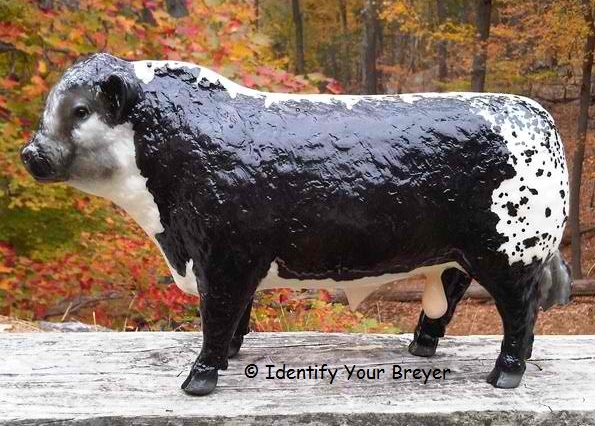
Recent BreyerFest Nonhorse Special Runs haven’t been much to my liking – and I was baffled by the inclusion of a Spanish Fighting Bull in the French-themed year, when there were so many more appropriate (and less controversial) options available – but I am quite delighted by this year’s edition Hamish:


Take a boring but competent mold that’s been out of circulation for a few years and give it a snazzy, shiny makeover!

As I’ve said before, I would have been happy if they had just given him an updated version of his original Solid Black paint job, add some shading, hoof and facial detailing, and wrap it up in a Gloss Finish. But Hamish in all his sparkly, splashy, glittery glory is more than fine!

This has gotten me to thinking. Who else is a boring but competent mold who hasn’t seen a lot of action lately? And who would definitely benefit from a sharp modern update?

(FYI: Not a typical Stud Spider.)

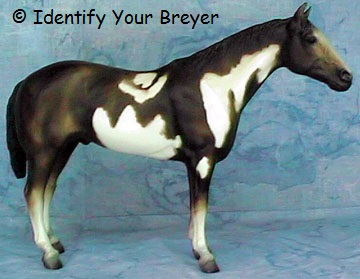
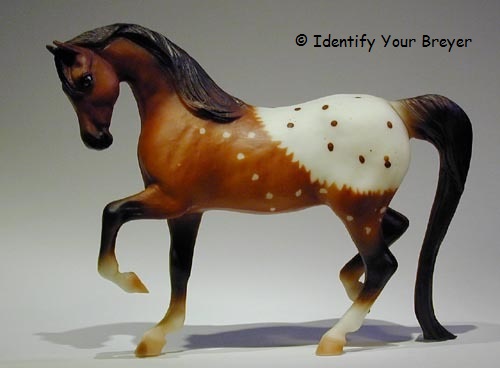
Stud Spider! We haven’t seen much of Spider in the past ten(!) years; the last time we saw him as a production piece was Stetson, a very nice Dun Micro Run (24 pieces) for the Lone Star Experience in 2009.

As for whether or not there’s a market for a new Stud Spider release, all I have to do is point to one of the Regular Run releases that immediately preceded Stetson: the #1236 Banjo in Buckskin Tobiano Pinto. He ran a remarkable five years as a part of the My Favorite Horses Series, from 2004 through 2008. That’s longer than his beloved original pinto release – the #88 Overo Pinto, that only ran for three years, from 1979 through 1981.

I was thinking a minimal frame overo would be nice (Blue Roan, or Sooty Palomino?), but the Collector’s Club “Picture This” Sweepstakes – where we had to choose one of four different molds to appear as a Special Run Frame Overo next year – tragically did not include Stud Spider as an option.

(I would have voted for him instead of... gosh, I don’t even remember now! Was it Latigo?)

So, not likely.

But stranger things have happened, and maybe whatever magic I seem to have at my disposal here might help make another Stud Spider happen sooner, regardless.

Friday, February 14, 2020

Hamish

Yes, I am very pleased by this year’s BreyerFest Nonhorse Special Run Hamish, on the #365 Standing Black Angus Bull mold. He is even prettier than I imagined!


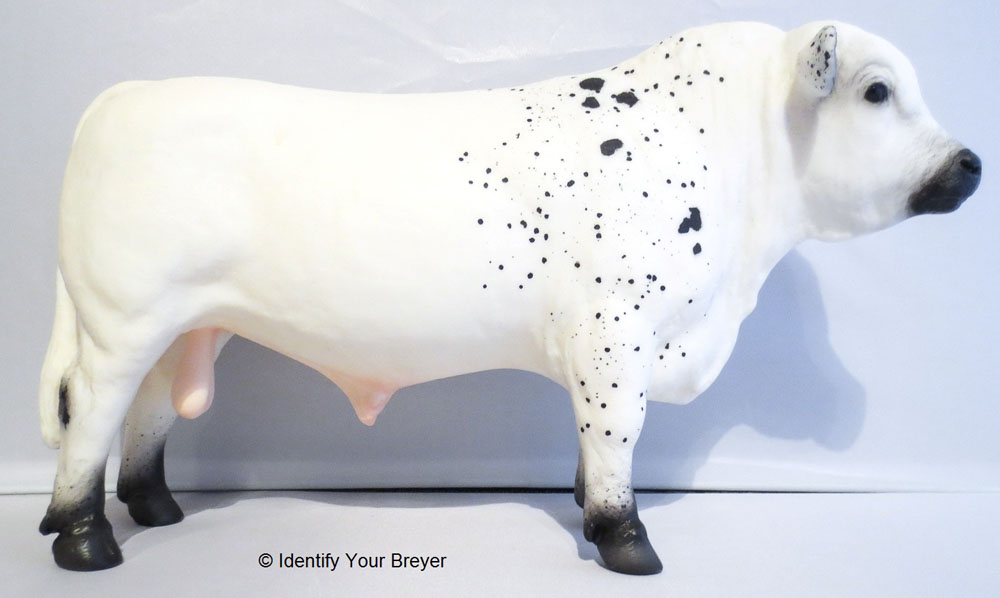
I thought this one was pretty obvious from the clue they gave us earlier in the week. Although combining splash spotting with masked markings is a technique that has been used on horse molds before – most notoriously on the Lady Roxana release Cinnamon – it’s been more typically found on livestock molds.

For examples, there’s the Micro Run Polled Hereford Bull Marshall, the BreyerFest Special Run Charolais Bowland, the Exclusive Event Longhorn Bull Wrangler, and the #384 Texas Longhorn Bull.

I momentarily considered the possibility that they might use the Charolais Bull mold instead. Usually when a mold returns after an extended absence as a small Special Run (like Reuben!) it’s followed up with a more plentiful Special Run or Regular Run shortly afterwards.

It’s costly and time-consuming to get a mold up and running, so it’s not something you’re going to do for just a couple hundred pieces. You run more, and warehouse the unused portion for later use. 

But it’s also possible that Reuben was made from the production leftovers from Bowland, back in 2012. After all, they only made 450 of him, which is partly why he’s one of the more difficult to find BreyerFest Nonhorse runs. That, and the fact that I consider him one of the more attractive recent BreyerFest Nonhorse Special Runs.

But Hamish is… well, all that and a bag of kettle chips: a vintage mold that hasn’t been in production for over 15 years, in an eyecatching gloss parti-color paint job. He’s basically Marshall with an Irish accent!

The consensus online seems to agree with me, so I am just a wee bit concerned about the piece run on this one. I hope that it’s a decently-sized one, because getting a good draw on my ticket times tends to be the exception, not the rule.

I have to admit that some of the more recent BreyerFest Nonhorse releases (namely, 2015’s Le Taureau, 2016’s Zebu, and 2017’s Diwali) haven’t blown me away. I collect the Dog molds so last year’s Saint Bernard Bucky was obvious, and I’ve been yearning (yearning!) for more Elk releases, so 2018’s Inari was my number one want (and got!) that year.

My only (minor) complaint is having to scroll past all of the usual backhanded compliments about this release being “appropriate to the theme this time”.

As I’ve addressed before, having every release hew as closely to a given theme is neither creatively nor economically viable. It’s in Reeves’s best interest to have a variety of molds and models to suit as wide an audience as possible – up to and including people who have little or no interest in the theme itself.

Personally I am indifferent to the theme this year, but all the models revealed so far have been quite lovely, whether they directly fit the theme (Hamish) or not (Oak).

Friday, July 12, 2019

The #365 Black Angus Bull Mold

For those of you who have chosen (perhaps wisely!) to avoid BreyerFest this year, here is a little something from this year’s Sampler.

The Black Angus Bull (mold #365) was introduced in 1978, and was the last of the Breyer Cattle molds until Carol Herden’s Cutting and Roping Calves were introduced in the Western Performance Series in the late 1990s. 


In addition to being a more modern replacement for the #72 Walking Black Angus Bull – which was copied from a design by Edward Boehm, in the 1950s – he was designed to be more “in scale” with Breyer’s other cattle molds, like the #360 Charolais and #68 Polled Hereford Bull.

However, unlike the rest of Breyer’s Bull molds, the newer Black Angus Bull has a remarkably short release history: he’s only had two in his 40-year history!

The original #365 Black ran through 2004; other than the bi-eyed examples from early 1997, his solid Black paint job varied little over the years. “The Big Red One” – a Special Run made for the Iowa Red Angus Association in 1983/4 – comes in two distinct variations: an earlier and less common version with a pinked nose, and a slightly later and more common version without. 

Considering that the breed itself only comes in those two colors – both without much variation – the lack of releases probably should not be surprising.

What is remarkable is the fact that the mold has remained out of production since 2004! Aside from the logical choices they could go with – slightly different versions of the previous releases in Chalky, Glossy, or with more modern shading and detail – Breyer has not let breed standards or Mother Nature get in the way of releasing an older mold in a new or pretty color. Why make an exception now?

In other words: hop to it guys, I know you’re up to the task!

Sunday, November 11, 2012

Getting It All Done

I am just having the hardest time finding the time and motivation for this year’s NaNoWriMo novel. Even though I technically have what most people would consider to be an ungodly amount of free time on my hands (because of the slow work season), it isn’t, actually.

It’s all nonfrivolous work, none of that "alphabetizing canned vegetables in the pantry" stuff that desperate writers turn to when the words don’t work. It includes, among other things, taking care of a high-maintenance dog, helping a coworker build a web site, helping with the Copenhagen Belgian auction, trying to get my own auctions listed, last minute work assignments, fighting the crowds at the last big rummage sale of the season, sorting and inventorying that paperwork…

Even so, I’m not that far behind - maybe half a day’s quota off. And I really don’t even have to leave the house the next couple of days if I don’t have to, so catching up - or getting ahead of myself - is theoretically possible.

A picture’s worth a thousand words, as the old saw goes, so I offer to everyone a photograph from the archives that truly lives up to it - and which is providing me with some unexpected motivation, as well:


It’s a photo from May 1977, of Chris Hess working in the shop. It’s probably partially "staged" - it was part of a group of photographs taken for the Spring 1977 issue of Just About Horses - but still, take a closer look at everything going on here.

The lumpy blob in his hands is that of the Benji, being prepared for the moldmaking process; on the table and off to the side is a Charolais Bull, possibly being used as a reference point for the Standing Black Angus Bull, which would come out the following year. Multiple photographs and other reference materials cover the table - some for the Black Angus, obviously, but also for the Stud Spider, another late 1977/early 1978 release.

Other photographs in the set show him fiddling around with the molded halves of Stud Spider, and of another project he was working on at the time, which was apparently repairing a crack in the Longhorn Bull mold. Other molds that were making their debut around this time - but not seen in this set of photos - included Tiffany, San Domingo, the Galiceno, and the Rough Coat Stock Horse Foal.

And he had the nearly completely sculpts of the Legionario and the Andalusian Family ready for approvals by January 1978.

"Get" the picture now? The man was busy!

You can understand, then, when it raises my hackles just a tad to see hobbyists dismiss Chris Hess’s work as lightly as they do. In the space of a year and a half, he casted or sculpted nearly a dozen molds, largely by himself, many of which are still staples in the Breyer line today.

Every time I’ve found myself getting discouraged by my work load over the past several days, I look at that picture and think: Get it done, get it done. Find the time, and just get it done.

Saturday, April 17, 2010

Angus Black and Angus Red

Is today Friday or Saturday? I’ve lost track. It was another rougher than expected week; I didn’t make it home from work one night. (Chocolate cupcakes were involved. That’s all I’m saying.)

When I’ve had a few moments to think this week, I’ve been thinking about, of all things, the Standing Black Angus Bull.

Nobody thinks much about the #365 Standing Black Angus Bull. That’s because there’s not much to think about. He was introduced in 1978, as an updated and more to-scale replacement for the Walking Angus Bull, and discontinued with most of the "Farm Friends" molds in 2004. He came in basic solid Black, without much (if any) shading. Some have glossed eyes, and for a few months in 1997, he came with bi-eyes.

And that’s about all there is to know.

I do have one in my collection, but only by accident. A few years ago on eBay I bought a large lot of Breyer non-equines that included, as its main attractions, a SR Hampshire Hog and a Polled Holstein Cow and Calf set. A Black Standing Angus Bull just happened to come with. Even though I didn’t have one in my collection at the time, he was initially slated to go to the saleslist with some of the duplicates in the lot.

I decided to give him a reprieve. I still had a bit of room to work with back then, and I figured, what the heck? He had fallen into good company, so he must have had some merit I hadn’t noticed yet. No harm in keeping him around.

There was a little bit of sympathy in the decision, too. While he’s not a part of the display collection at the moment, I always manage to shoot a bit of positive mojo his way whenever I run across him in the storage collection. I totally understand the whole "not being noticed" thing, buddy; you’ll get your moment in the sun someday. (Like me, I hope.)

In contrast, his one SR counterpart, the Red Angus Bull (aka "The Big Red One") has enough history, complications and attention to spare. He was an early SR in an era when we didn’t have a lot to choose from (something that would change very, very quickly in the early 1980s) and a non-horse SR? Now that was something!


There were about 1000 models made, in four batches: 100 of the first batch, 200 of the second, 300 of the third, and presumably 400 of the fourth. The first batch of 100 is easy to distinguish from the rest, as they came with pinkish noses: the subsequent releases did not.

Later releases can be distinguished from each other by their hand-numbering: each batch had a slightly different numbering system. The first batch was over 100 (i.e. "23/100") the second over 200 ("145/200"), the third batch over 300 ("223/300"); the fourth batch didn’t indicate a batch quantity number ("278.")

Mine’s from the second batch: I’m not feeling up to photographing the numbering between his front legs to show you, so I’ll just scan the certificate he came with instead:


I still have the box he came in, too: just an ordinary illustrated shipper for the #365. The box is as I received it, save for the tape being yellowed and all that; all I did was slit the box open, pulled the bull out, and tossed the box in my closet, like a good little history nerd. The handwriting is original, and not my own.


I'm not normally a big fan of his "dead red" coloring, but it looks good on him. Breyer thought so too, and followed up a short time later with another SR Bull release - the Shorthorn Bull, on the Charolais mold.

I have one of those too, sorta. It's another long story.