Thursday, May 31, 2018

Liver Chestnut Scratching Foal Oddity

On the left is your standard, garden-variety #169 Liver Chestnut Scratching Foal, a relatively scarce vintage model who was only in production from 1970 through 1971. This release used to be hard to come by, but then the Internet and eBay happened, so not as much anymore.


They still sell for decent price – especially ones with good shading and detail, or with original boxes and stickers – but the big money in the Scratching Foal game is with either Test Colors or some of the scarcer Fun Foal variations like the Black, Dark Gray, or Blue Roan.

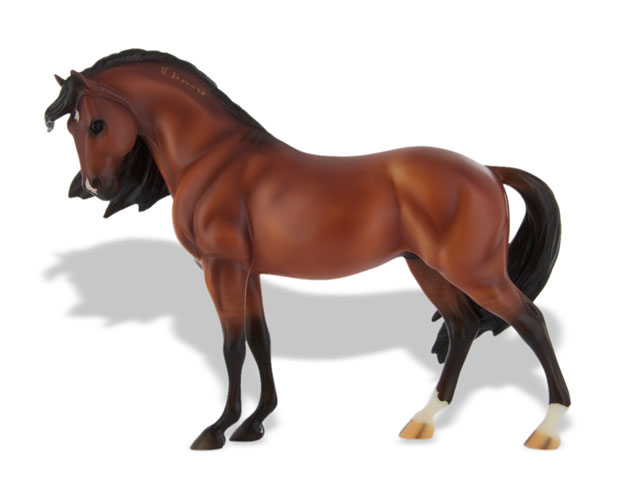
But who is the Foal on the right? I’m not sure! It’s either a Test Color that just happens to be very similar to the Liver Chestnut, or it’s a Liver Chestnut with a factory overhaul, and lots of extra dark shading and added black points.

There were a lot of Special Runs in the 1980s that were basically just updates of previous Regular Runs; the first ones that come to mind are two of the Montgomery Ward Christmas SRs: the Dapple Gray Shire from 1982-1983, and the Alabaster Old Timer from 1983.

There were subtle differences that distinguished those SRs from their Regular Run antecedents: the newer Shires tended to have fewer and more random dapples, and the newer Old Timers didn’t have the heavy gray body shading that the original #200 was known for.

So this subtly different Liver Chestnut Scratching Foal could have been a Test for a similar Special Run that didn’t happen.

The other theory is that – like some other Oddities that have popped up in recent years (the Palomino Family Arabian Mares with black points, et al) – it might have been something that a painter enhanced at the factory, either as a gift or for their own amusement.

There’s also the possibility that it was a Cull that Marney or one of her cohorts salvaged at the Chicago factory: it came out of a collection in Illinois within a reasonable driving distance of Chicago, with other oddities that obviously came straight from the factory. And touching up salvageable Culls with a bit of black paint was very much a Marney thing!

One this is certain, though: it’s not a Test Color for the original release of the Scratching Foal. The earliest Scratching Foals – including my Liver Chestnut one, above left – don’t have a USA mold mark, but my new dark and lovely one does.

Test Colors on the Scratching Foal are a bit hard to come by; the closest I came before was a Cull that I purchased off eBay from the family of a former Breyer contractor, also in the Chicago area.

The funniest thing about this situation was that I was making a few additions and changes to my BreyerFest want list, and the Scratching Foal was one of the molds I wanted to focus on this year!

Monday, May 28, 2018

Alabaster Foundation Stallion

Although I did “win” a Rialto, I had to give him up for a multitude of reasons; seeing just how lovely he is from the in-hand pictures is making me wince even more than I usually do and I probably should just stop looking at those pictures, already.

(I’m hoping karma doesn’t bite me in the butt over that decision to pass, but I’m the kind of person who has to have contingency plans for my contingency plans, so… yeah, probably.)

I was tasked with dusting over the weekend (long story) and as I was finishing up very late last night, I paused to consider this pretty little SR from years past:


It’s the Special Run Alabaster Foundation Stallion, from 1985. About 700 pieces were made for the mail-order company Horses International in Arizona, though some were also sold elsewhere.

In terms of color, shading, quantities, distribution pattern et al, this model was typical of Special Runs sold in the 1980s. These were the kinds of Special Runs we got back then, and were happy to get them!

(Shakes fist at passing cloud.)

He pales in comparison to recent releases like Rialto – whose glossy, roany, elaborately masked paint job and hand-painted eyes would have blown our minds in 1985. Most customs didn’t have that level of detail back then!

Of course, the Rialto costs over a dozen times what the Alabaster Foundation Stallion cost – then, and now. (The original price for the Alabaster was $12.50, not including postage.)

That Foundation Stallion is not easy to find nowadays, but only because no one is looking for someone like him. I have known the feeling all too well, lately….

The Alabaster Foundation Stallion falls into that hole of undesirability a lot of Special Runs from the 1980s now do: a little too common to be considered rare, with a paint job considered too bland/boring to modern tastes, on an older mold that’s not all that popular at the moment.

He’s no Rialto, but I still love him.

Friday, May 25, 2018

Brown Rin Tin Tin Variation

On the left is a standard issue #64 Rin Tin Tin from the 1950s or 1960s. On the right is the re-release #327 “German Shepherd” from the early 1970s.  But who’s the mostly-brown guy in the middle?


Heck if I know!

Normally I’d just chalk him up as a later variation of the original Rin Tin Tin, with looser, less defined markings. The #64 Rin Tin Tin ran for about ten years (from ca. 1956 through 1965), and variations are not unusual in production runs that long.

My fellow on the left is the most common variant – dark saddle and tail, white chest, face and tail tip – but I’ve seen him lighter and darker, with more shading and less, with pink tongues and red. I’ve even seen a Chalky one!

The thing is that this brown one was being sold as a part of a collection that was obviously from a collector active in the Chicago area during the Chicago era (pre-1985).

Whenever something a little unusual is found under those circumstances, it makes you wonder if there’s more than meets the eye. Test Color? Oddity? Employee Take-Home?

I know there’s at least one Matte Brown German Shepherd floating around; the 1972 and 1973 Collector’s Manuals show a photograph of a light brown one, and one was listed in Marney’s estate sale in 1992 (though the list doesn’t specify if it was Matte or Gloss).

In spite of the fact that Breyer was phasing out Gloss finishes by then, they still continued to experiment with them on Test Colors in the early 1970s.

So it’s possible that there’s something more than meets the eye with my newest Rin Tin Tin.

Most likely not, though; too many of us automatically assume that whenever we run across something we haven’t seen before, it must automatically be something rare, or unusual. Sometimes it’s just something we haven’t run across before – nothing more, nothing less.

He does make a nice trio with my other two though, doesn’t he?

Tuesday, May 22, 2018

Finding the Reasons Why

Another box of horses at the flea market, yay!


There are a couple of salvageable pieces in there (one of the Chestnut Merrylegs is drop-dead gorgeous) and one is being pulled for a possible project idea I have, but the rest are headed for the Body Box section of my sales list.

One reason I love finding boxes full of horses isn’t just because of the group discounts or the sheer thrill of discovery, but the story in the lot itself.

Every model may be a memory, but a collection tells a story.

Two identical Merrylegs (the one from the Slumber Party Gift Set) and two complete 2010 WEG Three-Horse Sets? This was the collection of two young siblings, not one. But did they actually go to the World Equestrian Games, or did a relative bring them back from a trip?

That they ended up at the flea market, selling for not much more than a song, could mean so many different things. Perhaps like most horse-crazy girls, they grew out of it, or thought they did. Maybe they finally got “real” horses of their own, and had no time (or money!) for imitations? Or… boys?

Those are the most common explanations. I was too excited to find a Box of Cheap Horses to stick around and find out the real reason why. It was a blustery day and I hadn’t slept well the night before, so once struck the proverbial pay dirt, I took the horses and ran.

The WEG Classics are a bit on the scarce side, so I feel bad about tossing the majority of them into the Body Box; while they’re not terrible, the demand for most of the more modern Classics molds – even scarce releases – is not high enough to merit an effort to restore on my part. One of the Gray Best-in-Show Thoroughbreds looks like he might clean up, though:


He’s very appealing in this color, and I do not have an example of this mold in the herd just yet; I missed out on the American Pharoahs on the short-tailed version when they were clearance out at Tuesday Morning last year.

This fellow might do. I’ll have to think about it. (It’s the pink hooves. They slay me.)

Here’s one thing I don’t have to think much about: some of these bodies are going up on MHSP by the end of the week. Since it’s still a couple of months until Kentucky, and the flea market season has just gotten underway, it’s probably best that I thin the box out a bit before it gets any further out of hand.

Saturday, May 19, 2018

Catching Up Is Hard To Do

I was on the road and dealing with some work-related issues most of the week (and a dentist appointment, blerg) so I missed most of the hubbub about the Rialto:


Being on the Totilas mold, there was some concern he was a follow-up “consolation prize” Special Run to the Koh-i-Noor, but it turned out he was just another piece in the America the Beautiful Series.

I like him a lot, and if I happen to be drawn for one I’ll be more than happy to add him to the herd. I won’t be heartbroken if I’m not though, because after watching some of the behaviors that went on with the distribution of Koh-i-Noor, I’m fine with just walking away from the mold for a little while.

Much as I had to do with the Esprit mold.

It’s interesting that the distribution of the Koh-i-Noor variations seems to be relatively even – the three sock version seems to be a little less common than the two, four, and no sock versions, but not excessively so.

I don’t quite understand what everybody’s fascination with the no-sock version is, but as I’m not really in the market for one, it’s more of an academic question for me. Was it the assumption that he’d be the “rare” one driving it, or the fact that it represented the opposite end of the scale from the four-stocking one: All vs. Nothing?

The first item in the BreyerFest Garland Pop-Up Shops has popped up, and I have to give kudos to the photographer:


His hair is so metal! Love it. I have a few Breyer Plushes, and I wouldn’t mind a few more, but Vita assumes all plushes that enter the house are her property… and let’s just say she destroys what she loves.

It’s worth noting that this is the second item – after Newmarket – to feature jockey silks as the main decorative element. So my initial assumption wasn’t entirely wrong.

Since I’ve decided to forego the customizing this year to catch up on the sewing projects, and purchasing them secondhand is not going to happen, I have (almost) no opinion of the Best Customs Contest prizes. It is nice to see another Bobby Jo in a non-chestnut-based color scheme, though!

The entry period for the Scottsdale Stampede Event is coming up, and I am still undecided about entering; I am hoping to have a definitive answer by the end of next week.

Also and obviously, I did not “win” the Test Color Black Stallion. I keep telling myself that it’s for the best: if I ever do, I’d probably keel over from the shock. Not because of the winning, but because of the bill…

Wednesday, May 16, 2018

The Chris Hess Flier

I had a really rough day today. Actually, the whole week has been suboptimal.

Imagine baking a cake just to be nice, and it turns out great, but nobody in the house wants to eat it? For no particular reason, either?

That’s the kind of week I’ve been having. The worst part? The cake isn’t even metaphorical.

(If there’s anyone within driving distance of my house, I have free Applesauce Spice Cake to give away. Not joking.)

Anyway, rather than bore you with any more details of my I-just-can’t-even kind of week, I’ll present a transcription of the flier from the 1996 Breakfast with Peter Stone held at the Holiday Inn-North on July 27, 1996.

I transcribed it a while ago, as I was getting a number of requests for more biographical information about Chris Hess. It seemed to make more sense to just publish the text from the flier than to quote and paraphrase it. Scanning it wouldn't have made it as searchable as text, either.

There’s much more to his story, of course. But this will help put a little bit more of his life and legacy on the Internet:

Welcome to 
“A Tribute to Christian Hess”

Christian Hess was a handy man to have around. According to his son Chris, Christian could repair anything and everything. Combine those talented hands with a love for art, and it’s not surprising that you’ll have someone who sculpted hundreds of horses and animals that continue to delight collectors today.

Christian Hess was born in Chicago in 1918. After studying art at the Art Institute of Chicago, Christian began a career as a commercial artist. He started as a wood carver, creating decorations for buildings, and eventually turned his talents to mold making. According to Chris, his father made more than 100 molds for Breyer, his first being the Western Horse #57 in 1950. Some accounts have that number as high as 118 including traditional, classic and Little Bits models. His last piece was Secretariat in 1987.

Christian also made over 50 other animals and figures for other companies, including the children’s riding toy known as the “Wonder Horse”, Santa Claus figures, art and advertising pieces. Christian was the sculptor and mold maker responsible for many of those familiar plastic pink yard flamingos.

Christian was married to Elizabeth for 55 years. They have 4 children, Barbara, Christian, Pamela and Lisa, and are the proud grandparents of 10 and great-grandparents of 4. Chris, who worked with his father in their company from 1963 to 1988, describes him as hard working and conscientious, always thinking about his business. Chris says his father hated to go on vacation because he didn’t like to be away from the business for very long!

Though Chris died in 1988, his art lives on in the models he produced. His sculpture “Trouble” is the basis for the first model of the new Peter Stone Collection.

(Note: there are some obvious errors and typos in the text itself, but they have been left as-is.)

Sunday, May 13, 2018

Spirits

A last minute change to the schedule left me with an unexpected but welcome day off. So I did a couple of my favorite, non-horsey things: baked a cake and organized stuff! On the way to the store for supplies for both, I stopped at the Salvation Army and found some horse goodies anyway:


An Ertl, and a Traditional Spirit and Rain! That makes up for the lack of ponies at the flea market the past two weeks.

I don’t have either the Spirit or the Rain in the collection yet, but since both go for crazy-good money on eBay in almost any condition, and I could really use that money right now, it’s off to Internet for the both of them once some paperwork is done…

I haven’t had many of the Spirits in my possession over the years – just a BreyerFest Special Run Ringmaster briefly, purchased for a friend who couldn’t attend that year – and I have to say that now I’ve been able to examine him in greater detail, I’m actually even more impressed by him.

Aside from the cartoony head and the slightly exaggerated proportions on his lower legs, he’s remarkably realistic for a model horse adapted from a cartoon – and he is also, as they say in the animation biz – very “on model”. That’s a pretty remarkable feat!

As I’ve stated several times before, I’m not all that bothered by the “eyebrow thing”: it’s an affectation that the animators used to make animating the horse’s expressions easier, and a (probable) necessary requirement for the license.

That the hobby, in general, has latched on to them as a perpetual source of griping (like dappling, urgh) is another mildly worrying reminder of the hobby’s tendency toward groupthink.

I already have a Rain – the 2007 BreyerFest Special Run Lady Liberty – and I’d like to add a Traditional Spirit in some form to the herd eventually. However, the two Spirit releases I like most – the 2004 BreyerFest Raffle Horse El Corazon, and the 2013 Live Show Benefit Raffle Zuni – are unaffordable.

I wanted to like the Padre; he was a really pretty shade of Bay, and an affordable and long-running Regular Run. But his big black undetailed eyes were a bridge too spooky for me, and a strange contrast to the care that went into the rest of his paint job.

He’s too popular a mold on his own to be tied up with the Spirit license in perpetuity, so I’m sure they’re be a release more to my liking (and my budget) eventually.