Monday, October 13, 2014

Almost Solid Black Morgan

This particularly handsome Black Morgan Variation - Solid Black with gray hooves, a star, and no socks - actually predates the previous two in my collection, by at least a year:

 
I found him at a local live show. This show had set up a "sales area" for showers who didn’t want to deal with the hassle of simultaneously showing and selling, or worry about grabby hands reaching for the wrong models. They’d drop off their sales items in the morning, and pick up whatever cash they made at the end of the day.

I hustled over to that area quickly because we had a local dealer in attendance that day with a reputation as a flipper - buying up quality pieces very low, and pricing/selling them fairly high. While I had a cordial relationship with this person, I was still in college at the time and on a super-tight budget. This dealer frequented the same flea markets I did, and I had lost out on enough goodies: it wasn't planning on letting anything good slip away that day.

This model has always been one of my favorites, but what amazes me is the reaction that others have had to him. Every time I’d take him to a show, or show off a picture of him, other hobbyists would gush over how beautiful he was.

I have to guess that the fact that I have a ton of Variations, Test Colors and Rarities has made me a little bit blasé about him. He is wonderful, but he’s only the third or fourth most-fabulous Stretched Morgan in my herd. (Not going anywhere. Don't ask.)

Odd thing was, he didn't show well. I never did figure out the disparity. If everyone loved him, why wasn’t he placing? The only thing I could come up with was that when I was actively live showing, the Stretched Morgan - especially Black ones - just happened to be on the unfashionable list. The Black Stretched Morgan, at that point, had been in production for 20 some years. Except for the Solid Black variation that everyone was looking for, he was the definition of common and uncool.

It’s certainly not the case anymore, especially since the advent of Collectibility showing. The length of the production run on the Black release is no longer a liability, but an asset: more history means more potential variations. Even without that as a consideration, opinion of the Stretched Morgan mold as a Morgan has shifted back from "not very good" to "more typey than most." If I were to start live showing again, he’d definitely get shortlisted for my showstring.

I used to think of this variation as a "small v" variation - a random, unplanned one - as opposed to a "big V" variation - a deliberate and sustained change in the production paint job. Over the years, though, I’ve seen - and heard of - a few others identical to him, and there was one on eBay recently that went for a rather impressive amount of money.

So it might have been something deliberate after all. As I’ve written before, I’m a little hesitant to classify things as "big V" variations, because that’s where madness begins. Sometimes a variation is just a variation, and doesn’t need to be anything more than that.

Friday, October 10, 2014

Chalky Stretched Morgan

I got lucky and threw an order in for Mischief with my Vintage Club Isabelle; I figured it’d be my last little splurge on myself before the holidays. While I figured he’d sell out eventually, I had no idea he’d sell out early this week.

I can offer no special insights why - other than having a lower piece count compared to other recent Classics specials, and all of us underestimating the power of Halloween.

Back to the Black Morgan Parade. Here’s my Chalky one:


According to my records, he was another early flea market find - a few years after the Solid Black, and not long after I had started going to the flea markets on my own. (I had a car! And a job that paid me cash money!)

I can’t recall any other details of my first encounter with him, or who he came with. Not that he was all that mundane, but finding Chalkies - good quality ones, too - was not as big a deal back then. It was more "Hey!" than "OMG!!@!1!" kind of find.

Other than his condition - exceptional, for a Chalky - he didn’t stand out enough to imprint a special memory. But just because he didn’t bowl me over when I found him doesn’t mean I didn’t love or appreciate him any less: the fact that I’ve owned him for over two decades now should be testament to my affection.  

Chalkies used to be considered sort of an odd thing to collect. Prices reflected that: more often than not, they weren’t any more expensive than non-Chalkies. In fact, their delicate nature and associated paint flaws - runs, drips, hoof puddling, softened/filled in details - were seen as detriments, in some hobbyists’ eyes.

Two of my first three Traditional models - the Man o’ War and the Smoke Western Prancing Horse - were Chalkies. I thought they were beautiful: they were the models that made me fall in love with model horses. While I didn’t necessarily seek more Chalkies out at first - once I knew what they were - I bought the ones I did find.

And after so many years of doing that, I ended up with a pretty decent-sized collection. The last time I took an official tally, it was somewhere around 30 pieces.

Then they became popular, and I stopped seeking them out on eBay and at BreyerFest, because they stopped being affordable on my budget. Most of the ones I pick up now are local finds.

Even so, I still manage to add to the collection on a regular basis; you may recall the fabulously nice Palomino Family Foal I found earlier this year. And there was that cool Black Bear Mama from a couple years back.

The Morgan is sort of in the middle of the scale in terms of rarity  - not as common as the Appaloosa Performance Horse or Yellow Mount, but considerably more common than the Misty or Bucking Bronco. He also comes in an "unpainted" version where the gray of his plastic is allowed to show through the unpainted areas of his star and stockings, giving him an unusual (and not unappealing) two-tone effect.

I’ve found a couple of other standard basecoat Chalky Morgans over the years but my first, thankfully, was my best.

Monday, October 6, 2014

Solid Black Morgan

The brain is still not in writing mode, so here’s another picture - one of the many Black Stretched Morgan variations that seem to follow me home like lost puppies. Up first is one of my first big finds at the flea market, Stretched Morgan or otherwise:


Solid Black! Well, almost solid black - he does have a chipped ear, revealing pinkish-purple plastic underneath. Solid Black Morgans mostly - though not exclusively - date to the Chalky Era of the early 1970s. Why bother basecoating a model, when you can just paint it solid black, instead?

Allegedly some Solid Blacks were made as trophy models for the American Morgan Horse Association, around the same time. As far as I know, they’d be indistinguishable from the Regular Run Variations - unless they came with the documentation to prove otherwise.

In either case, the Solid Black Morgan is quite the rarity: I haven’t found another Solid Black Morgan since then. The prices I see them bringing on the secondary market make it unlikely that I’d ever be able to upgrade my boy if I wanted to.

Fortunately for me, it’s a low priority. Aside from the fact that he was one of my first "scores", the story of that score is also a keeper.

Many, many years ago I went with my family to an indoor flea market, one best known in these parts for having a dealer who carried most of the then-current Hagen-Renaker line. And also for a taxidermied Cheetah, but that’s another story. (The flea market, I mean, not the dealer.)

One dealer near the entrance had a small selection of Traditional Breyers - maybe a half dozen pieces - all priced at ten dollars apiece. I picked up the Morgan and stared at it, entranced; the dealer noticed my interest and said "I can go eight on the horses."

"All I have is seven." I answered back, matter-of-factly.

The dealer paused, nodded, and said "Okay, seven." And wrapped him up for me.

A few aisles later, Dad nudged me and whispered "That was a pretty smooth move you pulled back there." He was so proud: my daughter, the canny horse-trader.

I had to break it to him that the truth was far more mundane. "Dad, seriously, all I had was seven dollars!"

Friday, October 3, 2014

More New Old Photos

Friday already?

Still up to my eyeballs in old business, of both the hobby and nonhobby sort. So more new old pictures today. First up, another vintage Test Color:


A Resist Dapple Gray Midnight Sun! I believe this might have been another one of those early 1970s "Micro" Runs that may have been repurposed Test Colors. Like the better-known Traditional Man o’ War in Dapple Gray, the Red Chestnut Midnight Sun, and the Cantering Welsh Pony in Dapple Gray.

By the way, those early Cantering Welshies predated the 1985 Just About Horses Special Run by several years, and don’t look anything like them. The one I saw in person looked more like the Midnight Sun, above, except a little darker.

The second photo is part of a small set of pictures of one wall of Marney’s collection - what appears to be her Arabian Shelf:


Yep, those are Test Colors on the far right side there. I suspect that some of the Glosses on the shelf are Test Colors, too, and not merely Old Molds. There are some Proud Arabian Mares in the Test Color Album that appear to be attempts at recreating Old Mold colors and finishes. Some of them in that album might be the same models seen in this photo, but for a variety of reasons (size, quality, angle of photos) it’s difficult to confirm. The Chestnut Proud Arabian Stallion might be this guy, though:


I know there was some controversy a few years ago about the authenticity of a Gloss Proud Arabian Mare - with the Breyer mold mark - that made its way to eBay. I was less skeptical than most about it, but I didn’t have the money then to verify my hunch.

The plastic bags on the Customs (aka "Repaint/Remakes") were a not-uncommon practice back then. It was done partly to cut down on the dusting and protect the paint job, but primarily to keep the mohair manes and tails clean.

Hairing was de rigueur in the 1970s and 1980s: even Foals and Stablemates got the mohair treatment! Keeping them neat and dust-free, though, was a pain in the behind. Periodically replacing the hair wasn’t an option either, since good mohair was expensive and hard-to-find.

Getting the hairdo to look just right was an art all its own, too. During that brief window of time when I did custom work, hairing was the one aspect of it I was actually really good at.

That being said, I was kind of glad to see the trend fade away a bit, at least in this part of the model horse world. Hairing jobs, no matter how carefully tended, don’t age well.

Tuesday, September 30, 2014

Factory Tour, 1986

Wrapping up some old business here, so it’s going to be more show than tell today.

But the pictures are worth it. Presenting - a Breyer Factory Tour ca. 1986!

From Marney’s files, of course. They’re all in black in white, so I’m assuming that they may have been taken for future reference or use in an article or feature. When I had my first article published in Just About Horses in 1985, I recall, photographic submissions had to be in Black and White.

Here are the painting booths, awaiting fresh victims:


First ones up in the factory - the Traditional Black Beauty! The story I heard was that the first models Reeves manufactured fully under their aegis were the #89 Traditional Black Beauties, so it’s possible they may be them. There are no notes on any of these photos anywhere, so I can’t be sure.


There’s also no way of knowing/distinguishing those early Reeves Black Beauties from the thousands that roam the Earth today. Quality control was a bit of an issue in those days, and seams were a little rougher than they should have been, but that’s about it.

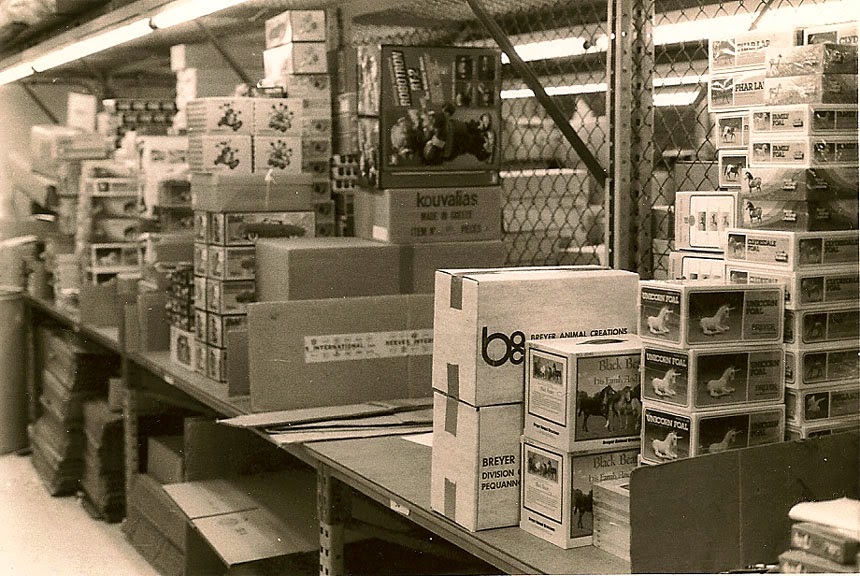
Here’s the warehouse:


I work in inventory services, so this is a sight I see often - though the boxes in my case are usually filled with car parts, electronics, or paper towels. Be still my heart - is that a case of Polled Hereford Bulls (#74) down front? I think we’re going to need to ask for a SKU check and run a variance report on that…

Here’s what I’m assuming is the packaging/fulfillment area. Among the sights I see are Phar Lap, the Lying Down Unicorn, Stormy, the Bay Shetland, the Family Foal, the Black Beauty Family, and some Corrals down front:


Ah, the mysteries contained in those freshly wrapped shrinkwrapped boxes! You both knew - and didn’t know - what you were purchasing. The box would say "Phar Lap" - but would he be awesome, or awful? It was like a retail version of Schrödinger's cat.

And here’s my favorite picture of the group:


I had no idea Ron Burgundy had a brother who worked for Reeves. Huh.

No actually, that’s Tony Fleischmann. They have plenty of awkward and slightly embarrassing pictures of me in their files, so having one picture in my files brings a little more karmic balance to the universe.

Saturday, September 27, 2014

Showrights and Stuff

After work on Friday I drove right past the one hobby shop that I knew had the Sahran and Night Mare in stock. I had been feeling off most of the week, but when I realized what I had done, I went right back to bed once I was home. I knew I had to be sick, because the change of seasons wouldn’t be messing with my head that much!

Anyway, here is another photo from the batch of ephemera I recently picked up:


This picture excited me because I own the Sorrel one on the right. It’s not a look-a-like or one of a small batch: it’s the exact same one, because the back of the photo tells me so!


I bought the Pony directly from Linda at BreyerFest in 2012. She already had a pretty fabulous provenance as it was, but having this photo makes it even better, now.


The "NOT FOR SHOWING" written on the back of the photo is in reference to photo showing and showrights, because photo showing was IT back then. If you were lucky you’d make it to one or two live shows in a year - if they even had one in your area - but the average model horse newsletter would have at least a dozen or more photo shows in a month.

The best way to describe showrights would be photo showing by proxy, mostly. You’d buy the rights to show a set of photos  - either as that specific show horse, or as a completely different horse, depending on the seller of the showrights.

Sounds weird, I know, but it made complete sense back then. Hobbyists who didn’t have the time or money to show their models as much as they wanted still managed to get their models out to shows via people who could. Others saw it as a way of showing without having to invest in camera equipment, film processing, or tack and props.

There’d be disputes, naturally, over what kind of showrights were sold, over the ownership of the compensation you might receive from a show, whether the purchaser of the showrights was living up to the agreement, etc. In other words, it could get real messy, real fast.

Photo showing is much less of a thing than it used to be, and cost is less of an issue now with digital cameras and online photo showing. Showrights are not extinct, but a much reduced aspect of the hobby; I’ve met some younger hobbyists who scoff at the notion we ever did such a thing.

But let’s get back to the ephemera.

Because photo showing was a much bigger deal back then, everyone who was in the model horse hobby had a lot of photos, and photo albums. Most were for showing, but some were for reference: we didn’t have a lot of written reference material to go by then, either. Photos were often the only evidence we had that anything existed at all. I was in the hobby for seven years before I ever saw a Decorator in person!

I have no idea how many albums or photos Marney had; I know there are other albums in the possession of others. My most recent batch came from a mostly-retired hobbyist who knew Marney and assisted her family with the dispensation of her estate.

Will there be more to come? Maybe. I have enough to keep me occupied for a while yet, and I understand how hard it is for some people to give up their ephemera. You start sifting through the old fliers, newsletters and photographs, and suddenly a whole afternoon has vanished…

As I mentioned last time, I did digitize one album already, in its entirety. It’s the one I think would be of most interest and value to other hobbyists: it’s primarily Test Colors and Oddities, some of which have since been tracked down and identified. I’ll release this as a CD at some point. (If anyone can give me pointers on how to go about that, it’d be much appreciated.)

What I’ll digitize from the rest, I do not know. The other albums and photos are a mix of everything: photos of bog-standard Original Finish models, Live Show photos, Test Colors, Customs, and (in this most recent pile of stuff) factory photos from ca. 1985/6.

Some of it will be of major interest to hobbyists, and some of it will not: they’ll need more careful editing and curation, at the very least. Like some of my other materials that I’d like to make available to the public, there may be some "showrights" issues that need to be worked out in advance.

It’s getting late, and the weather will be perfect for flea marketing Sunday, so more on this topic next time.

Tuesday, September 23, 2014

Making Mischief

The seemingly endless parade of Fall Special Runs continues, now with more Classics "Farm Store" Mustang sets, Tractor Supply Specials Maverick (Bay/Dun/Brownish Missouri Fox Trotter) and Travis (Black Pinto Carrick), and now this fascinating little oddment, Mischief Night:


(Photo taken from the Breyer web site Collector’s Club sneak preview page.)

A Classics … Hobo? Interesting mold choice, and one we haven’t seen since the Pony Express Gift Set in 2001. The price is right and he Glows In The Dark, so my next order to Reeves will include him if he’s still to be gotten. That seems likely, since the Classics Hobo has never been a wildly popular model in any color, but you never know with these things.

The appearance of the Hobo after such an extended period of time, on a Special Run with a rather narrow appeal, suggests two different things to me. Either they’re using up warehoused bodies, or gearing up for another production run of the mold in the near future.

We won’t know for sure about the "warehoused bodies" theory until the first ones start showing up, and they can be physically inspected for clues. The photos on the web site are better than we’re used to, but still not helpful clue-wise.

Speaking of, an example of the other Glowing Halloween Horse "Night Mare" just showed up on eBay today, sooner than I expected. I don’t know what’s up with having two different Glowing Halloween Specials this year. Will Glowy Little Bits/Paddock Pal and Stablemates SRs be not far behind?

By the way, I had no idea that "Mischief Night" is what they called "Devil’s Night" in New Jersey; I learned something new today. Technically we’re rather loath to refer to the nights before Halloween by that name any more in the metro Detroit area, for a variety of reasons I won’t get into here.

(Just a helpful little tip if you happen to be traveling in and around our area around that time of year.)

In another BTW, I’m finally getting some stuff up on MHSP! All items there will do a two-week stint before being shopped elsewhere. Extra money this time of year is always helpful, but the additional space will be an even bigger boon, especially now that I have more archival materials to deal with.

More on some of the latest ephemera acquisitions next time, and their origins.

(Before I go, I will answer the most pressing question here and now: yes, I do plan on publishing at least one of the photo albums in the near future. It’s already digitized, I just haven’t had the time to take care of the rest.)